









- Focus and Scope
- Section Policies
- Peer Review Process
- Publication Frequency
- Open Access Policy
- Archiving
- Publication Ethics
- Indexing and Reputation
- Plagiarism Screening
- Authorship Criteria
- Manuscript Type
Focus and Scope
EduHumaniora is a peer-reviewed, professional scientific journal. It is an international online journal in the field of primary education. EduHumaniora focuses on theorical issues and pedagogical practices in primary education, published twice a year (January and July).
EduHumaniora welcomes submissions on all aspects of primary education in the form of articles that report original research, analyse practice, discuss local and national policy and initiatives, offer a comparative perspective on research and policy and report on major research projects. Illustrations, tables, figures, photos and examples of children's work are welcomed.
To expand the studies, EduHumaniora covers worldwide primary education studies and develops research topics into various scopes such as teaching and learning, curriculum and development, assessment and instruction, school management, educational counseling, educational policy, and STEM in primary education for universal audiences and international practices.
Section Policies
Preface
 Open Submissions |
 Indexed |
Peer Reviewed |
Articles
| Open Submissions |
Indexed |
Peer Reviewed |
Peer Review Process
All papers are fully peer-reviewed. We only publish articles that have been reviewed and approved by highly qualified researchers with expertise in a field appropriate for the article. We are using blind peer-reviewing process. At least 2 reviewers are assigned to review the manuscript. Detailed information about the flow for the manuscript submission (author) to the acceptance by editor is shown in the following figure.
Before going to review process, all manuscripts will be checked that they are free from plagiarism practice (less than 30% similarities). If there an indication of plagiarism (higher than 30% similarities), the manuscript will instantly be rejected.
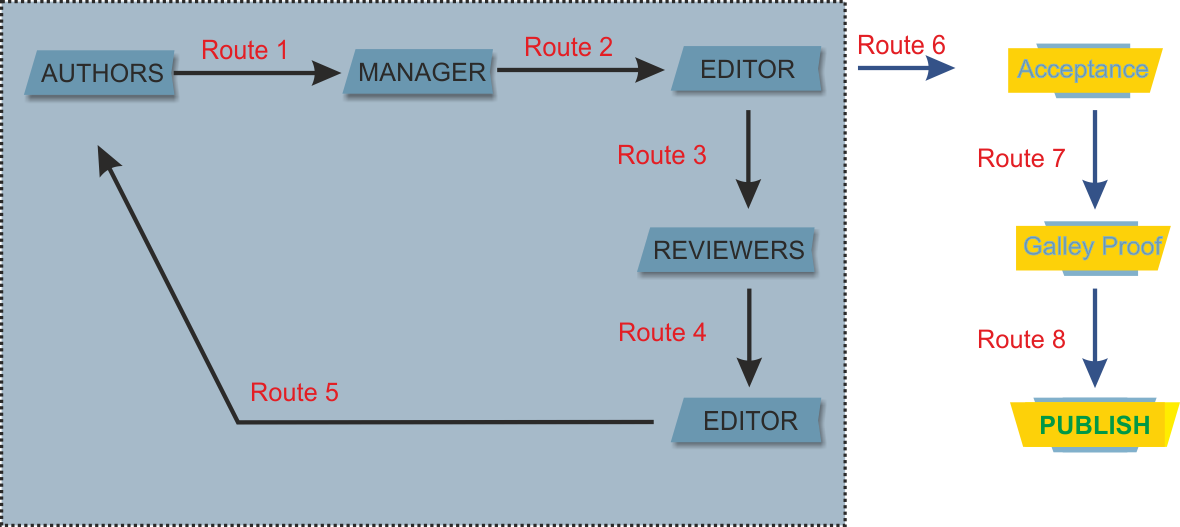
In short, the steps are:
- Manuscript Submission (by author) (route 1)
- Manuscript Check and Selection (by manager and editors) (route 2). Editors have a right to directly accept, reject, or review. Prior to further processing steps, plagiarism check using turtitin is applied for each manuscript.
- Manuscript Reviewing Process (by reviewers) (route 3-4)
- Notification of Manuscript Acceptance, Revision, or Rejection (by editor to author based on reviewers comments) (route 5)
- Paper Revision (by author)
- Revision Submission based on Reviewer Suggestion (by author) with similar flow to point number 1. (route 1)
- If reviewer seems to be satisfied with revision, notification for acceptance (by editor). (route 6)
- Galley proof and publishing process (route 7 and 8)
The steps point number 1 to 5 is considered as 1 round of peer-reviewing process (see grey area in the figure). And, our reviewing process at least goes through 2 round of reviewing process.
The journal editor or editorial board considers the feedback provided by the peer reviewers and arrives at a decision. The following are the most common decisions:
(i) accept without any changes (acceptance): the journal will publish the paper in its original form
(ii) accept with minor revisions (acceptance): the journal will publish the paper and asks the author to make small corrections
(iii) accept after major revisions (conditional acceptance ): the journal will publish the paper provided the authors make the changes suggested by the reviewers and/or editors
(iv)revise and resubmit (conditional rejection): the journal is willing to reconsider the paper in another round of decision making after the authors make major changes
(v) reject the paper (outright rejection): the journal will not publish the paper or reconsider it even if the authors make major revisions
Publication Frequency
This journal will be published two times a year on the following months: January and July. Every issue consist of about 10 articles and therefore every volume has about 25 articles/reviews.
Open Access Policy
This journal provides immediate open access to its content on the principle that making research freely available to the public supports a greater global exchange of knowledge.

This work is licensed under a Creative Commons Attribution-ShareAlike 4.0 International License.
Archiving
This journal utilizes the LOCKSS system to create a distributed archiving system among participating libraries and permits those libraries to create permanent archives of the journal for purposes of preservation and restoration. More...
Publication Ethics
(Based on Committee on Publication Ethics (COPE) and the World Association of Medical Editors (WAME)'s Best Practice Guidelines for Journal Editors)
EduHumaniora: Jurnal Pendidikan Dasar is a peer-reviewed journal. This statement clarifies the ethical behavior of all parties involved in the act of publishing an article in this journal, including the author, the chief editor, the Editorial Board, the peer-reviewer and the publisher (Prodi PGSD UPI Kampus Cibiru). This statement is based on the previous COPE’s Code of Conduct and Best Practice Guidelines for Journal Editors (see below) and the current COPE's Core Practices.
Ethical Guideline for Journal Publication
The publication of an article in a peer-reviewed EduHumaniora: Jurnal Pendidikan Dasar is an essential building block in the development of a coherent and respected network of knowledge. It is a direct reflection of the quality of the work of the authors and the institutions that support them. Peer-reviewed articles support and embody the scientific method. It is, therefore, important to agree upon standards of expected ethical behavior for all parties involved in the act of publishing: the author, the journal editor, the peer reviewer, the publisher and the society.
Reporting standards
-----------------------
Authors of reports of original research should present an accurate account of the work performed as well as an objective discussion of its significance. Underlying data should be represented accurately in the paper. A paper should contain sufficient detail and references to permit others to replicate the work. "Fraudulent or knowingly inaccurate statements constitute unethical behavior and are unacceptable". Review and professional publication articles should also be accurate and objective, and editorial opinion works should be clearly identified as such.
Data access and retention
------------------------------
Authors may be asked to provide the raw data in connection with a paper for editorial review, and should be prepared to provide public access to such data, if practicable, and should in any event be prepared to retain such data for a reasonable time after publication.
Originality and plagiarism
------------------------------
The authors should ensure that they have written entirely original works, and if the authors have used the work and/or words of others that this has been appropriately cited or quoted. Plagiarism takes many forms, from 'passing off' another's paper as the author's own paper, to copying or paraphrasing substantial parts of another's paper (without attribution), to claiming results from research conducted by others. Plagiarism in all its forms constitutes unethical publishing behaviour and is unacceptable.
Multiple, redundant or concurrent publication
--------------------------
An author should not in general publish manuscripts describing essentially the same research in more than one journal or primary publication. Submitting the same manuscript to more than one journal concurrently constitutes unethical publishing behaviour and is unacceptable. In general, an author should not submit for consideration in another journal a previously published paper. Publication of some kinds of articles (e.g. guidelines, translations) in more than one journal is sometimes justifiable, provided certain conditions are met. The authors and editors of the journals concerned must agree to the secondary publication, which must reflect the same data and interpretation of the primary document. The primary reference must be cited in the secondary publication.
Acknowledgement of sources
--------------------------------
Proper acknowledgment of the work of others must always be given. Authors should cite publications that have been influential in determining the nature of the reported work. Information obtained privately, as in conversation, correspondence, or discussion with third parties, must not be used or reported without explicit, written permission from the source. Information obtained in the course of confidential services, such as refereeing manuscripts or grant applications, must not be used without the explicit written permission of the author of the work involved in these services.
Authorship of the paper
---------------------------
Authorship should be limited to those who have made a significant contribution to the conception, design, execution, or interpretation of the reported study. All those who have made significant contributions should be listed as co-authors ( so its mean that manuscript at least have author and co author). Where there are others who have participated in certain substantive aspects of the research project, they should be acknowledged or listed as contributors. The corresponding author should ensure that all appropriate co-authors and no inappropriate co-authors are included on the paper, and that all co-authors have seen and approved the final version of the paper and have agreed to its submission for publication. If the work involves chemicals, procedures or equipment that have any unusual hazards inherent in their use, the author must clearly identify these in the manuscript.
Disclosure and conflicts of interest
--------------------------------------
All authors should disclose in their manuscript any financial or other substantive conflict of interest that might be construed to influence the results or interpretation of their manuscript. All sources of financial support for the project should be disclosed. Examples of potential conflicts of interest which should be disclosed include employment, consultancies, stock ownership, honoraria, paid expert testimony, patent applications/registrations, and grants or other funding. Potential conflicts of interest should be disclosed at the earliest stage possible.
Fundamental errors in published works
-------------------------------------------
When an author discovers a significant error or inaccuracy in his/her own published work, it is the author's obligation to promptly notify the journal editor or publisher and cooperate with the editor to retract or correct the paper. If the editor or the publisher learns from a third party that a published work contains a significant error, it is the obligation of the author to promptly retract or correct the paper or provide evidence to the editor of the correctness of the original paper.
DUTIES OF THE EDITORIAL BOARD
(Based on Committee on Publication Ethics (COPE) and the World Association of Medical Editors (WAME)'s Best Practice Guidelines for Journal Editors)
Publication decisions
------------------------
The editor of a peer-reviewed EduHumaniora: Jurnal Pendidikan Dasar is responsible for deciding which of the articles submitted to the journal should be published. The validation of the work in question and its importance to researchers and readers must always drive such decisions. The editor may be guided by the policies of the journal's editorial board and constrained by such legal requirements as shall then be in force regarding libel, copyright infringement and plagiarism. The editor may confer with other editors or reviewers in making this decision.
Fair play
-----------
An editor should evaluate manuscripts for their intellectual content without regard to race, gender, sexual orientation, religious belief, ethnic origin, citizenship, or political philosophy of the authors.
Confidentiality
----------------
The editor and any editorial staff must not disclose any information about a submitted manuscript to anyone other than the corresponding author, reviewers, potential reviewers, other editorial advisers, and the publisher, as appropriate.
Disclosure and conflicts of interest
---------------------------------------
Unpublished materials disclosed in a submitted manuscript must not be used in an editor's own research without the express written consent of the author. Privileged information or ideas obtained through peer review must be kept confidential and not used for personal advantage. Editors should recuse themselves (i.e. should ask a co-editor, associate editor or other member of the editorial board instead to review and consider) from considering manuscripts in which they have conflicts of interest resulting from competitive, collaborative, or other relationships or connections with any of the authors, companies, or (possibly) institutions connected to the papers. Editors should require all contributors to disclose relevant competing interests and publish corrections if competing interests are revealed after publication. If needed, other appropriate action should be taken, such as the publication of a retraction or expression of concern.
Involvement and cooperation in investigations
---------------------------------------
An editor should take reasonably responsive measures when ethical complaints have been presented concerning a submitted manuscript or published paper, in conjunction with the publisher (or society). Such measures will generally include contacting the author of the manuscript or paper and giving due consideration of the respective complaint or claims made, but may also include further communications to the relevant institutions and research bodies, and if the complaint is upheld, the publication of a correction, retraction, expression of concern, or other note, as may be relevant. Every reported act of unethical publishing behavior must be looked into, even if it is discovered years after publication.
DUTIES OF REVIEWERS
(Based on Committee on Publication Ethics (COPE) and the World Association of Medical Editors (WAME)'s Best Practice Guidelines for Journal Editors)
Contribution to editorial decisions
-------------------------------------
Peer review assists the editor in making editorial decisions and through the editorial communications with the author may also assist the author in improving the paper. Peer review is an essential component of formal scholarly communication, and lies at the heart of the scientific method.
Promptness
--------------
Any selected referee who feels unqualified to review the research reported in a manuscript or knows that its prompt review will be impossible should notify the editor and excuse himself from the review process.
Confidentiality
----------------
Any manuscripts received for review must be treated as confidential documents. They must not be shown to or discussed with others except as authorized by the editor.
Standards of objectivity
---------------------------
Reviews should be conducted objectively. Personal criticism of the author is inappropriate. Referees should express their views clearly with supporting arguments.
Acknowledgement of sources
---------------------------------
Reviewers should identify relevant published work that has not been cited by the authors. Any statement that an observation, derivation, or argument had been previously reported should be accompanied by the relevant citation. A reviewer should also call to the editor's attention any substantial similarity or overlap between the manuscript under consideration and any other published paper of which they have personal knowledge.
Disclosure and conflict of interest
------------------------------------
Unpublished materials disclosed in a submitted manuscript must not be used in a reviewer's own research without the express written consent of the author. Privileged information or ideas obtained through peer review must be kept confidential and not used for personal advantage. Reviewers should not consider manuscripts in which they have conflicts of interest resulting from competitive, collaborative, or other relationships or connections with any of the authors, companies, or institutions connected to the papers.
Indexing and Reputation
Eduhumaniora: Jurnal Pendidikan Dasar has been indexed by
1. DOAJ
2. SINTA
3. Garuda
5. Crossref
Plagiarism Screening
Before going to review process, all manuscripts will be checked that they are free from plagiarism practice (less than 20% similarities). If there an indication of plagiarism (higher than 20% similarities), the manuscript will be rejected.
Authorship Criteria
EduHumaniora: Jurnal Pendidikan Dasar is committed to upholding transparency, accountability, fairness, and ethical standards in scholarly publishing. The journal's authorship policy is informed by the ethical principles and recommendations of the Committee on Publication Ethics (COPE). Authorship must represent the actual intellectual contributions of individuals involved in conducting the research and preparing the manuscript. All authors are expected to make meaningful scholarly contributions, approve the final version of the manuscript, and take responsibility for the integrity of their respective contributions.
1. Authorship Eligibility
Authorship is reserved for individuals who have made substantial intellectual contributions to the research and the development of the manuscript. In accordance with COPE's principles of publication ethics, decisions concerning authorship should be made transparently, fairly, and with the agreement of all contributors.
Eligible authors should have participated substantively in one or more aspects of the scholarly work, including the formulation of research objectives, development of the research design or methodology, data collection, data analysis, interpretation of findings, manuscript drafting, or critical revision of the intellectual content. All listed authors must approve the final manuscript and agree to be accountable for their contributions and for addressing questions concerning the accuracy or integrity of the research.
Individuals whose involvement is limited to activities that do not meet the journal's authorship requirements should not be listed as authors. Their contributions may instead be recognized in the Acknowledgments section, where appropriate and with their consent.
2. Responsibilities of the Corresponding Author
The Corresponding Author is the individual designated to communicate with the EduHumaniora editorial office on behalf of all authors during submission, peer review, revision, publication, and any subsequent editorial correspondence. The corresponding author is responsible for the following:
a) Manuscript Submission: Submitting the manuscript through the journal's online submission system and ensuring that it complies with the journal's author guidelines, submission procedures, and publication ethics requirements.
b) Authorship Verification: Confirming that all listed authors have made appropriate scholarly contributions, agreed to the authorship arrangement and author order, and approved the manuscript before submission.
c) Editorial Communication: Acting as the principal contact for communications concerning editorial decisions, reviewer feedback, revision requests, and publication matters.
d) Revision Coordination: Communicating editorial and reviewer comments to all co-authors and coordinating the preparation, review, and submission of revised manuscripts.
e) Research Integrity and Disclosure: Ensuring that relevant declarations are provided, including conflicts of interest, funding information, applicable research ethics approval, and individual author contributions.
f) Final Manuscript Approval: Ensuring that all co-authors have reviewed and approved the final version of the manuscript intended for publication.
g) Publication Documentation: Coordinating the completion of required documents, including authorship declarations, copyright agreements, and applicable licensing forms.
h) Post-Publication Communication: Remaining available to address reasonable inquiries concerning the published article and cooperating with the editorial office in handling corrections, clarifications, or concerns relating to research integrity.
The corresponding author does not automatically possess greater intellectual ownership or decision-making authority than the other authors. All authors remain responsible for the integrity of their respective contributions. The corresponding author has the additional responsibility of coordinating communication and ensuring that the journal's editorial and administrative requirements are fulfilled.
3. Prevention of Authorship Misconduct
EduHumaniora does not permit unethical authorship practices, including gift authorship, guest authorship, ghost authorship, and unauthorized changes to the author list.
All individuals who meet the journal's authorship requirements should receive appropriate credit. Conversely, individuals who have not made qualifying contributions must not be included as authors solely because of their academic rank, institutional position, supervisory relationship, or personal association with the research team.
Allegations or indications of authorship misconduct will be assessed in accordance with relevant COPE guidance and the journal's publication ethics procedures. Depending on the circumstances, the editorial office may request explanations or supporting documentation from the authors, seek clarification from the relevant institutions, suspend the editorial process while the matter is investigated, or take other appropriate action to protect the integrity of the scholarly record.
4. Authorship Declaration
At the time of submission, the corresponding author must confirm that all listed authors have agreed to submit the manuscript to EduHumaniora, approved the version submitted for consideration, and accepted responsibility for their respective contributions.
All authorship information must be accurate and complete. Any proposed change to the author list, author order, or contribution declarations must be reported promptly to the editorial office and supported by the agreement of the relevant authors.
By submitting a manuscript to EduHumaniora, the authors acknowledge their responsibility to comply with this policy and with the journal's applicable publication ethics requirements.
Manuscript Type
EduHumaniora: Jurnal Pendidikan Dasar is a peer-reviewed, open-access scholarly journal that publishes original research in English language, literature, and culture. The journal aims to disseminate scholarly findings that contribute to the advancement of knowledge, theoretical development, methodological innovation, and practical understanding in these fields.
EduHumaniora accepts Original Research Articles, including empirical research, systematic literature reviews (SLR), and bibliometric analyses, provided that submissions demonstrate originality, methodological rigor, and a clear contribution to scholarship in the journal's focus and scope.
Original Research Articles
Original Research Articles report original scholarly findings obtained through systematic investigation and rigorous analysis. The journal welcomes quantitative, qualitative, and mixed-methods studies, as well as systematic analyses of existing literature and scholarly publication data.
The following research approaches are eligible for consideration:
- Empirical Research: Studies based on primary or secondary data, including experimental and quasi-experimental studies, surveys, case studies, ethnographic research, classroom action research, discourse analysis, corpus-based studies, and research and development.
- Systematic Literature Reviews (SLR): Studies that systematically identify, select, evaluate, and synthesize relevant scholarly literature through transparent and clearly defined procedures. Manuscripts must explain their research questions, information sources, search strategies, eligibility criteria, selection procedures, and methods of data extraction and synthesis.
- Bibliometric Analyses: Studies that quantitatively examine scholarly publications to identify research trends, publication patterns, influential authors and sources, citation relationships, collaboration networks, and thematic or intellectual structures. Manuscripts must report their data sources, search strategies, selection criteria, data processing procedures, and analytical techniques.


EduHumaniora: Jurnal Pendidikan Dasar
Published in collaboration Program Studi PGSD UPI Kampus Cibiru
and
HDPGSDI

This work is licensed under a Creative Commons Attribution-ShareAlike 4.0 International License.