



 CONTACT
 FOCUS & SCOPE
 COPYRIGHT TRANSFER AGREEMENT
 AUTHOR(S) GUIDELINES
 SUBMISSIONS
- Focus and Scope
- Section Policies
- Peer Review Process
- Publication Frequency
- Open Access Policy
- Archiving
- Aims
- Author(s)’ Publication Ethics
- Plagiarism Screening
- Publication Ethics Statement
- Licensing
- Article Processing Charge (APC)
- Indexing
- Policy on Using GenAI
- Authorship Criteria
Focus and Scope
The Journal aims to promote and disseminate research and reviews on Korean language and Korean language-related concerns that have implications to applied fields. The Journal encourages enquiries into theoretical and practical studies of Korean language.
The Journal welcomes contributions in such areas of current analysis in:
- Korean language teaching and learning
- Korean linguistics
- Korean studies (including history, culture, and politics)
- Korean literature
- Korean for academic purposes
- Korean for specific purposes
- Korean language teacher education
- Korean language acquisition
Section Policies
Articles
 Open Submissions |
Indexed |
Peer Reviewed |
Peer Review Process
The Journal operates a peer review process and promotes blind reviewing process (at least two reviewers per article). The acceptance or rejection of articles will be decided by the editorial boards based the review results supplied by the reviewers. There are no communications between authors and editors concerning the rejection decision. Authors whose papers are rejected will be informed with the reasons of the rejection.
The following is the entire publication process in Journal of Korean Applied Linguistics.

- The first stage is the manuscript submission. Every author aiming to publish a paper in the journal is required to submit the manuscript through the journal's OJS system. Manuscript sent via email or direct contact with the editors will not be processed further.
- The second stage is the initial screening. All manuscripts submitted to the journal's OJS system will be checked by the editorial team to ensure whether the manuscripts have fulfilled the basic criteria expected by the journal. Authors are expected to study the Author Guidelines contained on the “About” section. In addition, all manuscripts must adhere to the writing format in the template.
- The third stage is the review process. The status of the manuscript that pass the initial screening will change from “Awaiting Assignment” to “In-Review”. The journal’s editorial team will select and invite two reviewers whose expertise is related to the topic of the article. The reviewers will be asked to fill out a consent form to review the paper along with a review sheet. They also have to report their decision on the manuscript to the Editor-in-Chief: ACCEPT or REJECT. Author whose manuscript is accepted or rejected will receive an email notification from the journal’s managing editor.
- The fourth stage is the revision process. Manuscript accepted with revision must be revised by the author. After the author revises the manuscript, the author is required to send the revised version of the manuscript through the journal's OJS system again. The editorial team will forward the manuscript to each reviewer for further assessment; whether it is already eligible for publication. Stages 3 and 4 are usually conducted more than once to ensure the quality of each manuscript.
- The fifth stage is the manuscript editing process. Manuscript that has been determined worthy by both reviewers and by the Editor-in-Chief will be forwarded to the editorial team to re-check the writing format and language style.
- The sixth stage is the Copyright Transfer Agreement. Author will be asked to complete a CTA if the manuscript has been edited by the editorial team. Details regarding the CTA will be provided via email.
- The seventh stage is final-proof. The editorial team will send back the edited manuscript to the author. Author will be asked to double check whether the manuscript is ready for publication. The author is given the opportunity to improve the manuscript content. If the manuscript is revised by the author, the author must send the latest version of the manuscript to the journal’s editorial team. The editorial team will also check the metadata of each manuscript to be published. The author will be asked for confirmation of the metadata to ensure its accuracy.
- The eighth stage is the publication of the manuscript. The metadata and galley version of the manuscript that is ready to be published will appear on the home page of the journal.
Publication Frequency
Journal of Korean Applied Linguistics publishes two issues per year in March and October.
Open Access Policy
This journal provides immediate open access to its content on the principle that making research freely available to the public supports a greater global exchange of knowledge.
The published articles are licensed under the Creative Commons Attribution-ShareAlike 4.0 International License.
Archiving
This journal utilizes the LOCKSS system to create a distributed archiving system among participating libraries and permits those libraries to create permanent archives of the journal for purposes of preservation and restoration. More...
Aims
Journal of Korean Applied Linguistics is an open access peer-referred journal which is managed by Korean Language Education Study Program, Faculty of Language and Literature Education, Universitas Pendidikan Indonesia. The Journal is published by Journal and Publication Office (Kantor Jurnal dan Publikasi – UPI). Journal of Korean Applied Linguistics welcomes and acknowledges high quality research-based or review articles written by researchers, academicians, professionals, practitioners, and higher education students from all over the world.
As far as the criteria for evaluating and accepting submissions is concerned, a rigorous review process will be used. Submitted papers will, prior to the formal review, be screened so as to ensure their suitability and adequacy to the journal. In addition, an initial quality control will be performed, so as to ensure matters such as language, style of references and others, comply with the journal´s style.
Author(s)’ Publication Ethics
To submit the article, author (s) must submit an ethic statement. In short, Author(s)’ Publication Ethics and Malpractice Statement including the following statement:
Author(s)’ Publication Ethics and Malpractice Statement
The undersigned
1) Name:______________________________________
Affiliation: ________________________________________
2) Name: __________________________________________________
Affiliation: ________________________________________
3) Name:______________________________________
Affiliation: ______________________________________________
4) Name: ______________________________________
Affiliation: _________________________________________
hereby declare that I/we:
1) accept and comply with JoKAL's publication ethics and publication malpractice statement.
2) the manuscript entitled:
______________________________________________________________________________________________________________________________________________________________________________________________________
I/we sent to JoKAL for its .................... edition is my/our original work which is free from plagiarism and has not been published before either in printed or online and is not being sent to/reviewed by other publishers.
3) agree with the final version of the manuscript sent by JoKAL’s editors as the final proof.
Signed: ________________________________________ Date ______________
Signed: ________________________________________ Date ______________
Signed: ________________________________________ Date ______________
Signed: ________________________________________ Date ______________
Plagiarism Screening
Before going to review process, all manuscripts will be checked that they are free from plagiarism practice using "Turnitin" software. The threshold of similarity index is 20%. If there is an indication of plagiarism (higher than 20% similarity index), the manuscript will instantly be rejected.
Publication Ethics Statement
(Based on Committee on Publication Ethics (COPE) and the World Association of Medical Editors (WAME)'s Best Practice Guidelines for Journal Editors)
Ethical guidelines for journal publication
--------------------------------------------
The publication of an article in the peer-reviewed journals published by Universitas Pendidikan Indonesia is process of permanent knowledge improvement. It is a direct reflection of the quality of the work of the authors and the institutions that support them. Peer-reviewed articles support and embody the scientific method. It is therefore important to agree upon standards of expected ethical behaviour for all parties involved in the act of publishing: the author, the journal editor, the peer reviewer, the publisher and the society of society-owned or sponsored journals.
We are committed to ensuring that advertising, reprint or other commercial revenue has no impact or influence on editorial decisions. In addition, Editorial Board will assist in communications with other journals and/or publishers where this is useful to editors.
DUTIES OF AUTHORS
(Based on Committee on Publication Ethics (COPE) and the World Association of Medical Editors (WAME)'s Best Practice Guidelines for Journal Editors)
Reporting standards
-----------------------
Authors of reports of original research should present an accurate account of the work performed as well as an objective discussion of its significance. Underlying data should be represented accurately in the paper. A paper should contain sufficient detail and references to permit others to replicate the work. "Fraudulent or knowingly inaccurate statements constitute unethical behavior and are unacceptable". Review and professional publication articles should also be accurate and objective, and editorial opinion works should be clearly identified as such.
Data access and retention
------------------------------
Authors may be asked to provide the raw data in connection with a paper for editorial review, and should be prepared to provide public access to such data, if practicable, and should in any event be prepared to retain such data for a reasonable time after publication.
Originality and plagiarism
------------------------------
The authors should ensure that they have written entirely original works, and if the authors have used the work and/or words of others that this has been appropriately cited or quoted. Plagiarism takes many forms, from 'passing off' another's paper as the author's own paper, to copying or paraphrasing substantial parts of another's paper (without attribution), to claiming results from research conducted by others. Plagiarism in all its forms constitutes unethical publishing behaviour and is unacceptable.
Multiple, redundant or concurrent publication
--------------------------
An author should not in general publish manuscripts describing essentially the same research in more than one journal or primary publication. Submitting the same manuscript to more than one journal concurrently constitutes unethical publishing behaviour and is unacceptable. In general, an author should not submit for consideration in another journal a previously published paper. Publication of some kinds of articles (e.g. guidelines, translations) in more than one journal is sometimes justifiable, provided certain conditions are met. The authors and editors of the journals concerned must agree to the secondary publication, which must reflect the same data and interpretation of the primary document. The primary reference must be cited in the secondary publication.
Acknowledgement of sources
--------------------------------
Proper acknowledgment of the work of others must always be given. Authors should cite publications that have been influential in determining the nature of the reported work. Information obtained privately, as in conversation, correspondence, or discussion with third parties, must not be used or reported without explicit, written permission from the source. Information obtained in the course of confidential services, such as refereeing manuscripts or grant applications, must not be used without the explicit written permission of the author of the work involved in these services.
Authorship of the paper
---------------------------
Authorship should be limited to those who have made a significant contribution to the conception, design, execution, or interpretation of the reported study. All those who have made significant contributions should be listed as co-authors ( so its mean that manuscript at least have author and co author). Where there are others who have participated in certain substantive aspects of the research project, they should be acknowledged or listed as contributors. The corresponding author should ensure that all appropriate co-authors and no inappropriate co-authors are included on the paper, and that all co-authors have seen and approved the final version of the paper and have agreed to its submission for publication. If the work involves chemicals, procedures or equipment that have any unusual hazards inherent in their use, the author must clearly identify these in the manuscript.
Disclosure and conflicts of interest
--------------------------------------
All authors should disclose in their manuscript any financial or other substantive conflict of interest that might be construed to influence the results or interpretation of their manuscript. All sources of financial support for the project should be disclosed. Examples of potential conflicts of interest which should be disclosed include employment, consultancies, stock ownership, honoraria, paid expert testimony, patent applications/registrations, and grants or other funding. Potential conflicts of interest should be disclosed at the earliest stage possible.
Fundamental errors in published works
-------------------------------------------
When an author discovers a significant error or inaccuracy in his/her own published work, it is the author's obligation to promptly notify the journal editor or publisher and cooperate with the editor to retract or correct the paper. If the editor or the publisher learns from a third party that a published work contains a significant error, it is the obligation of the author to promptly retract or correct the paper or provide evidence to the editor of the correctness of the original paper.
DUTIES OF THE EDITORIAL BOARD
(Based on Committee on Publication Ethics (COPE) and the World Association of Medical Editors (WAME)'s Best Practice Guidelines for Journal Editors)
Publication decisions
------------------------
The editor of a peer-reviewed JoKAL is responsible for deciding which of the articles submitted to the journal should be published. The validation of the work in question and its importance to researchers and readers must always drive such decisions. The editor may be guided by the policies of the journal's editorial board and constrained by such legal requirements as shall then be in force regarding libel, copyright infringement and plagiarism. The editor may confer with other editors or reviewers in making this decision.
Fair play
-----------
An editor should evaluate manuscripts for their intellectual content without regard to race, gender, sexual orientation, religious belief, ethnic origin, citizenship, or political philosophy of the authors.
Confidentiality
----------------
The editor and any editorial staff must not disclose any information about a submitted manuscript to anyone other than the corresponding author, reviewers, potential reviewers, other editorial advisers, and the publisher, as appropriate.
Disclosure and conflicts of interest
---------------------------------------
Unpublished materials disclosed in a submitted manuscript must not be used in an editor's own research without the express written consent of the author. Privileged information or ideas obtained through peer review must be kept confidential and not used for personal advantage. Editors should recuse themselves (i.e. should ask a co-editor, associate editor or other member of the editorial board instead to review and consider) from considering manuscripts in which they have conflicts of interest resulting from competitive, collaborative, or other relationships or connections with any of the authors, companies, or (possibly) institutions connected to the papers. Editors should require all contributors to disclose relevant competing interests and publish corrections if competing interests are revealed after publication. If needed, other appropriate action should be taken, such as the publication of a retraction or expression of concern.
Involvement and cooperation in investigations
---------------------------------------
An editor should take reasonably responsive measures when ethical complaints have been presented concerning a submitted manuscript or published paper, in conjunction with the publisher (or society). Such measures will generally include contacting the author of the manuscript or paper and giving due consideration of the respective complaint or claims made, but may also include further communications to the relevant institutions and research bodies, and if the complaint is upheld, the publication of a correction, retraction, expression of concern, or other note, as may be relevant. Every reported act of unethical publishing behavior must be looked into, even if it is discovered years after publication.
DUTIES OF REVIEWERS
(Based on Committee on Publication Ethics (COPE) and the World Association of Medical Editors (WAME)'s Best Practice Guidelines for Journal Editors)
Contribution to editorial decisions
-------------------------------------
Peer review assists the editor in making editorial decisions and through the editorial communications with the author may also assist the author in improving the paper. Peer review is an essential component of formal scholarly communication, and lies at the heart of the scientific method.
Promptness
--------------
Any selected referee who feels unqualified to review the research reported in a manuscript or knows that its prompt review will be impossible should notify the editor and excuse himself from the review process.
Confidentiality
----------------
Any manuscripts received for review must be treated as confidential documents. They must not be shown to or discussed with others except as authorized by the editor.
Standards of objectivity
---------------------------
Reviews should be conducted objectively. Personal criticism of the author is inappropriate. Referees should express their views clearly with supporting arguments.
Acknowledgement of sources
---------------------------------
Reviewers should identify relevant published work that has not been cited by the authors. Any statement that an observation, derivation, or argument had been previously reported should be accompanied by the relevant citation. A reviewer should also call to the editor's attention any substantial similarity or overlap between the manuscript under consideration and any other published paper of which they have personal knowledge.
Disclosure and conflict of interest
------------------------------------
Unpublished materials disclosed in a submitted manuscript must not be used in a reviewer's own research without the express written consent of the author. Privileged information or ideas obtained through peer review must be kept confidential and not used for personal advantage. Reviewers should not consider manuscripts in which they have conflicts of interest resulting from competitive, collaborative, or other relationships or connections with any of the authors, companies, or institutions connected to the papers.
Licensing

Journal of Korean Applied Linguistics is licensed under a Creative Commons Attribution-ShareAlike 4.0 International License.
Article Processing Charge (APC)
Journal of Korean Applied Linguistics is an open access journal. There are no submission fees or article processing charges for publication in our journal. Readers can read and download all full-text articles for free.
Indexing
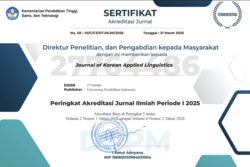
This journal is indexed by Google Scholar, GARUDA (Garda Rujukan Digital), and accredited by Sinta (Science and Technology Index) 5 from Kemdiktisaintek.
Policy on Using GenAI
Policy on the use of GenAI
This policy outlines the journal's stance on the ethical and responsible use of Artificial Intelligence {AI} and AI-assisted technologies in the preparation of manuscripts submitted for publication. This policy aims to ensure transparency, accountability, and the integrity of the scientific record.
1. Authorship and Accountability
- AI cannot be an Author: AI tools and AI-assisted technologies {e.g., Large Language Models, Generative AI} do not meet the criteria for authorship as they cannot take responsibility for the content, integrity, or originality of the work. Therefore, AI tools or software cannot be listed as authors on any submitted manuscript.
- Authors' Full Responsibility: Authors remain fully responsible and accountable for the entire content of their submitted manuscript, including any parts generated, edited, or enhanced by AI tools. This includes the accuracy, integrity, originality, and ethical soundness of the work. Authors must verify the factual correctness of any statements, citations, data, or figures generated by AI.
- Human Oversight Required: The use of AI tools must be under direct human supervision. Authors must critically evaluate, edit, and revise any material generated by AI to ensure it aligns with scientific standards, accuracy, and ethical guidelines.
2. Transparency and Disclosure
Mandatory Disclosure: Authors are required to disclose the use of AI and AI-assisted technologies in the preparation of their manuscript. This disclosure must be explicit, specific, and transparent.
What to Disclose: The disclosure should include:
- The name of the AI tool{s} used: e.g., ChatGPT {OpenAI}, Bard {Google}, Grammarly, GPT-4, Midjourney, etc.
- The specific purpose{s} for which the AI tool was used: e.g., language refinement, grammar check, drafting of specific sections {specify which sections}, brainstorming, data analysis assistance, image generation, etc.
- The extent of AI involvement: A brief description of how the AI tool contributed to the manuscript.
Where to Disclose: This disclosure should typically be included in one of the following sections:
- Acknowledgements section: {Preferred for general writing assistance}
- Methods section: {If AI was used for specific methodological steps, e.g., data analysis or coding assistance}
- A dedicated "Declaration of AI Use" statement just before the References section or in a footnote on the title page. IJE requires the maximum 25% of AI writing index.
Example Disclosure Statement: "Portions of this manuscript were drafted/edited/enhanced using [Name of AI tool, e.g., ChatGPT-4 {OpenAI}]. The authors used this tool for [specific purpose, e.g., improving grammar and clarity/drafting an initial version of the Introduction section]. All content generated by the AI was thoroughly reviewed, edited, and validated by the authors, who take full responsibility for the final content." Or for image generation: "Figure X was generated with the assistance of [Name of AI tool, e.g., Midjourney v5]. The authors provided the prompts and edited the output to ensure accuracy and relevance."
3. Permissible Uses {with Disclosure}
AI tools may be used to assist authors in the following ways, provided full disclosure is made:
- Language and Grammar Refinement: Improving readability, spelling, grammar, and sentence structure.
- Drafting Support: Assisting in the generation of initial drafts of specific, non-research-critical sections {e.g., parts of the Introduction or Discussion for stylistic purposes}, which must then be thoroughly reviewed and revised by the authors.
- Brainstorming and Idea Generation: Assisting in conceptualizing ideas or outlining the structure of the manuscript.
- Data Analysis and Visualization Assistance: {Only if verified and reproducible by human authors}. If AI is used in data processing, analysis, or generating figures/tables, the specific methods, tools, and validation steps must be clearly described in the Methods section.
- Summarization of Literature: Aiding in summarizing existing literature, but the authors must ensure the accuracy of the summary and proper citation of original sources.
4. Prohibited Uses
The use of AI and AI-assisted technologies is strictly prohibited for:
- Generating Fictitious Content: Creating false data, fabricated research results, or non-existent references/citations.
- Plagiarism: Using AI-generated content without proper attribution {i.e., treating it as original work when it is not fully human-generated or verified}. All AI-generated content must be treated as any other source and properly attributed if it relies on existing intellectual property or specific datasets.
- Substituting for Human Intellectual Contribution: AI cannot perform the core intellectual work of research, such as formulating original hypotheses, designing experiments, interpreting novel findings, or drawing original conclusions.
- Violating Confidentiality: Reviewers and editors are strictly prohibited from using AI tools with confidential manuscript content {e.g., uploading the manuscript to publicly available AI models}, as this may breach confidentiality, copyright, and the integrity of the peer-review process.
- Misrepresenting Research: Using AI to intentionally mislead readers about the methods, results, or conclusions of the research.
5. Consequences of Misuse
Failure to adhere to this policy regarding the ethical use of AI and AI-assisted technologies will be considered a serious breach of publication ethics. Such breaches may result in:
- Rejection of the submitted manuscript.
- Retraction of the published article.
- Banning of the author{s} from future submissions to the journal.
- Notification to the authors' institution and relevant ethics committees.
This policy will be periodically reviewed and updated to reflect advancements in AI technology and evolving ethical guidelines in scholarly publishing.
Authorship Criteria
Journal of Korean Applied Linguistics (JoKAL) is committed to upholding transparency, accountability, fairness, and ethical standards in scholarly publishing. The journal's authorship policy is informed by the ethical principles and recommendations of the Committee on Publication Ethics (COPE) and the Contributor Roles Taxonomy (CRediT). Authorship must represent the actual intellectual contributions of individuals involved in conducting the research and preparing the manuscript. All authors are expected to make meaningful scholarly contributions, approve the final version of the manuscript, and take responsibility for the integrity of their respective contributions.
1. Authorship Eligibility
Authorship is reserved for individuals who have made substantial intellectual contributions to the research and the development of the manuscript. In accordance with COPE's principles of publication ethics, decisions concerning authorship should be made transparently, fairly, and with the agreement of all contributors.
Eligible authors should have participated substantively in one or more aspects of the scholarly work, including the formulation of research objectives, development of the research design or methodology, data collection, data analysis, interpretation of findings, manuscript drafting, or critical revision of the intellectual content. All listed authors must approve the final manuscript and agree to be accountable for their contributions and for addressing questions concerning the accuracy or integrity of the research.
Individuals whose involvement is limited to activities that do not meet the journal's authorship requirements should not be listed as authors. Their contributions may instead be recognized in the Acknowledgments section, where appropriate and with their consent.
2. Author Contributions Based on CRediT
JoKAL encourages authors to specify individual contributions using the Contributor Roles Taxonomy (CRediT). This taxonomy provides a standardized framework for identifying and acknowledging the different roles undertaken by contributors to scholarly research. It comprises the following 14 contributor roles:
- Conceptualization: Establishing the principal research ideas, objectives, and overall direction of the study.
- Data Curation: Organizing, documenting, annotating, maintaining, and preparing research data for current and potential future use.
- Formal Analysis: Applying statistical, mathematical, computational, or other formal analytical techniques to examine and interpret research data.
- Funding Acquisition: Obtaining financial support for the research project.
- Investigation: Carrying out research activities, including experiments, fieldwork, observations, and data collection.
- Methodology: Designing or developing the research methodology, procedures, and analytical approaches.
- Project Administration: Coordinating and managing the planning, organization, and implementation of research activities.
- Resources: Providing research materials, instruments, participants, facilities, or other resources required for the study.
- Software: Developing, programming, implementing, or testing software used in the research.
- Supervision: Providing academic leadership, oversight, mentorship, and guidance throughout the research process.
- Validation: Verifying the reliability, accuracy, and reproducibility of research findings, methods, or results.
- Visualization: Preparing and presenting research findings through figures, tables, diagrams, or other visual formats.
- Writing – Original Draft: Preparing and writing the initial version of the manuscript.
- Writing – Review & Editing: Critically reviewing, revising, and refining the manuscript to improve its scholarly quality and clarity.
An author may undertake several contributor roles, and a particular role may be shared by multiple authors. Contribution statements must accurately represent the work performed by each individual. The assignment of a CRediT role alone does not automatically qualify an individual for authorship; eligibility must also be assessed in accordance with the journal's authorship and publication ethics policies.
3. Responsibilities of the Corresponding Author
The Corresponding Author is the individual designated to communicate with the JoKAL editorial office on behalf of all authors during submission, peer review, revision, publication, and any subsequent editorial correspondence. The corresponding author is responsible for the following:
- Manuscript Submission: Submitting the manuscript through the journal's online submission system and ensuring that it complies with the journal's author guidelines, submission procedures, and publication ethics requirements.
- Authorship Verification: Confirming that all listed authors have made appropriate scholarly contributions, agreed to the authorship arrangement and author order, and approved the manuscript before submission.
- Editorial Communication: Acting as the principal contact for communications concerning editorial decisions, reviewer feedback, revision requests, and publication matters.
- Revision Coordination: Communicating editorial and reviewer comments to all co-authors and coordinating the preparation, review, and submission of revised manuscripts.
- Research Integrity and Disclosure: Ensuring that relevant declarations are provided, including conflicts of interest, funding information, applicable research ethics approval, and individual author contributions.
- Final Manuscript Approval: Ensuring that all co-authors have reviewed and approved the final version of the manuscript intended for publication.
- Publication Documentation: Coordinating the completion of required documents, including authorship declarations, copyright agreements, and applicable licensing forms.
- Post-Publication Communication: Remaining available to address reasonable inquiries concerning the published article and cooperating with the editorial office in handling corrections, clarifications, or concerns relating to research integrity.
The corresponding author does not automatically possess greater intellectual ownership or decision-making authority than the other authors. All authors remain responsible for the integrity of their respective contributions. The corresponding author has the additional responsibility of coordinating communication and ensuring that the journal's editorial and administrative requirements are fulfilled.
4. Authorship Order and Changes
The order of authors should be agreed upon by all contributors before the manuscript is submitted. Authors are encouraged to determine their order based on the nature and extent of their scholarly contributions, taking into account the conventions of their respective research disciplines.
Any proposed change to the author list or authorship order after submission, including the addition or removal of an author, must be communicated to the editorial office by the corresponding author. Such a request must include a clear justification and written agreement from all affected authors, including those being added or removed, as applicable. The editorial office may request additional documentation and will assess the proposed change in accordance with relevant publication ethics guidance.
Changes to authorship after publication must be handled through the journal's formal correction procedures, where justified and appropriate. No authorship modification should be made without adequate justification and the required consent of the individuals concerned.
5. Acknowledgments and Contributions Not Qualifying for Authorship
Individuals who have contributed to the research but do not meet the journal's authorship requirements may be recognized in the Acknowledgments section, provided that their contributions are accurately described and their consent has been obtained.
Examples of non-author contributions include administrative assistance, technical support, language editing, proofreading, and other forms of assistance that do not constitute substantial intellectual contributions to the scholarly work. The provision of funding, general supervision, institutional support, or administrative assistance alone is insufficient to establish authorship.
JoKAL encourages authors to acknowledge contributions fairly and transparently while maintaining a clear distinction between authorship and other forms of assistance.
6. Prevention of Authorship Misconduct
JoKAL does not permit unethical authorship practices, including gift authorship, guest authorship, ghost authorship, and unauthorized changes to the author list.
All individuals who meet the journal's authorship requirements should receive appropriate credit. Conversely, individuals who have not made qualifying contributions must not be included as authors solely because of their academic rank, institutional position, supervisory relationship, or personal association with the research team.
Allegations or indications of authorship misconduct will be assessed in accordance with relevant COPE guidance and the journal's publication ethics procedures. Depending on the circumstances, the editorial office may request explanations or supporting documentation from the authors, seek clarification from the relevant institutions, suspend the editorial process while the matter is investigated, or take other appropriate action to protect the integrity of the scholarly record.
7. Authorship Disputes and Resolution
Disagreements regarding authorship eligibility, contribution attribution, or author order should initially be addressed through open and constructive communication among the individuals concerned.
If the parties are unable to reach an agreement, they are encouraged to seek assistance from their affiliated institutions or other appropriate institutional authorities. JoKAL may request written explanations, authorship declarations, contribution statements, or other relevant documentation to clarify the circumstances of the dispute.
Journal editors are generally not in a position to determine the factual basis of competing authorship claims or to adjudicate disputes between contributors. Accordingly, unresolved cases may be referred to the relevant institutions for investigation and resolution. The journal will handle such matters in accordance with COPE guidance and the principles of fairness, transparency, and publication integrity.
8. Authorship Declaration
At the time of submission, the corresponding author must confirm that all listed authors have agreed to submit the manuscript to JoKAL, approved the version submitted for consideration, and accepted responsibility for their respective contributions.
Authors are encouraged to provide a contribution statement based on the CRediT taxonomy, identifying each author's role in the research and manuscript preparation. All authorship information must be accurate and complete. Any proposed change to the author list, author order, or contribution declarations must be reported promptly to the editorial office and supported by the agreement of the relevant authors.
By submitting a manuscript to JoKAL, the authors acknowledge their responsibility to comply with this policy and with the journal's applicable publication ethics requirements.
References and Ethical Guidelines
Committee on Publication Ethics (COPE). Principles of Transparency and Best Practice in Scholarly Publishing.
Contributor Roles Taxonomy (CRediT). Contributor Roles Taxonomy.
Journal of Korean Applied Linguistics published by Universitas Pendidikan Indonesia is licensed under a Creative Commons Attribution-ShareAlike 4.0 International License.