
















- Focus and Scope
- Section Policies
- Peer Review Process
- Publication Frequency
- Open Access Policy
- Archiving
- Plagiarism Screening
- Ethics Statement & Guidelines for Roles in the Journal Publication
- Licensing
- Indexed
- Fee
Focus and Scope
IJoST promotes researches in the field of science and technology with particular respect to Indonesia, but not limited to authorship or topical coverage within the region. Contributions are expected from scientists, educators, senior researchers, project managers, research administrators, and students at advanced stages of their research. To be published in IJoST, a rigorous review process will be done.
The editorial contents and elements that comprise the journal include:
- Theoretical articles
- Empirical studies.
- Case studies
- Systematic Literature Review.
The editorial board welcomes innovative manuscripts from Science and Technology field. The scopes of this journal are
- Agriculture
- Architecture and Civil Engineering
- Astronomy and Space Engineering
- Biology, Biological and Bio System Engineering
- Chemistry and Chemical Engineering
- Computer Science and Engineering
- Earth Science and Engineering
- Electric, Electronic, and Electrical Engineering
- Environment Science and Engineering
- Food Science and Engineering
- Organization of Laboratories
- Physics, Material, and Mechanical Engineering
- Logistics Engineering
Section Policies
Articles
 Open Submissions Open Submissions |
Indexed |
Peer Reviewed |
Peer Review Process
Authors must submit their manuscripts through the journal’s online submission system for consideration in journals managed by Universitas Pendidikan Indonesia. After presubmission verification, each manuscript will undergo a single-blind peer-review process. The detailed workflow is illustrated in Figure 1, and the core stages are explained below with their estimated timeframes.

1. Initial Submission and Editorial Screening
Once the manuscript is submitted (Route 1), the Managing Editor and Editor conduct an initial screening (Route 2), which typically takes approximately one week. This stage includes:
- checking completeness and formatting compliance,
- assessing the relevance to the journal’s aims and scope,
- evaluating novelty and scholarly contribution,
- conducting a plagiarism check using Turnitin.
Possible decisions at this stage include:
- proceeding to peer review,
- rejecting the manuscript due to scope, ethical, or technical issues.
2. Reviewer Assignment and Peer Review
Manuscripts that pass screening are assigned to a minimum of three reviewers, one internal reviewer from Universitas Pendidikan Indonesia and the remaining external reviewers. The single-blind peer-review process (Routes 3–4) generally requires one to three months per review round, depending on manuscript complexity and reviewer availability.
Reviewers assess:
- methodological rigor,
- originality and significance,
- clarity and coherence,
- ethical compliance and reporting standards.
Their reports form the basis of the editorial decision.
3. Editorial Decision and Notification
Once all reviewer reports are submitted, the Editor issues a decision (Route 5), normally within one to seven days. Possible decisions include:
- accept without changes,
- accept with minor revisions,
- accept after major revisions (conditional acceptance),
- revise and resubmit (conditional rejection),
- reject (outright rejection).
Following completion of the peer-review process (or the applicable editorial screening stage), the Editor will issue an editorial decision and communicate it to the author(s) through the OJS system and, where enabled, via email notification. Each decision category has specific implications for the workflow in OJS and determines the actions required from the author(s). The decision types and corresponding procedures are outlined below.
1) Accept without changes
The manuscript meets the journal’s scientific, technical, and ethical standards and requires no further amendments. In the OJS system, the submission is typically advanced to Copyediting/Production (or an equivalent stage, depending on the journal workflow). For this decision, no revision is required; authors proceed with copyediting and production-related requests (e.g., proofreading, layout, and metadata verification), as instructed by the journal.
2) Accept with minor revisions
The manuscript is acceptable in principle, but requires limited amendments that do not affect the core methodology or main findings (e.g., wording clarifications, formatting adjustments, citation/style corrections, minor additions to references, or small improvements to figures/tables). In the OJS system, the submission is usually marked Revisions Required (or an equivalent label), accompanied by an editorial decision letter and reviewer comments. For this decision, authors must submit (a) a revised manuscript and (b) a point-by-point Response to Reviewers addressing each comment, in accordance with the journal’s revision instructions.
3) Accept after major revisions (Conditional Acceptance)
The manuscript shows clear potential for publication, but requires substantial revisions before it can be accepted (e.g., significant strengthening of analysis, major restructuring, additional validation, or methodological clarifications). Where deemed necessary, the revised manuscript may be returned to the reviewers for reassessment. In the OJS system, the submission is typically marked Revisions Required, with a decision indicating conditional acceptance upon satisfactory completion of major revisions. For this decision, authors must provide a comprehensive revision, including a detailed Response to Reviewers and any additional files requested by the journal (e.g., a tracked-changes version), following the journal’s stated requirements.
4) Revise and resubmit (Conditional Rejection)
The manuscript is not acceptable in its current form, but may be reconsidered if it is substantially rewritten or redeveloped (e.g., fundamental improvements to contribution, framing, methodology, analysis, or overall structure). This decision typically entails a new evaluation cycle upon resubmission. In the OJS system, authors may be instructed to resubmit a substantially revised version either as a new submission or as a new round of review, depending on the journal’s policy and OJS configuration. For this decision, authors should prepare a thoroughly revised manuscript and a detailed document explaining major changes; the resubmitted version will be subject to standard editorial screening and may undergo peer review again.
Rejection Decisions
A) Reject at First Screening (Desk Rejection)
The manuscript is rejected before peer review during the initial editorial screening. This may occur due to misalignment with the journal’s scope, insufficient originality or scholarly contribution, failure to meet minimum quality or formatting requirements, incomplete submission materials, or potential ethical concerns (e.g., suspected plagiarism). In the OJS system, authors will receive an email notification stating that the manuscript will not proceed to peer review (where email notifications are enabled) and/or the submission status may be moved to Archived, indicating that processing has been discontinued at the screening stage. For this decision, authors may revise the manuscript to comply with journal requirements and/or submit to a more appropriate outlet, as applicable.
B) Reject after Peer Review
The manuscript is rejected after external peer review when the concerns raised are substantial and cannot be adequately resolved within the journal’s revision framework (e.g., major methodological limitations, inadequate evidence/analysis, lack of novelty, or fundamental interpretation issues). In the OJS system, the decision will appear as Declined/Rejected (or an equivalent label), accompanied by an editorial decision letter and reviewer reports; the submission is normally closed and may subsequently be archived according to journal policy. For this decision, authors are encouraged to use the reviewer feedback to substantially improve the work before submitting to another journal, unless the journal explicitly invites resubmission as a new submission.
Direct communication between authors and reviewers, or between authors and editors regarding rejection decisions, is not permitted.
4. Revision and Resubmission Process
If revisions are required, authors are given:
- 1–2 weeks for minor revisions,
- 2–4 weeks for major revisions.
The revised manuscript must be uploaded through the submission system (Route 1) along with a detailed response-to-reviewers document. The revised version may undergo a second round of review (Route 5 → Route 4), which again takes approximately one to three months.
Each cycle of submission, review, and decision constitutes one review round, and the journal follows at least two rounds before final acceptance.
5. Final Acceptance
When reviewers and the Editor confirm that the manuscript meets publication standards, the Editor issues a final acceptance decision (Route 6). This step typically takes around one week after the final reviewer approval. In this stage, the authors are required to pay the Article Processing Charge (APC) with the amount as mentioned Terms of Payment for Article Publication.
6. Production, Galley Proof, and Publication
Once accepted, the manuscript enters the production stage (Routes 7–8), which includes:
- copyediting and proofreading,
- layout and typesetting,
- galley proof preparation and author confirmation,
- finalization for online publication.
This stage normally requires two weeks to one month before the article is officially published on the journal’s website.
Stage | Estimated Duration | Core Activities |
Initial Editorial Screening | ± 1 week | Scope, formatting, novelty check; Turnitin |
Peer Review (per round) | ± 1–3 months | Single-blind review by ≥3 reviewers |
Editorial Decision | ± 1–7 days | Decision based on reviewer reports |
Author Revision | ± 1–4 weeks | Revision and response to reviewers |
Second Review Round | ± 1–3 months | Review of revised manuscript |
Final Acceptance | ± 1 week | Editor confirmation of acceptance |
Publication Frequency
Since 2020, IJoST issues 3 times a year (April, September, and December). Each issue consists of 5-20 articles and therefore each volume has max 60 articles/reviews.
Open Access Policy
This journal provides immediate open access to its content on the principle that making research freely available to the public supports a greater global exchange of knowledge.

This work is licensed under a Lisensi Creative Commons Atribusi-BerbagiSerupa 4.0 Internasional.
Archiving
This journal utilizes the LOCKSS system to create a distributed archiving system among participating libraries and permits those libraries to create permanent archives of the journal for purposes of preservation and restoration. More...
Plagiarism Screening
Before going to review process, all manuscripts will be checked that they are free from plagiarism practice (less than 20% similarities). If there an indication of plagiarism (higher than 20% similarities), the manuscript will instantly be rejected.
Ethics Statement & Guidelines for Roles in the Journal Publication
ETHICS AND MALPRACTICE STATEMENT
(Based on Committee on Publication Ethics (COPE) (see https://publicationethics.org/) and the World Association of Medical Editors (WAME) (see https://wame.org/) in the Best Practice Guidelines for Journal Publication Process).
Ethical guidelines for the journal publication
----------------------------------------------------------
In the peer-reviewed journals published by Universitas Pendidikan Indonesia, the publication of an article is process of permanent knowledge improvement. The article submitted must be original that has never been published elsewhere in any language, as well as is not under review for publication anywhere. Our journal publishes articles only focused based on scope explained in the focus and scope section.
The article must be supported by scientific method that embedded in the text. This can reflect the quality of the work of the authors and the institutions that support them. The article must be agreed upon standards of expected ethical behavior for all parties, including the author, the journal editor, the peer reviewers, and the publisher as well as sponsored journals.
Articles published in our journals in Universitas Pendidikan Indonesia are for advancement of ongoing research from current knowledge and theories. All articles are produced and must be agreed to follow ethical behavior from all parties involved in the publication process, including authors, editors, reviewers, and publishers, as well as sponsored papers and journals.
Our publications pledge to make sure that editorial decisions are unaffected by advertising, reprints, or other commercial revenue. Additionally, where it is beneficial to editors, the Editorial Board will help in discussions with other journals and/or publishers.
AUTHOR(S)’S DUTIES
Authors have several duties based on Committee on Publication Ethics (COPE) (see https://publicationethics.org/) and the World Association of Medical Editors (WAME) (see https://wame.org/):
- Important. Author(s) submitted only article that must be original (has never been published elsewhere in any language, as well as is not under review for publication anywhere). The article must be in scope explained in the focus and scope section.
- Scientific report submitted by authors. The authors must report on original research, which ought to give a truthful summary of the work that has been done with an unbiased analysis and relevance. The report should appropriately depict the underlying data, having enough information and citations to let someone else duplicate the work. False or deliberately inaccurate statements are inappropriate, and they can represent unethical behavior. Data must be truthful, unbiased, accurate, and objective.
- Data protection and availability. The raw data related to the article submitted by author may be requested for editorial review. If possible, authors should be ready to make these data accessible to the public. In any case, they should be ready to keep these data for a fair amount of time after publication. Authors can ask data submitted to be accessible or not to the public, and this can be discussed with editors; and this must be confirmed during reviewing process.
- Submission of article against plagiarism and originality. The authors should make sure that their writing is unique and original. In the case that authors need to borrow any ideas or words from other papers, they should make sure that they have properly cited or quoted them. Plagiarism is unacceptable in all forms since it is unethical behavior in scientific publication. There are many types of plagiarism, such as 'passing off' another person's paper as the author's own paper, copying or paraphrasing significant portions of another paper without giving credit/citation, or claiming the findings of research that was undertaken by someone else.
- Authorship (who must be included in the article). The authors are only individuals who significantly contributed to the conception, design, implementation, or interpretation of the reported study. There are first author (that is positioned in the first position in the authors’ list), co-authors (other authors put after the first author), and corresponding author (author(s) with asterix and email information). All authors must agree to the paper's submission for publication.
- Recognition and Acknowledgements. All recognitions and acknowledgments must be added in the acknowledgment section in the article. The authors must give credit/thank to other people's contributions, giving private information, conversations, letters, or discussions, citations for works that had a significant impact on understanding the reported work, grant applications, and institutions that support the research and article.
- Conflicts of interest. Any financial or other significant conflict of interest (including author-author conflict of interest) that could be taken to have an impact on the findings or interpretation of a manuscript should be disclosed by all authors in the publication. At the earliest submission, such conflicts of interest must be clarified and the information must be put in the article.
- Basic mistakes and fundamental errors in the published works. It is the responsibility of the authors to contact the editor as soon as when a serious error or inaccuracy in the author's own published work is found. The authors must work with the editor to retract or fix the manuscript.
- Publication with contemporaneous, multiple types, duplication, redundancy. It is unacceptable to simultaneously submit the same article to multiple journals, which is considered unethical publishing behavior. Indeed, the authors should not submit an article that has already been published for consideration in another publication journal(s). If authors add other results from their previous work or another paper, they have to inform as citation in the submitted article.
EDITOR(S)’S DUTIES
Editors have several duties based on Committee on Publication Ethics (COPE) (see https://publicationethics.org/) and the World Association of Medical Editors (WAME) (see https://wame.org/):
- Publication decisions. Editor(s) has a right to take decision whether the article is accepted/published or not. The first result is based on editor’s decision. If the article passes the first editor decision, it goes to the second result guided by the decision of reviewers. Editors collect, compile, and decide from reviewers’ comments. Several points can be used to take decision by editor: the policies of the journal's editorial board such as focus and scope, novelties, legal requirements, libel, copyright infringement, and plagiarism.
- Fair play and confidentiality in taking care article. All articles received by editors must be taken care without author(s)'s race, gender, sexual orientation, religion, ethnicity, citizenship, or political philosophies. All data during the reviewing and editing processes must be taken confidentially. Editors and journal’s staff must not share and disclose any information about the article that submitted to the journal to other people, except authors, reviewers, potential reviewers, other editorial advisers, and the publisher.
- Conflicts of interest. Without the author's clear written approval, including peer-review-derived sensitive information and ideas, the editor may not use disclosed unpublished materials for their research. Editors should abstain from reviewing and evaluating manuscripts when they have conflicts of interest resulting from cooperative or other relationships or connections with any of the authors, businesses, or institutions; thus, the editor must ask co-editor, associate editor, or other editors to review and consider the manuscript. The authors should complete any pertinent competing interests, including publishing revisions if there are any discovered after the article has been published. If required, the action must be adopted, such as a publication.
- Complaints and investigations. When there is a complaint regarding ethical concerns raised on the submitted or published article, the editor should work with the publisher to take reasonable action, such as revision, correction, retraction, expression of concern, and other notes that are relevant. However, all actions must be done by additional confirmations and communications with authors to take action fairly.
REVIEWER(S)’S DUTIES
After passing the first screening by editor, to get fair reviewing process, our journal usually proceeds each article with at least 3 reviewers: 1 internal reviewer (from Universitas Pendidikan Indonesia) and the others are external reviewers. Reviewers have several duties based on Committee on Publication Ethics (COPE) (see https://publicationethics.org/) and the World Association of Medical Editors (WAME) (see https://wame.org/):
- Roles, Promptness, Confidentiality, and Fair Play Process in Reviewing. The reviewers help editors in giving judgments fairly without personal critism, suggestions/ideas to improve article qualities via peer reviewing process. Communication is only done between the reviewers and the editors, and there is no communication between the reviewer and the authors. All communications must be done via a formal scholarly communication in a time manner. If reviewer feels to be unqualified for reviewing the article, reviewer must inform and notify editor as soon as possible. Reviewers just give suggestion, while the final decision for the publication is on Editor. Article and all peer reviewing processing documents are confidential. The reviewer cannot discuss with authors or anybody without editor's permission.
- Acknowledgment. The reviewer should point out pertinent published works that the authors have not cited, giving ideas and claims based on a certain observation, deduction, or argument. The reviewer also informs and notice for any significant overlap or resemblance between article under consideration and any other published material based on reviewer’s knowledge.
- Conflict of interest. Without the author's express written authorization and editor’s permission, the reviewer may not use any unpublished materials disclosed in a submitted manuscript for their work. All peer review process is privileged knowledge. Thus, ideas must be kept secret and confidential, as well as not used for the reviewer’s benefit. Reviewers should not take into account in the reviewing process when they have relationships or links with any of the authors, organizations, or businesses associated with the articles.
THE USE OF GENERATIVE AI AND AI-ASSISTED TECHNOLOGIES IN WRITING FOR IJOST
The purpose of this policy is to give authors, readers, reviewers, editors, and contributors more information and direction regarding generative AI and AI-assisted technologies.
To guarantee the privacy and confidentiality of their data and inputs, including their unpublished and published manuscripts, authors must review the terms and conditions of any AI tool they use. Any personally identifiable information should be handled with extra caution. It is forbidden to create images that mimic or make reference to already-existing copyrighted images, real people, identifiable brands or products, or any likeness of a person's voice. Authors should review their work for potential bias and factual errors.
In order to ensure that the AI Tool is only given limited rights to use their materials (i.e., to offer a service to the user) and not any other rights (including but not limited to the right to train the AI Tool on those materials), authors should also review the terms and conditions of any AI tool they want to use. Additionally, they must make sure that the AI Tool doesn't place restrictions on how its outputs can be used, which might limit the publication of the relevant book chapter or commissioned content in the future.
When submitting a manuscript, authors should include a separate AI declaration statement disclosing the use of AI tools for manuscript preparation. The "Declaration of Generative AI and AI-assisted technologies in the writing process" should be included at the end of the manuscript, right above the references. The published work will contain the statement. The name of the AI tool used, the reason for using it, and the degree of their oversight should all be recorded by authors. Declaring the use of AI tools promotes openness and confidence among authors, readers, reviewers, editors, and contributors. It also makes it easier to adhere to the associated AI tool's terms of use. No declaration is required for simple grammar, spelling, and punctuation checks. If applicable, the methods section should include a declaration and a detailed description of the use of AI in the research process.
AI Tools should not be cited as an author or listed as a co-author by authors. Authorship entails duties and responsibilities that are exclusive to humans. It is the responsibility of each author to make sure that concerns about the integrity or accuracy of any portion of the work are properly looked into and addressed.
Using generative AI or AI-assisted tools to create or modify images in submitted manuscripts is prohibited by IJOST. A particular feature within an image or figure may be enhanced, obscured, moved, eliminated, or introduced. Brightness, contrast, and color balance changes are permissible as long as they don't obfuscate or remove any information from the original. To find suspected image irregularities, submitted manuscripts may be subjected to image forensics tools or specialized software.
The only exception is when the research design or methods include the use of generative AI or AI-assisted tools (e.g., in AI-assisted imaging approaches to generate or interpret the underlying research data, for example in the field of biomedical imaging). If this is done, the methods section must include a reproducible description of the use. This should include the model or tool name, version and extension numbers, manufacturer, and an explanation of how the generative AI or AI-assisted tools were used in the image creation or modification process. The usage guidelines of the AI software should be followed by authors, who should also make sure that all content is properly attributed. For editorial review, authors may be requested to submit pre-AI-adjusted images or the composite raw images that were used to produce the final submitted versions, if applicable.
Licensing
IJoSt is licensed under a Creative Commons Attribution-ShareAlike 4.0 International License.
Indexed
This Journal is indexed by
- Scopus
- Crossref / Dimensions
- SINTA (S1)
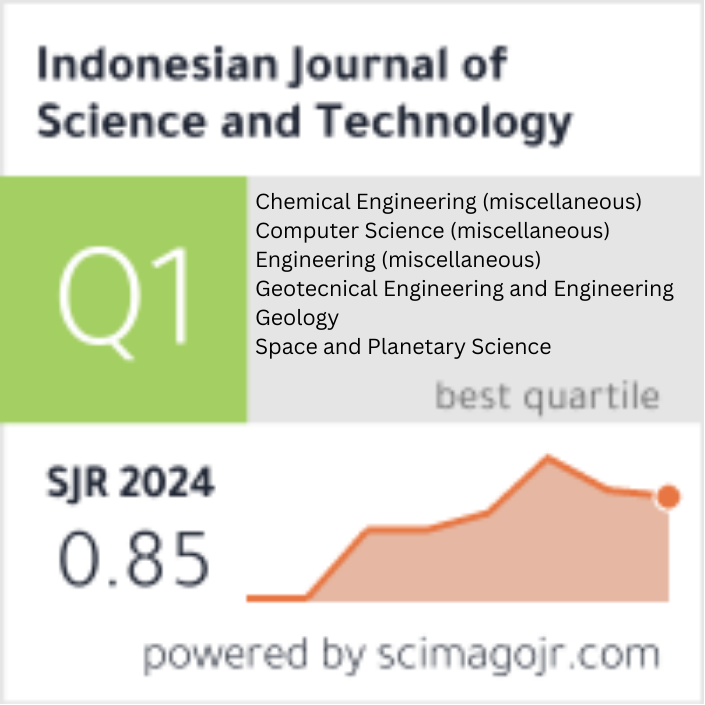
- Scimago JR (Q1)
- GARUDA (Garba Rujukan Digital)
- Google Scholar
- BASE Bielefeld Academic Search Engine
- Science Library Index
- Microsoft Academic
Fee
The Article Processing Charge (APC) is determined according to the year in which the article is published.
• For articles published in 2026, authors are required to pay an APC of USD 500 or IDR 8,500,000.
• For articles published from January 2027 onward, authors are required to pay an APC of USD 1,000.
The APC must be paid upon acceptance of the manuscript and confirmation of its publication schedule. The fee includes:
• DOI registration;
• Similarity checking using Turnitin;
• English proofreading; and
• Paper layout and publication preparation.
Payment should be made via bank transfer using the following details:
Virtual Account Number: 9881954325502306
Account Name: IJOST
Bank Name: Bank Negara Indonesia (BNI)
For international transfers, please use the bank’s Swift Code: BNINIDJAXXX (Bank BNI). Please ensure that all transfer fees are covered by the sender.
Authors are responsible for covering all bank transfer and administrative fees. Please include the manuscript ID or paper ID in the payment description or transfer note.
The APC must be paid within seven days after the payment notification is issued. After completing the payment, authors must submit the payment receipt to [email protected].
