








- Focus and Scope
- Section Policies
- Peer Review Process
- Publication Frequency
- Open Access Policy
- Archiving
- Publication Ethics, Malpractice, and Artificial Intelligence (AI) Governance Statement
- Plagiarism Screening
- Fees
- Manuscript Submission Guidelines
Focus and Scope
The Journal of Science Learning (JSL) is a peer-reviewed, open-access international journal dedicated to expanding the intellectual frontiers and challenging the traditional boundaries of global science education research. Historically, mainstream science education literature has been constrained by linear frameworks and Anglo-Eurocentric metrics that frequently overlook localized socio-cultural landscapes and advanced human-technological entanglements. JSL addresses this systemic gap by providing a progressive, high-quality international forum that centers on digitally mediated, culturally sustained, and equity-driven science learning contexts, with a specialized emphasis on cross-regional transformations and emerging economies within the Global South.
The core mission of JSL is to investigate how scientific literacy, systemic thinking, and epistemic dispositions are constructed, transformed, and enacted when global educational technologies and sustainability mandates intersect with diverse local cultures. Rather than positioning digital media as a mere classroom delivery tool or treating culture as a static background variable, the journal champions research that views these elements as deeply entangled drivers of human cognitive and sociological evolution. JSL seeks to bridge the gap between advanced methodological rigor and transformative educational philosophies by publishing original empirical studies, non-linear quantitative modeling, macro-level comparative analyses, and critical theoretical papers that define how humanity teaches, learns, and internalizes science in the Anthropocene era.
JSL is a triannual journal issued in March, July, and November.
Section Policies
Human-AI Entanglement and Prompt Epistemology in Science Learning
This section aims to investigate how advanced computational tools function not merely as administrative aids, but as epistemological catalysts that structurally transform the cognitive mechanics of science learning. It establishes an international niche for modeling how automated, algorithmic infrastructures alter how students conceptually process, critique, and validate scientific phenomena. To fulfill this aim, the scope welcomes high-quality empirical and theoretical studies exploring the deep, co-evolutionary cognitive relationships between students and advanced generative artificial intelligence platforms specifically within the domain of science learning. Submissions must focus on Prompt Epistemology investigating how the iterative act of prompting AI systems, interacting with machine learning interfaces, and collaborating with algorithmic logic shapes, expands, or disrupts a student’s internal scientific truth-seeking, automated hypothesis generation, and socio-scientific reasoning. The scope comprehensively covers hybrid human-AI cognitive setups, cyborg pedagogies, and the long-term cognitive dependencies formed during AI-mediated science learning.
 Open Submissions Open Submissions |
Indexed |
Peer Reviewed |
Advanced Analytics, Psychometrics, and Bias Elimination in Science Learning Assessment
This section aims to establish a rigorous, equity-driven international standard for dismantling algorithmic bias, structural profiling, and data sovereignty violations within science learning assessment. By actively seeking papers that mathematically expose and correct evaluation biases across differing national and cultural borders, this section positions the journal as a progressive leader in fair, cross-regional evaluation of science learning outcomes. Concurrently, this methodologically driven scope focuses on the direct application of cutting-edge educational data mining, learning analytics, and modern psychometric frameworks to evaluate how students internalize scientific concepts. It prioritizes original research utilizing advanced statistical modeling including Rasch family models, Item Response Theory (IRT), and Partial Least Squares Structural Equation Modeling (PLS-SEM) to examine the validity, equity, and cross-cultural generalizability of science learning test instruments. It explicitly invites structural critiques of automated scoring classifiers and machine learning grading metrics used to track science learning achievements across demographically diverse student cohorts.
| Open Submissions |
Indexed |
Peer Reviewed |
Immersive Media, Mixed Realities, and Real-Time Neuropedagogical Scaffolding of Science Learning
This section aims to move past traditional, post-hoc self-reported data (such as surveys administered hours after a lesson has concluded) to capture the exact micro-second of science learning and conceptual evolution. By mapping the precise moment a student experiences cognitive dissonance or successfully restructures a persistent misconception in physics, chemistry, or biology within an immersive environment, this section drives unprecedented empirical precision in designing media for science learning. This scope features developmental, design-based, and empirical research on advanced immersive media environments encompassing Augmented, Virtual, and Mixed Reality (AR/VR/XR), virtual reality labs, and interactive simulation systems designed specifically to optimize science learning. A key requirement for this scope is the integration of real-time cognitive and physiological tracking data. It explicitly welcomes studies that pair immersive learning experiences with biometric indicators such as mobile eye-tracking, portable EEG brainwave synchrony, galvanic skin response (GSR), and facial expression coding to dynamically map cognitive load, emotional scaffolding, and conceptual trajectories as active science learning occurs.
| Open Submissions |
Indexed |
Peer Reviewed |
Transnational Curricular Reform, De-Colonial Ethnoscience, and Climate Grief Processing in Science Learning
This section aims to de-colonize standard Eurocentric curriculum frameworks to make global science learning deeply responsive to the psychological and ecological crises of the 21st century. By pairing indigenous data sovereignty with modern sustainability technologies, this section transforms science learning standards from rigid state checklists into adaptive, globally relevant blueprints for regional survival and cross-cultural equity. The scope targets the international restructuring of frameworks that guide curriculum-based science learning by embedding Education for Sustainable Development (ESD), global systems thinking, and ethnoscience into modern instructional designs. It seeks studies that evaluate how science learning connects state-of-the-art green technologies with indigenous knowledge, local ecological wisdom, and traditional crafts (e.g., ethnoscience, localized agricultural or textile engineering). Furthermore, this section embraces the psychological realities of the Anthropocene era, welcoming studies that explore how science learning spaces can be structurally designed to map, process, and channel student eco-anxiety, climate grief, and eco-paralysis into active socio-environmental resilience and robust scientific literacy.
| Open Submissions |
Indexed |
Peer Reviewed |
Virtual-Physical Hybrid Laboratories and Quantum Cognition Decision Modeling in Experimental Science Learning
This section aims to challenge the outdated assumption that student logic, choices, and identities during experimental science learning always follow classical, linear probability models. By introducing quantum cognition mathematical models to science pedagogy, this section pioneers non-linear behavioral psychology within laboratory settings, explaining how students simultaneously balance conflicting scientific, political, and ethical identities before making an experimental decision. The complete scope targets the frontiers of experiential, inquiry-driven, and simulation-based laboratory frameworks designed to foster hands-on science learning. It focuses on the deployment of interactive virtual-physical hybrid laboratory setups and remote-access experiments to analyze how students navigate highly complex, ambiguous socio-scientific dilemmas during the science learning process. Crucially, this category welcomes papers that apply quantum cognition frameworks utilizing the mathematical principles of quantum mechanics, such as superposition, interference, and entanglement to model human decision-making and non-classical cognitive states during open-ended experimental problem-solving.
| Open Submissions |
Indexed |
Peer Reviewed |
Epistemic Cognition, Classroom Discourse Metatalk, and Teacher Professional Development for Science Learning
This section aims to investigate the teacher as an active epistemic facilitator of science learning, rather than a passive pipeline for automated or algorithmic curriculum delivery. By focusing heavily on classroom discourse analysis and instructional noticing, this section provides global teacher-training institutions and professional development frameworks with verified, deep-level strategies to cultivate genuine pedagogical leadership that effectively guides student science learning in a highly digitized era. The scope addresses the profound professional, cognitive, and sociological transformation of pre-service and in-service educators who orchestrate environments for science learning within highly digitized or fluctuating educational landscapes. It prioritizes research on teachers’ epistemic cognition (their underlying belief systems regarding the nature of scientific truth, knowledge, and authority) and how these beliefs manifest in classroom discourse. The scope highlights the analysis of interactional "metatalk" moves, instructional noticing patterns, and the development of Technological Pedagogical Content Knowledge (TPACK) as teachers enact pedagogical agency to optimize science learning across different national education systems.
| Open Submissions |
Indexed |
Peer Reviewed |
Peer Review Process
1. Purpose and Ethical Foundation of Peer Review
The Journal of Science Learning (JSL) recognizes peer review as a fundamental component of scholarly publishing and a critical mechanism for ensuring the quality, credibility, and integrity of the scientific record. Peer review supports editors in making informed publication decisions and assists authors in improving the clarity, rigor, and impact of their work.
The peer review policy of JSL is developed in alignment with internationally accepted best practices and partially adopts the Elsevier Publication Ethics Guidelines and the Committee on Publication Ethics (COPE) Core Practices. All manuscripts submitted to the journal are evaluated according to consistent ethical standards and are judged solely on their academic merit, originality, methodological rigor, ethical compliance, and relevance to the scope of the journal.
2. Manuscript Submission and Preliminary Editorial Assessment
Upon submission, each manuscript undergoes an initial editorial assessment conducted by the main Editors. This preliminary evaluation, commonly referred to as desk review, is intended to determine whether the manuscript meets the basic requirements necessary to proceed to external peer review.
During this stage, the Editors assess whether the manuscript falls within the aims and scope of the Journal of Science Learning, demonstrates sufficient originality and scholarly value, complies with ethical and publication standards, and adheres to the journal’s submission guidelines. Manuscripts may be rejected at this stage without external review if they are clearly outside the scope of the journal, lack adequate academic quality, raise ethical concerns, or fail to meet minimum publication standards.
This screening process is designed to ensure an efficient and responsible use of reviewer expertise and to maintain the overall quality of the journal.
3. Peer Review Model and Anonymity
The Journal of Science Learning employs a double-blind peer review model, in which the identities of authors and reviewers are concealed from each other throughout the review process. This model is adopted to minimize potential bias and to promote objective and impartial evaluation of manuscripts.
To preserve the integrity of the double-blind review process, authors are required to submit manuscripts that do not contain identifying information, including author names, institutional affiliations, acknowledgements, or self-identifying references. Editors and reviewers are equally required to respect the confidentiality and anonymity of the review process at all stages.
4. Assignment of Manuscripts and Selection of Reviewers
Manuscripts that pass the initial editorial assessment are assigned to one of the main Editors, who assumes responsibility for overseeing the peer review process. The Editor selects reviewers with appropriate subject-matter expertise, academic qualifications, and research experience relevant to the manuscript.
Each manuscript is normally reviewed by at least two independent external reviewers. Reviewers are selected based on their expertise, availability, and absence of conflicts of interest. The Editors take reasonable steps to avoid the selection of reviewers with personal, professional, financial, or institutional relationships that could compromise objectivity.
Reviewers who consider themselves unqualified to review a manuscript or unable to complete the review within the requested timeframe are expected to decline the invitation promptly.
5. Responsibilities and Ethical Conduct of Reviewers
Reviewers play a critical role in maintaining the integrity of the peer review process. They are expected to conduct their evaluations objectively, constructively, and in a timely manner. Reviews should be scholarly, respectful, and focused on the academic content of the manuscript.
All manuscripts received for review are treated as confidential documents. Reviewers must not share manuscripts or review comments with others, nor may they use unpublished material, data, or ideas obtained through peer review for personal or professional advantage. Any suspected ethical issues, including plagiarism, data fabrication, image manipulation, or inappropriate citation practices, should be reported to the Editor.
6. Scope and Criteria of Peer Review Evaluation
Reviewers are asked to provide a comprehensive and reasoned assessment of the manuscript. The evaluation typically addresses the scientific soundness of the study, the originality and significance of the contribution to the field, the appropriateness and transparency of the methodology, the validity of the analysis and interpretation, and the clarity and coherence of the presentation.
Reviewers are also expected to consider whether the manuscript appropriately acknowledges prior work, accurately cites relevant literature, and complies with ethical standards related to data integrity, image authenticity, and research involving human or animal subjects.
Recommendations should be supported by clear arguments and, where appropriate, specific suggestions for improvement.
7. Editorial Decision-Making Process
The Editor or Editorial Board carefully evaluates the reviewers’ reports and makes an independent editorial decision based on the overall quality, merit, and ethical soundness of the manuscript. While reviewer recommendations are given substantial weight, the final decision rests solely with the Editor.
Authors are informed of the editorial decision and provided with anonymized reviewer comments explaining the basis of the decision. Editorial decisions generally fall into one of the following categories: acceptance without revision, acceptance with minor revisions, acceptance after major revisions, revise and resubmit, or rejection.
The editorial decision-making process is conducted consistently and transparently, and decisions are communicated to authors in a clear and timely manner.
8. Revision Process and Multiple Rounds of Peer Review
When revisions are requested, authors are expected to respond carefully and systematically to all reviewer and editor comments. A detailed response to reviewers must accompany the revised manuscript, indicating how each comment has been addressed or explaining why certain suggestions could not be implemented.
Revised manuscripts may be returned to the original reviewers for further evaluation, particularly in cases involving substantial revisions. The peer review process may involve multiple rounds of review, depending on the nature and extent of the required revisions.
Each round of review is conducted with the same standards of objectivity, confidentiality, and academic rigor as the initial review.
Detailed information about the flow for the manuscript submission (author) to the acceptance by the editor is shown in the following figure.
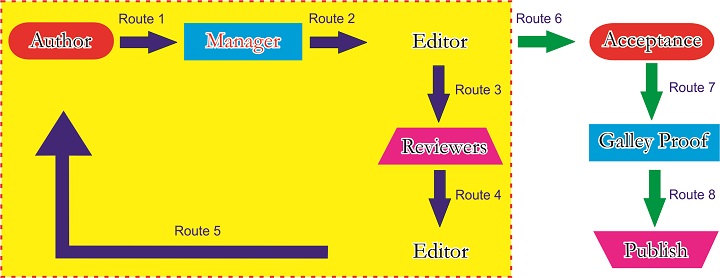
In short, the steps are:
- Manuscript Submission (by author) (route 1)
- Manuscript Check and Selection (by manager and editors) (route 2). Editors have a right to directly accept, reject, or review.
- Manuscript Reviewing Process (by reviewers) (route 3-4)
- Notification of Manuscript Acceptance, Revision, or Rejection (by editor to author based on reviewers comments) (route 5)
- Paper Revision (by author)
- Revision Submission based on Reviewer Suggestion (by author) with similar flow to point number 1. (route 1)
- If reviewer seems to be satisfied with revision, notification for acceptance (by editor). (route 6)
- Galley proof and publishing process (route 7 and 8)
The steps point number 1 to 5 is considered as 1 round of peer-reviewing process (see yellow area in the figure). And, our reviewing process at least goes through 2 round of reviewing process.
The journal editor or editorial board considers the feedback provided by the peer reviewers and arrives at a decision. The following are the most common decisions:
- accept without any changes (acceptance): the journal will publish the paper in its original form
- accept with minor revisions (acceptance): the journal will publish the paper and asks the author to make small corrections
- accept after major revisions (conditional acceptance ): the journal will publish the paper provided the authors make the changes suggested by the reviewers and/or editors
- revise and resubmit (conditional rejection): the journal is willing to reconsider the paper in another round of decision making after the authors make major changes
- reject the paper (outright rejection): the journal will not publish the paper or reconsider it even if the authors make major revisions.
9. Confidentiality and Integrity of the Peer Review Process
Throughout the peer review process, all submitted manuscripts are treated as confidential. Editors and reviewers must not disclose information about the manuscript, the review process, or the identities of participants. Unpublished material disclosed in a manuscript must not be used without the explicit written permission of the author.
Any breach of confidentiality or ethical misconduct identified during peer review will be addressed in accordance with COPE guidelines.
10. Conflicts of Interest and Editorial Independence
Editors and reviewers are required to disclose any potential conflicts of interest that could influence their judgment. Reviewers with conflicts of interest must decline participation in the review process.
Manuscripts authored or co-authored by Editors or members of the Editorial Board are handled through an independent editorial process. Such submissions are subject to the same standards of peer review and ethical scrutiny as all other manuscripts, and editorial decisions are made without the involvement of the author-editor.
11. Appeals and Complaints
The Journal of Science Learning recognizes the right of authors to appeal editorial decisions under specific circumstances. Appeals may be submitted if authors believe that a decision was based on a factual error, a significant misunderstanding, or a procedural irregularity.
Appeals must be submitted in writing and supported by clear justification. Disagreement with reviewers’ opinions alone does not constitute grounds for appeal. Appeals are reviewed objectively by the Editors, and additional independent expert opinions may be sought when appropriate. Decisions following an appeal are final.
Complaints related to the peer review process, including allegations of bias, conflicts of interest, or breaches of confidentiality, are handled seriously and confidentially in accordance with COPE Core Practices.
12. Commitment to Transparency, Quality, and Scholarly Integrity
The Journal of Science Learning publishes only articles that have successfully completed the peer review process and have been approved by qualified experts in the relevant field. The journal is committed to maintaining transparency, fairness, and integrity throughout the peer review process as a cornerstone of responsible scholarly publishing and the advancement of scientific knowledge.
Publication Frequency
Journal of Science Learning was published three times a year in March, July, and November.
Open Access Policy
COPYRIGHT AND LICENSE AGREEMENT
Journal of Science Learning (JSL)
By submitting a manuscript to the Journal of Science Learning (JSL) and agreeing to this Copyright and License Agreement, the Author(s) confirm that, in the event the manuscript is accepted for publication, the following terms and conditions shall apply.
This Agreement becomes legally effective upon acceptance of the manuscript for publication.
1. Parties to the Agreement
This Agreement is entered into between the Author(s) of the submitted manuscript and the Journal of Science Learning (JSL) as the publishing journal.
2. Purpose of the Agreement
The purpose of this Agreement is to define clearly:
the ownership of copyright,
the rights granted by the Author(s) to the journal,
the licensing terms under which the article will be made publicly available,
the rights retained by the Author(s),
and the ethical and legal guarantees provided by the Author(s).
This Agreement is intended to support open access dissemination of scholarly work while safeguarding academic integrity and legal clarity.
3. Copyright Ownership
Copyright of the published article is retained by the Author(s).
Nothing in this Agreement shall be construed as a transfer of copyright ownership from the Author(s) to the journal or the publisher.
4. Grant of License to the Journal
The Author(s) grant the Journal of Science Learning (JSL) a non-exclusive, worldwide, irrevocable license, for the full duration of the applicable copyright, to:
publish the article;
reproduce and distribute the article in any medium or format;
publicly display and communicate the article;
archive and preserve the article in electronic or other repositories;
identify itself as the original publisher of the work.
This license is exercised in accordance with the Creative Commons license specified in this Agreement and does not restrict the Author(s)’ own reuse rights.
5. Open Access and Creative Commons License
All articles published in Journal of Science Learning (JSL) are made immediately and permanently available under the Creative Commons Attribution–ShareAlike 4.0 International License (CC BY-SA 4.0).
Under this license, any user is permitted to:
share — copy and redistribute the material in any medium or format;
adapt — remix, transform, and build upon the material for any purpose, including commercial use;
provided that the conditions of attribution and share-alike are fully respected.
The full license text is available at:
https://creativecommons.org/licenses/by-sa/4.0/

JSL by http://ejournal.upi.edu/index.php/jslearning is licensed under a Creative Commons Attribution-ShareAlike 4.0 International License.
6. Conditions of the Creative Commons License
Reuse of the published article is subject to the following conditions:
6.1 Attribution
Users must give appropriate credit to the Author(s), provide a link to the Creative Commons license, and indicate if changes were made. Attribution must be presented in a reasonable manner and must not imply endorsement by the Author(s) or by the journal.
6.2 ShareAlike
If the article is remixed, transformed, or built upon, any resulting derivative works must be distributed under the same Creative Commons Attribution–ShareAlike 4.0 International License.
6.3 No Additional Restrictions
Users may not apply legal terms or technological measures that legally restrict others from exercising the rights granted by the license.
7. Author Reuse and Self-Archiving Rights
The Author(s) retain the unrestricted right to:
deposit the published version or accepted manuscript in institutional, disciplinary, or other repositories;
share the article on personal or institutional websites;
use the article in teaching, presentations, or academic courses;
reuse the article in future works, including books, edited volumes, or derivative scholarly publications.
All reuse must include clear acknowledgment of the original publication in Journal of Science Learning (JSL) and reference to the applicable Creative Commons license.
8. Third-Party Material
If the manuscript contains any third-party material (including figures, tables, images, or data) that is not covered by the Creative Commons license, the Author(s) must:
obtain written permission from the copyright holder prior to submission;
clearly identify such material in the manuscript with an appropriate credit line.
The Author(s) bear full responsibility for securing permission for third-party content and for any legal consequences arising from failure to do so.
9. Author Guarantees and Warranties
The Author(s) jointly and severally guarantee that:
The manuscript is an original work, has not been published previously, and is not under consideration for publication elsewhere.
All listed co-authors have:
made a significant scholarly contribution to the work,
been informed of and agreed to the submission,
approved the final version of the manuscript,
agreed to the terms of this Agreement.
The manuscript does not contain:
defamatory, libelous, or unlawful statements;
material that infringes copyright, patent, trademark, or other proprietary rights;
content that may cause harm or injury to individuals, institutions, or society;
confidential or sensitive information disclosed without proper authorization.
All sources of funding, support, and potential competing interests have been fully disclosed in accordance with the journal’s policies.
10. Editorial Actions and Ethical Compliance
The Author(s) acknowledge that failure to comply with this Agreement or with the Journal of Science Learning’s Publication Ethics and Malpractice Statement may result in editorial actions.
Such actions may include, but are not limited to:
publication of corrections or corrigenda;
publication of an expression of concern;
retraction of the article;
in accordance with COPE (Committee on Publication Ethics) guidelines and international best practices in scholarly publishing.
11. Governing Ethics Policy
This Agreement is governed by and shall be interpreted in accordance with the Journal of Science Learning’s Publication Ethics and Malpractice Statement, which is partially adopted from Elsevier Publication Ethics Guidelines and aligned with COPE Core Practices.
12. Final Provisions
This Agreement represents the complete understanding between the Author(s) and the journal regarding copyright, licensing, and publication of the manuscript.
13. Ethical Use of Artificial Intelligence (AI) in Scholarly Writing
The Journal of Science Learning (JSL) recognizes the increasing use of artificial intelligence (AI) tools in academic research and scholarly communication. The journal supports responsible, transparent, and ethical use of AI technologies in ways that enhance, but do not replace, human intellectual contribution.
AI tools may be used by Author(s) solely as supportive instruments, such as for language refinement, grammar checking, formatting assistance, or preliminary data organization, provided that such use does not compromise the originality, integrity, or accountability of the scholarly work.
AI tools must not be listed as authors under any circumstances, as they cannot take responsibility for the accuracy, integrity, originality, or ethical implications of the work.
14. Author Responsibility for AI-Assisted Content
The Author(s) retain full and exclusive responsibility for all content contained in the manuscript, including any content generated or assisted by AI-based tools.
The use of AI does not absolve the Author(s) of responsibility for:
the accuracy and validity of data, analyses, interpretations, and conclusions;
proper citation of sources and avoidance of plagiarism;
compliance with ethical standards in research and publication;
respect for intellectual property rights and confidentiality.
Any errors, misrepresentations, ethical breaches, or infringements resulting from AI-assisted content remain the sole responsibility of the Author(s).
15. Transparency and Disclosure of AI Use
The Author(s) are required to explicitly disclose the use of AI tools in the preparation of the manuscript when such use goes beyond basic spelling or grammar checking.
Disclosure must include, where applicable:
the name of the AI tool or system used,
the purpose of its use (e.g., language editing, data visualization, code assistance),
confirmation that the final content was reviewed, verified, and approved by the Author(s).
Such disclosure should be made in a dedicated section of the manuscript (e.g., Author Contributions, Acknowledgments, or Ethical Statement).
Failure to disclose substantive AI use may be considered a breach of publication ethics.
16. Prohibited Uses of Artificial Intelligence
The following practices are strictly prohibited:
using AI to fabricate data, results, citations, or references;
using AI to manipulate images, figures, or datasets in a misleading manner;
submitting AI-generated content without meaningful human intellectual contribution;
using AI to impersonate peer reviewers, editors, or authors.
Any confirmed misuse of AI may result in rejection, retraction, or other editorial actions in accordance with COPE guidelines.
17. Competing Interest (Conflict of Interest) Declaration Policy
The Journal of Science Learning (JSL) is committed to ensuring that all research is conducted, reviewed, and published free from undue bias, and is perceived as such by the scholarly community.
A competing interest is defined as any financial or non-financial interest that could reasonably be perceived to interfere with, or influence, the objectivity, integrity, or interpretation of a manuscript at any stage of the publication process.
All competing interests must be declared to allow editors, reviewers, and readers to assess potential sources of bias transparently.
18. Scope of Competing Interests to Be Declared
The obligation to declare competing interests applies to:
Author(s),
funding bodies and sponsors,
reviewers,
editors (academic or professional),
and any individual commenting on or evaluating published articles.
Competing interests may arise in relation to organizations or individuals and may be financial or non-financial, professional or personal.
19. Financial Competing Interests
Financial competing interests include, but are not limited to:
ownership of stocks or shares;
paid employment, consultancies, or advisory roles;
board memberships;
patent applications or granted patents, whether held personally or by affiliated institutions;
research grants, whether restricted or unrestricted;
travel grants, honoraria, or gifts related to the subject of the manuscript.
Any financial interest that occurred within five years before or after the commencement of the research, or within five years of manuscript preparation, must be declared if reasonably relevant.
20. Non-Financial Competing Interests
Non-financial competing interests may include:
Professional Interests
Such as acting as an expert witness, serving on advisory boards, holding unpaid roles in organizations that may benefit from publication, or engaging in advocacy or lobbying activities related to the manuscript’s subject.
Personal Interests
Such as personal relationships, mentorships, adversarial relationships, or strong personal convictions (political, ideological, or religious) that could influence, or be perceived to influence, objectivity.
21. Author Competing Interest Declaration
The Author(s) must submit a Competing Interest Statement at the time of manuscript submission, declaring either:
the existence of relevant competing interests, with full disclosure, or
explicitly stating that no competing interests exist.
If no competing interests are declared, the following statement may be used:
“The authors declare that they have no known financial or non-financial competing interests that could have appeared to influence the work reported in this paper.”
22. Editorial and Reviewer Competing Interests
Editors and reviewers are required to declare any competing interests that could compromise their ability to evaluate a manuscript objectively.
Editors or reviewers with relevant competing interests must recuse themselves from handling or reviewing the manuscript.
23. Post-Publication Transparency
Anyone who comments on, reviews, or rates published articles in Journal of Science Learning (JSL) must disclose any relevant competing interests at the time of posting.
24. Consequences of Non-Disclosure
Failure to disclose relevant AI use or competing interests may result in:
rejection of the manuscript,
publication of a correction or expression of concern,
retraction of the published article,
in accordance with COPE Core Practices and international publication ethics standards.
Archiving
This journal utilizes the LOCKSS system to create a distributed archiving system among participating libraries and permits those libraries to create permanent archives of the journal for purposes of preservation and restoration. More...
Publication Ethics, Malpractice, and Artificial Intelligence (AI) Governance Statement
Journal of Science Learning (JSL)
1. Ethical Principles and Editorial Commitment
Journal of Science Learning (JSL) is committed to safeguarding the integrity of the scholarly record and ensuring that all published works meet the highest standards of academic quality and ethical responsibility. The journal adheres to the Committee on Publication Ethics (COPE) Core Practices and aligns its editorial policies with the Elsevier Publication Ethics Guidelines and the ethical expectations of the Scopus Content Selection and Advisory Board (CSAB). These principles guide all stages of the publication process and apply equally to authors, editors, reviewers, editorial board members, and the publisher.
The publication of scholarly work is a collaborative endeavor that depends on trust, transparency, and accountability. Peer review plays a central role in validating research quality and ensuring that published articles contribute meaningfully to the advancement of science education research. JSL is committed to maintaining a fair, transparent, and independent editorial process free from discrimination, bias, or undue influence.
2. Editorial Independence and Decision-Making
Editorial decisions at Journal of Science Learning are based solely on the scholarly merit of submitted manuscripts, including originality, methodological rigor, clarity of presentation, relevance to the journal’s scope, and contribution to the field. Decisions are not influenced by authors’ institutional affiliations, nationality, gender, political views, commercial considerations, or funding sources.
Editors exercise full editorial independence and are responsible for ensuring compliance with applicable legal and ethical standards, including those related to plagiarism, copyright, defamation, and data protection. When necessary, editors may consult external reviewers, associate editors, or ethical guidelines provided by COPE to support fair and informed decision-making.
3. Editorial Conflicts of Interest and Transparency
To ensure transparency and avoid conflicts of interest, Journal of Science Learning applies strict procedures for handling manuscripts submitted by members of the editorial team. Manuscripts authored or co-authored by one of the Editors-in-Chief are managed exclusively by the other Editor-in-Chief through an independent and confidential peer review process. The editor involved as an author has no access to reviewer identities, reviewer reports, or editorial decisions related to the manuscript.
Similar procedures apply to submissions from Associate Editors or Editorial Board members. All such manuscripts undergo the same rigorous peer review and editorial standards as any other submission. Editors are required to disclose any personal, professional, or financial interests that could be perceived as influencing editorial judgment and must recuse themselves from handling manuscripts where such conflicts exist.
4. Peer Review Process and Reviewer Ethics
Journal of Science Learning employs a rigorous peer review process designed to ensure objectivity, confidentiality, and academic rigor. Research articles are typically evaluated by at least two independent external reviewers with expertise relevant to the manuscript’s subject area. Editors are responsible for selecting qualified reviewers, monitoring review quality, and preventing fraudulent or manipulated peer review practices.
Reviewers are expected to evaluate manuscripts objectively, provide constructive feedback, and maintain strict confidentiality regarding the content under review. Manuscripts and associated materials must not be shared, discussed with unauthorized parties, or used for personal advantage. Reviewers are required to disclose any competing interests and decline review invitations when such interests may compromise impartiality.
Reviewers play an important role in identifying ethical concerns, including plagiarism, redundant publication, data inconsistencies, inappropriate image manipulation, citation manipulation, or unethical use of artificial intelligence. The use of AI tools by reviewers to analyze manuscripts or generate peer review reports is not permitted, as this may compromise confidentiality and intellectual property.
5. Author Responsibilities and Research Integrity
Authors submitting manuscripts to Journal of Science Learning are expected to uphold the highest standards of research integrity and ethical conduct. Submitted manuscripts must represent original work that has not been previously published and is not under consideration elsewhere. All forms of plagiarism, including direct copying, improper paraphrasing, and self-plagiarism, are considered unethical and unacceptable.
Authors must present accurate and honest accounts of their research, ensuring that data are not fabricated, falsified, or selectively reported. Sufficient methodological detail must be provided to allow replication, where appropriate. Authors may be requested to provide access to underlying data for editorial review and are encouraged to retain research data for a reasonable period after publication.
Research involving human participants or animals must comply with relevant ethical standards and regulations. Authors are responsible for obtaining appropriate ethical approval and informed consent and for clearly stating such compliance within the manuscript.
6. Authorship, Contributions, and Acknowledgment
Authorship should be limited to individuals who have made substantial scholarly contributions to the conception, design, execution, or interpretation of the study. All authors must approve the final version of the manuscript and agree to its submission. The corresponding author is responsible for ensuring that all listed authors meet authorship criteria and that no qualified contributor has been omitted.
Any changes to authorship after submission are subject to editorial approval and require written consent from all authors. Contributors who do not meet authorship criteria should be appropriately acknowledged. All authors share collective responsibility for the integrity and accuracy of the published work.
7. Disclosure of Conflicts of Interest and Funding
Authors must disclose any financial or personal relationships that could be perceived as influencing the research. Sources of funding must be clearly identified, and the role of funders in study design, data collection, analysis, interpretation, and publication decisions must be transparently stated. Failure to disclose relevant conflicts of interest may result in rejection, correction, or retraction.
8. Data, Image Integrity, and Citation Ethics
Journal of Science Learning takes data and image integrity seriously. Authors must ensure that figures and images accurately represent original data. While minor adjustments for clarity may be acceptable, manipulation that alters scientific meaning is unethical. Editors may request original data or images for verification.
Authors are expected to cite relevant literature accurately and responsibly. Citation manipulation, including excessive self-citation or coercive citation practices, is considered unethical and may lead to editorial action.
9. Ethical Use of Artificial Intelligence (AI)
The journal recognizes the growing role of artificial intelligence in scholarly communication and establishes clear ethical boundaries for its use. Authors may use AI tools for limited supportive purposes, such as language editing or improving readability. AI tools must not be used to generate research data, scientific interpretations, images, conclusions, or references, nor to fabricate content.
Artificial intelligence systems cannot be listed as authors, as they cannot assume responsibility for the work. Any use of AI tools must be transparently disclosed in the manuscript. Authors remain fully responsible for the accuracy, originality, and integrity of all content.
Editors and reviewers are prohibited from using AI tools in ways that compromise manuscript confidentiality or intellectual property, including uploading unpublished manuscripts to AI systems that store or reuse content.
10. Copyright, Licensing, and Access
Authors publishing in Journal of Science Learning retain copyright of their work. All articles are published under the Creative Commons Attribution–ShareAlike 4.0 International (CC BY-SA 4.0) license, which permits sharing and adaptation with appropriate attribution and under the same licensing terms.
11. Allegations of Misconduct and Corrective Actions
All allegations of publication misconduct, including plagiarism, data fabrication or falsification, unethical use of artificial intelligence, authorship disputes, and editorial or reviewer misconduct, are handled seriously and confidentially. Journal of Science Learning follows COPE flowcharts and procedures in investigating such cases and may issue corrections, retractions, expressions of concern, or notify relevant institutions when appropriate.
12. Policy Review and Updates
This publication ethics, malpractice, and AI governance statement is reviewed periodically to ensure alignment with evolving international standards, developments in artificial intelligence, and best practices in scholarly publishing. Submission to the journal or participation in its editorial and peer review processes constitutes agreement with the principles outlined in this policy.
Plagiarism Screening
Before going to review process, all manuscripts will be checked that they are free from plagiarism practice using "Turnitin" software. If there an indication of plagiarism, the manuscript will instantly be rejected.
Fees
JSL does not charge any submission or processing fees for every article received and published.
Manuscript Submission Guidelines
AUTHOR GUIDELINES
Please prepare your manuscript following the instructions for authors given below before submitting it online at below. Basically, the JSL journal follows the author guidelines of Elseiver at Elseiver Author Guidelines.
Manuscripts submitted for publication in JSL should be between 6,000 and 12,000 words typed in double spacing including tables and figures. The abstract should maintain a maximum of 250 words.
PREPARATION
Use of word processing software
It is important that the file be saved in the native format of the word processor used. The text should be in single-column format. Keep the layout of the text as simple as possible. Most formatting codes will be removed and replaced on processing the article. In particular, do not use the word processor's options to justify text or to hyphenate words. However, do use bold face, italics, subscripts, superscripts etc. When preparing tables, if you are using a table grid, use only one grid for each individual table and not a grid for each row. If no grid is used, use tabs, not spaces, to align columns. The electronic text should be prepared in a way very similar to that of conventional manuscripts. Note that source files of figures, tables and text graphics will be required whether or not you embed your figures in the text. See also the section on Electronic artwork. To avoid unnecessary errors you are strongly advised to use the 'spell-check' and 'grammar-check' functions of your word processor.
ARTICLE STRUCTURE
Subdivision - numbered sections: Divide your article into clearly defined and numbered sections. Subsections should be numbered 1.1 (then 1.1.1, 1.1.2, ...), 1.2, etc. (the abstract is not included in section numbering). Use this numbering also for internal cross-referencing: do not just refer to 'the text'. Any subsection may be given a brief heading. Each heading should appear on its own separate line.
Introduction: State the objectives of the work and provide an adequate background, avoiding a detailed literature survey or a summary of the results.
Material and methods: Provide sufficient detail to allow the work to be reproduced. Methods already published should be indicated by a reference: only relevant modifications should be described.
Results: Results should be clear and concise.
Discussion: This should explore the significance of the results of the work, not repeat them. A combined Results and Discussion section is often appropriate. Avoid extensive citations and discussion of published literature.
Conclusions: The main conclusions of the study may be presented in a short Conclusions section, which may stand alone or form a subsection of a Discussion or Results and Discussion section.
ESSENTIAL TITLE PAGE INFORMATION
Title: Concise and informative. Titles are often used in information-retrieval systems. Avoid abbreviations and formulae where possible.
Author names and affiliations: Please clearly indicate the given name(s) and family name(s) of each author and check that all names are accurately spelled. Present the authors' affiliation addresses (where the actual work was done) below the names. Indicate all affiliations with a lower-case superscript letter immediately after the author's name and in front of the appropriate address. Provide the full postal address of each affiliation, including the country name and, if available, the e-mail address of each author.
Corresponding author. Clearly indicate who will handle correspondence at all stages of refereeing and publication, also post-publication. Ensure that the e-mail address is given and that contact details are kept up to date by the corresponding author.
Present/permanent address. If an author has moved since the work described in the article was done, or was visiting at the time, a 'Present address' (or 'Permanent address') may be indicated as a footnote to that author's name. The address at which the author actually did the work must be retained as the main, affiliation address. Superscript Arabic numerals are used for such footnotes.
ABSTRACT
A concise and factual abstract is required. The abstract should state briefly the purpose of the research, the principal results and major conclusions. An abstract is often presented separately from the article, so it must be able to stand alone. For this reason, References should be avoided, but if essential, then cite the author(s) and year(s). Also, non-standard or uncommon abbreviations should be avoided, but if essential they must be defined at their first mention in the abstract itself.
GRAPHICAL ABSTRACT
Although a graphical abstract is optional, its use is encouraged as it draws more attention to the online article. The graphical abstract should summarize the contents of the article in a concise, pictorial form designed to capture the attention of a wide readership. Graphical abstracts should be submitted as a separate file in the online submission system. Image size: Please provide an image with a minimum of 531 × 1328 pixels (h × w) or proportionally more. The image should be readable at a size of 5 × 13 cm using a regular screen resolution of 96 dpi. Preferred file types: TIFF, EPS, PDF or MS Office files.
HIGHLIGHTS
Highlights are an optional for this journal. They consist of a short collection of bullet points that convey the core findings of the article and should be submitted in a separate editable file in the online submission system. Please use 'Highlights' in the file name and include 3 to 5 bullet points (maximum 85 characters, including spaces, per bullet point).
KEYWORDS
Immediately after the abstract, provide a maximum of 6 keywords, using American spelling and avoiding general and plural terms and multiple concepts (avoid, for example, 'and', 'of'). Be sparing with abbreviations: only abbreviations firmly established in the field may be eligible. These keywords will be used for indexing purposes. Acknowledgements Collate acknowledgements in a separate section at the end of the article before the references and do not, therefore, include them on the title page, as a footnote to the title or otherwise. List here those individuals who provided help during the research (e.g., providing language help, writing assistance or proof reading the article, etc.).
NOMENCLATURE AND UNITS
Follow internationally accepted rules and conventions: use the international system of units (SI). If other quantities are mentioned, give their equivalent in SI. You are urged to consult IUPAC: Nomenclature of Organic Chemistry: http://www.iupac.org/ for further information.
MATH FORMULAE
Please submit math equations as editable text and not as images. Present simple formulae in line with normal text where possible and use the solidus (/) instead of a horizontal line for small fractional terms, e.g., X/Y. In principle, variables are to be presented in italics. Powers of e are often more conveniently denoted by exp. Number consecutively any equations that have to be displayed separately from the text (if referred to explicitly in the text).
FOOTNOTES
Footnotes should be used sparingly. Number them consecutively throughout the article. Many word processors can build footnotes into the text, and this feature may be used. Otherwise, please indicate the position of footnotes in the text and list the footnotes themselves separately at the end of the article. Do not include footnotes in the Reference list.
TABLES
Please submit tables as editable text and not as images. Tables can be placed either next to the relevant text in the article, or on separate page(s) at the end. Number tables consecutively in accordance with their appearance in the text and place any table notes below the table body. Be sparing in the use of tables and ensure that the data presented in them do not duplicate results described elsewhere in the article. Please avoid using vertical rules.
REFERENCES
Citation in text
Please ensure that every reference cited in the text is also present in the reference list (and vice versa). Any references cited in the abstract must be given in full. Unpublished results and personal communications are not recommended in the reference list, but may be mentioned in the text. If these references are included in the reference list they should follow the standard reference style of the journal and should include a substitution of the publication date with either 'Unpublished results' or 'Personal communication'. Citation of a reference as 'in press' implies that the item has been accepted for publication.
Web references
As a minimum, the full URL should be given and the date when the reference was last accessed. Any further information, if known (DOI, author names, dates, reference to a source publication, etc.), should also be given. Web references can be listed separately (e.g., after the reference list) under a different heading if desired, or can be included in the reference list.
References in a special issue
Please ensure that the words 'this issue' are added to any references in the list (and any citations in the text) to other articles in the same Special Issue.
REFERENCE MANAGEMENT SOFTWARE
Most journals have their reference template available in many of the most popular reference management software products. These include all products that support Citation Style Language styles (http://citationstyles.org), such as Mendeley (http://www.mendeley.com/features/reference-manager) and Zotero (https://www.zotero.org/), as well as EndNote (http://endnote.com/downloads/styles). Using the word processor plug-ins from these products, authors only need to select the appropriate journal template when preparing their article, after which citations and bibliographies will be automatically formatted in the journal's style. If no template is yet available for this journal, please follow the format of the sample references and citations as shown in this Guide. Users of Mendeley Desktop can easily install the reference style for this journal by clicking the following link: http://open.mendeley.com/use-citation-style/journal-of-aerosol-science When preparing your manuscript, you will then be able to select this style using the Mendeley plugins for Microsoft Word or LibreOffice.
REFERENCE STYLE
Text: Citations in the text should follow the referencing style used by the American Psychological Association. You are referred to the Publication Manual of the American Psychological Association, Sixth Edition, ISBN 978-1-4338-0561-5, copies of which may be ordered from http://books.apa.org/books.cfm?id=4200067 or APA Order Dept., P.O.B. 2710, Hyattsville, MD 20784, USA or APA, 3 Henrietta Street, London, WC3E 8LU, UK.
List of references should be arranged first alphabetically and then further sorted chronologically if necessary. More than one reference from the same author(s) in the same year must be identified by the letters 'a', 'b', 'c', etc., placed after the year of publication.
SUBMISSION PREPARATION CHECKLIST
Essential title page information
Title
- Concise and informative. Titles are often used in information-retrieval systems. Avoid abbreviations and formulae where possible.
Author names and affiliations.
- Please clearly indicate the given name(s) and family name(s) of each author and check that all names are accurately spelled.
- Present the authors' affiliation addresses (where the actual work was done) below the names. Indicate all affiliations with a lowercase superscript letter immediately after the author's name and in front of the appropriate address.
- Provide the full postal address of each affiliation, including the country name and, if available, the e-mail address of each author.
Corresponding author.
- Clearly indicate who will handle correspondence at all stages of refereeing and publication, also post-publication.
- Ensure that the e-mail address is given and that contact details are kept up to date by the corresponding author.
Abstract
- A concise and factual abstract is required. The abstract should state briefly the purpose of the research, the principal results and major conclusions. An abstract is often presented separately from the article, so it must be able to stand alone.
- References should be avoided
Keywords
- Immediately after the abstract, provide a maximum of 6 keywords, using American spelling and avoiding general and plural terms and multiple concepts (avoid, for example, 'and', 'of').
- Be sparing with abbreviations: only abbreviations firmly established in the field may be eligible. These keywords will be used for indexing purposes.
Article structure
- Subdivision - numbered sections
- Divide your article into clearly defined and numbered sections. Subsections should be numbered 1.1 (then 1.1.1, 1.1.2, ...), 1.2, etc. (the abstract, acknoledgment,and references are not included in section numbering).
Math formulae
- Please submit math equations as editable text and not as images.
- Present simple formulae in line with normal text where possible and use the solidus (/) instead of a horizontal line for small fractional terms, e.g., X/Y.
- In principle, variables are to be presented in italics. Powers of e are often more conveniently denoted by exp. Number consecutively any equations that have to be displayed separately from the text (if referred to explicitly in the text)
Results
- Results should be clear and concise.
Discussion
- A combined Results and Discussion section is often appropriate. Avoid extensive citations and discussion of published literature.
- This should explore the significance of the results of the work, not repeat them.
Tables
- Please submit tables as editable text and not as images. Tables can be placed either next to the relevant text in the article, or on separate page(s) at the end.
- Tables can be placed either next to the relevant text in the article, or on separate page(s) at the end.
- Number tables consecutively in accordance with their appearance in the text and place any table notes below the table body
- Please avoid the use of prepositions “above”, “below” after the number tables indicating the position of table to the text.
References
- Citation in text. Please ensure that every reference cited in the text is also present in the reference list (and vice versa).
- Unpublished results and personal communications are not recommended in the reference list, but may be mentioned in the text.
- If these references are included in the reference list they should follow the standard reference style of the journal and should include a substitution of the publication date with either 'Unpublished results' or 'Personal communication'. Citation of a reference as 'in press' implies that the item has been accepted for publication.
Reference style
- Text: All citations in the text should refer to :
- Single author: the author's name (without initials, unless there is ambiguity) and the year of publication;
- Two authors: both authors' names and the year of publication;
- Three or more authors: first author's name followed by "et al." and the year of publication.
- Citations may be made directly (or parenthetically). Groups of references should be listed first alphabetically, then chronologically.
Examples: "as demonstrated (Allan, 1996a, 1996b, 1999; Allan and Jones, 1995). Kramer et al. (2000) have recently shown ...."
- List of References should be arranged first alphabetically and then further sorted chronologically if necessary.
- More than one reference from the same author(s) in the same year must be identified by the letters "a", "b", "c", etc., placed after the year of publication.
In-text APA citations typically appear at the end of the sentence, between the last word and the period.
Example of a parenthetical citations without the author’s name in the text:
Harlem had many artists and musicians in the late 1920s (Belafonte, 2008).
Example of a parenthetical citation when author is mentioned in the text:
According to Belafonte, Harlem was full of artists and musicians in the late 1920s (2008).
For parenthetical citations with two authors, format your parenthetical citation like this:
Rallying to restore sanity was a revolutionary undertaking (Stewart & Colbert, 2010).
For parenthetical citations with three to five authors: Include all names in the first in-text parenthetical citation, separated by commas and then an ampersand (&).
Rallying to restore sanity was a revolutionary undertaking (Stewart, Colbert, & Oliver, 2010).
For all subsequent in-text parenthetical citations, include only the first author, followed by “et al.” and the publication year if it is the first citation in a paragraph.
The event resulted in thousands of participants flocking to the National Mall in support of the cause (Stewart et al. 2010).
or
Stewart et al. (2010) state that the event resulted in thousands of participants flocking to the National Mall in support of the cause.
For parenthetical citations for six or more authors, include only the last name of the first author, followed by “et al.” and publication year in ALL parenthetical citations.
The study did not come to any definitive conclusions (Rothschild et al., 2013).
APA Styles Guideline for References
Book:
Author, F. M. (Year of Publication). Title of work. Publisher City, State: Publisher.
James, H. (2009). The ambassadors. Rockville, MD: Serenity.
Chapter in a Print Book:
Author, F. M. (Year of Publication). Title of chapter. In F. M. Editor (Ed.), Title of book (pp. xx-xx). Publisher City, State: Publisher.
Shuhua, L. (2007). The night of MidAutumn Festival. In J. S. M. Lau & H. Goldblatt (Eds.), The Columbia Anthology of Modern Chinese Literature (pp. 95-102). New York, NY: Columbia University Press.
E-Books:
Author, F. M. (Year of Publication). Title of work [E-reader version]. Retrieved from URL
Stoker, B. (2000). Dracula [Kindle HDX version]. Retrieved from http://www.overdrive.com/
Chapter in an E-book:
Author, F. M. (Year of Publication). Title of chapter. In F. M. Editor (Ed.), Title of book [E-reader version] (pp. xx-xx). Retrieved from URL or http://dx.doi.org/xxxx
Journals found on a database or online:
Author, F. M. (Year of Publication). Article title. Journal Title, Volume Number(Issue Number), pp.-pp. http://dx.doi.org/xxxx or Retrieved from homepage URL
Trier, J. (2007). “Cool” engagements with YouTube: Part 2. Journal of Adolescent & Adult Literacy, 50(7), 598-603. http://dx.doi.org/10.1598/JAAL.50.7.8
Journals found in print:
Author, F. M., Author, F. M. & Author, F. M. (Year of Publication). Article title. Journal Title, Volume(Issue Number), page range.
Lin, M.G., Hoffman, E.S., & Borengasser, C. (2013). Is social media too social for class? A case study of Twitter use. Tech Trends, 57(2), 39-45.
Magazine:
Last, F. M. (Date Published). Article title. Magazine Title, Volume(Issue), Page(s).
Website:
Last, F. M. (Date Published). Web page title. Retrieved from Homepage URL
Newspaper:
Last, F. M. (Year, Month Day published). Article title. Newspaper Title, Page(s).
Funding Sources
Any funds used to support the research of the manuscript should be placed here.
Notes
Any additional relevant notes should be placed here.
Abbreviations
SL, Science Learning; SPS, Science Process Skills.
Further considerations
- Manuscript has been 'spell-checked' and 'grammar-checked' using word processing.
- References are in the correct format for this journal
- All references mentioned in the Reference list are cited in the text, and vice versa
- Permission has been obtained for use of copyrighted material from other sources (including the Internet)
- Printed version of figures (if applicable) in color or black-and-white. Indicate clearly whether or not color or black-and-white in print is required.
- There is no grammatical and typographycal errors
- The active and passive sentences must be presented clearly.
- Checking the coordinating conjuction, subcoordinating conjunction, transitional expression.
- Checking the grammar rule of past tense, simple present, present perfect.
- Checking the grammar rule and style written english
Eg. count-uncount noun, gerund, adjective with the linking verb, dual comparisons, comparative sentences, causative verbs, subjunctive, inclusives (not only,… but also, as well as, both … and…), transitive-intransitive verbs, dependent-independent clauses, antecedent of pronouns, the parallel structure of sentence, direct-indirect objects
Acknowledgements
- Collate acknowledgements in a separate section at the end of the article before the references and do not, therefore, include them on the title page, as a footnote to the title or otherwise.
- List here those individuals who provided help during the research (e.g., providing language help, writing assistance or proof reading the article, etc.).


Jl. Dr. Setiabudhi 229 Bandung 40154, West Java, Indonesia