







Project Based Learning Innovation: Developing Nutritional Literacy through Moringa (Moringa oleifera) Leaf Pudding Making
Abstract
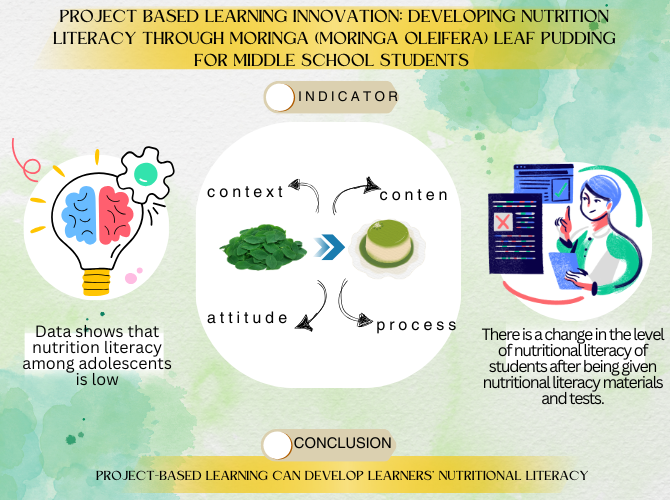
The low nutritional literacy of students and the lack of utilization of moringa leaves (Moringa oleifera) as contextual teaching materials in the form of foods such as pudding are challenges in increasing nutritional awareness from an early age. This study aims to analyze the development of students' nutritional literacy after the implementation of project-based learning on making pudding from Moringa oleifera leaves. The study employs a quantitative method with a one-shot case study design. The research subjects were 36 eleventh-grade students at a senior high school in West Java. The learning activity was conducted in the form of a moringa leaf pudding-making project designed to integrate chemistry concepts (colloids) and nutritional literacy in an applied manner. Nutrition literacy includes four main indicators: content, context, process, and attitude. The research findings revealed an overall average score of 94, which is categorized as very good. Detailed scores, including aspects of content, context, process, and attitude, are 84, 94, 99, and 100, respectively. This research shows that project-based learning conducted over three sessions can develop students' nutritional literacy through contextual and applicable learning experiences.
Keywords
Full Text:
Download PDFReferences
Agustina, T., Rudi, L., & Faahyuddin. (2025). Penerapan model pembelajaran project based learning pada materi koloid untuk meningkatkan hasil belajar siswa [Application of the project based learning model on colloid material to improve student learning outcomes]. Jurnal Pendidikan Kimia, 10(1), 59–75. doi:10.36709/jpkim.v10i1.72
Amalia, S. N. I., Octaria, Y. C., Maryusman, T., & Imrar, I. F. (2023). The associations between social media use with eating behavior, physical activity, and nutrition status among adolescents in DKI Jakarta. Amerta Nutrition, 7(2SP), 193–198. doi:10.20473/amnt.v7i2SP.2023.193-198
An Nabil, N. R., Wulandari, I., Yamtinah, S., Ariani, S. R. D., & Ulfa, M. (2022). Analisis indeks aiken untuk mengetahui validitas isi instrumen asesmen kompetensi minimum berbasis konteks sains kimia [Aiken index analysis to determine the content validity of the minimum competency assessment instrument based on a chemical science context]. Paedagogia, 25(2), 184. doi:10.20961/paedagogia.v25i2.64566
Angraeni, L., Elfika, F., Rahmi, S., Husin, H., & Anggriawin, M. (2025). Chemical analysis and organoleptic characteristics of pudding with the addition of moringa leaf extract and red bean milk. Edufortech, 10(1), 62–77. doi:10.17509/edufortech.v10i1
Aulia, N. R. (2021). Peran pengetahuan gizi terhadap asupan energi, status gizi dan sikap tentang gizi remaja [The role of nutritional knowledge on energy intake, nutritional status, and attitudes about adolescent nutrition]. Jurnal Ilmiah Gizi Dan Kesehatan (JIGK), 2(2), 31–35. doi:10.46772/jigk.v2i02.454
Azzahra, R. (2024). Penerapan pembelajaran berbasis proyek pada pembuatan fruitghurt dari kulit buah untuk mengembangkan literasi nutrisi [Application of project-based learning in the making of Fruitghurt from fruit peels to develop nutritional literacy] (Skripsi tidak dipublikasikan). UIN Bandung, Indonesia. Diperoleh dari https://digilib.uinsgd.ac.id/id/eprint/97328
Denniss, E., Lindberg, R., & McNaughton, S. A. (2023). Quality and accuracy of online nutrition-related information: a systematic review of content analysis studies. Public Health Nutrition, 26(7), 1345–1357. doi:10.1017/S1368980023000873
Eckardt, P. N., Craig, M., & Kraemer, L. (2020). The impact of project-based learning on student content knowledge in an undergraduate, teacher preparation, foundations of education course. Journal for Leadership and Instruction, 19(1), 38–42. Diperoleh dari https://files.eric.ed.gov/fulltext/EJ1255862.pdf
Fitri, R., Lufri, L., Alberida, H., Amran, A., & Fachry, R. (2024). The project-based learning model and its contribution to student creativity: A review. JPBI (Jurnal Pendidikan Biologi Indonesia), 10(1), 223–233. doi:10.22219/jpbi.v10i1.31499
Gibbs, H. D., Kennett, A. R., Kerling, E. H., Yu, Q., Gajewski, B., Ptomey, L. T., & Sullivan, D. K. (2016). Assessing the nutrition literacy of parents and its relationship with child diet quality. Journal of Nutrition Education and Behavior, 48(7), 505-509.e1. doi:10.1016/j.jneb.2016.04.006
Herawati, H. (2018). Potensi hidrokoloid sebagai bahan tambahan pada produk pangan dan nonpangan bermutu [The potential of hydrocolloids as additives in quality food and non-food products]. Jurnal Penelitian Dan Pengembangan Pertanian, 37(1), 17–25. doi:10.21082/jp3.v37n1.2018.p17-25
Islam, Z., Islam, S. M. R., Hossen, F., Mahtab-Ul-Islam, K., Hasan, M. R., & Karim, R. (2021). Moringa oleifera is a prominent source of nutrients with potential health benefits. International Journal of Food Science, 2021, 1–11. doi:10.1155/2021/6627265
Lestarini, P. A., Yuniarti, L. N. L., Sudiarta, I. K., Lestari, M. P. L., & Agustina, K. S. (2024). Pencegahan stunting melalui edukasi pada masyarakat di Desa Cepaka Kecamatan Kediri Kabupaten Tabanan Bali [Stunting prevention through education for the community in Cepaka Village, Kediri District, Tabanan Regency, Bali]. Jurnal Sinergi Kesehatan Indonesia, 2(1), 1–9. doi:10.55887/jski.v2i1.18
Mansfield, E., Wahba, R., & De Grandpré, E. (2020). Integrating a health literacy lens into nutrition labelling policy in Canada. International Journal of Environmental Research and Public Health, 17(11), 1–7. doi:10.3390/ijerph17114130
Marfu’ah, S., & Meristin, A. (2022). Lembar kerja laboratorium berbasis proyek pembuatan koloid dengan pemanfaatan daun cincau perdu (Premna oblongifolia) [Project-based laboratory worksheet for making colloids by utilizing shrub grass jelly (Premna oblongifolia) leaves]. Orbital: Jurnal Pendidikan Kimia, 6(2), 160–170. doi:10.19109/ojpk.v6i2.15015
Nomleni, F. T., Boimau, H., & Bullu, N. I. (2024). Penggunaan lkpd berbasis proyek terhadap hasil belajar siswa SMP Negeri 3 Amanuban Tengah [The use of project-based student worksheets on the learning outcomes of students at SMP Negeri 3 Amanuban Tengah]. Indigenous, 7(2), 28–33. doi:10.33323/indigenous.v7i2.593
Nugraheni, D. (2018). Pembelajaran berbasis proyek (project based learning) materi kalor dan perpindahannya untuk meningkatkan kreativitas siswa [Project based learning on heat and its transfer to improve student creativity]. Jurnal Penelitian Pembelajaran Fisika, 9(2). doi:10.26877/jp2f.v9i2.2798
Nursiah, A. (2024). The role of digital technology in improving nutrition education for millennials and generation z. Nutrizione, 1(3), 11–20. Diperoleh dari [tautan mencurigakan telah dihapus]
Pardede, D. E., Febrianti, D., & Putri, R. M. S. (2020). Karakteristik organoleptik flavor alami dari kaldu kepala ikan tongkol (Euthynnus affinis) [Organoleptic characteristics of natural flavor from tuna (Euthynnus affinis) head broth]. Jurnal Teknologi Pertanian, 9(2), 43–52.
Parera, L. A. M., Toni, S., Naat, J., Sudirman, S., Dewi, N. W. O., Kerihi, E. C. G., & Nenohai, J. A. (2022). Pengembangan video pembelajaran kimia berbantuan kinemaster pada materi sistem koloid untuk kelas XI SMA/MA [Development of kinemaster-assisted chemistry learning videos on the colloid system material for class XI SMA/MA]. Jurnal Beta Kimia, 2(1), 23–32. doi:10.35508/jbk.v2i1.7247
Pradita, L. S., Rakhma, L. R., & Widiyaningsih, E. N. (2023). Perbedaan tingkat literasi gizi dan status gizi pada siswa sekolah kesehatan dan non kesehatan di Surakarta [Differences in nutrition literacy levels and nutritional status in health and non-health school students in Surakarta]. Health Information : Jurnal Penelitian, 15(2), 1–11. Diperoleh dari https://myjurnal.poltekkes-kdi.ac.id/index.php/hijp/article/view/1241
Priatni, H. L., Kurniasari, N., & Wiryani, A. S. (2020). Identifikasi asam amino dan protein pada bahan makanan dengan menggunakan uji ninhidrin dan uji biuret [Identification of amino acids and proteins in food ingredients using the ninhydrin test and biuret test]. Sains Indonesiana: Jurnal Ilmiah Nusantara, 1(5), 20-23.
Quinapallo-quintana, A. M., & Quinapallo-quintana, A. M. (2024). Project-based learning. [Nama Jurnal tidak tersedia], 11(1), 58–65.
Ramadhan, E. H., & Hindun. (2023). Penerapan model pembelajaran berbasis proyek untuk membantu siswa berpikir kreatif [Application of a project-based learning model to help students think creatively]. Protasis: Jurnal Bahasa, Sastra, Budaya, Dan Pengajarannya, 2(2), 43–54. doi:10.55606/protasis.v2i2.98
Ratminingsih, N. M. (2017). Penelitian eksperimental dalam pembelajaran bahasa kedua [Experimental research in second language learning]. Prasi, 6(11), 31–40. Diperoleh dari https://ejournal.undiksha.ac.id/index.php/PRASI/article/view/6816
Srimiati, M., Habibah, P., Dinya Zahra, A., Harsanti, F., & Ratu Maharani, A. R. (2023). Effect of strawberry powder substitution on the organoleptic of instant pudding. Media Gizi Indonesia, 18(1), 74–81. doi:10.20473/mgi.v18i1.74-81
Sugiyono. (2015). Metode penelitian pendidikan. Bandung: Alfabeta.
Tazqiyah, R. Z., Windayani, N., & Helsy, I. (2021). Pengembangan lembar kerja berbasis proyek pada pemanfaatan limbah biji kurma terfermentasi sebagai bahan baku minuman date coffee [Development of project based worksheets on the utilization of fermented date seeds waste as a raw material for date coffee drinks]. Gunung Djati Conference Series, 2, 315–327. Diperoleh dari http://download.garuda.kemdikbud.go.id/article.php?article=3355077&val=29417
DOI: https://doi.org/10.17509/jsl.v8i3.83531
Refbacks
- There are currently no refbacks.

Copyright (c) 2025 Umi Kulsum

This work is licensed under a Creative Commons Attribution-ShareAlike 4.0 International License.


Jl. Dr. Setiabudhi 229 Bandung 40154, West Java, Indonesia