







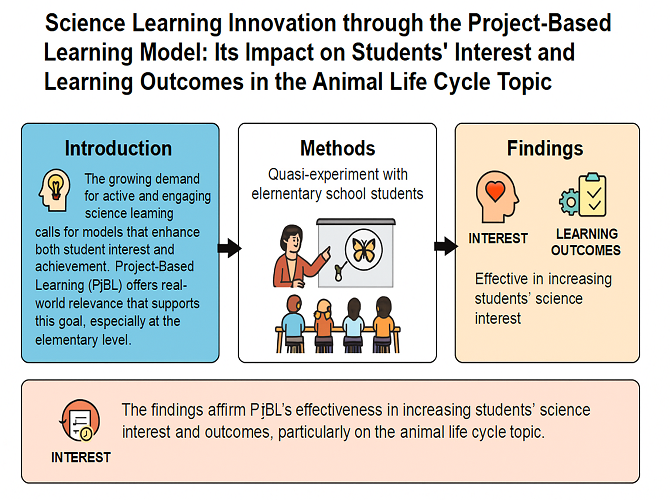
Project-Based Learning: A Catalyst for Enhancing Students' Interest and Science Learning Outcomes on Animal Life Cycles Topic
Abstract
Keywords
Full Text:
Download PDFReferences
Aifah, D. N., & Astriani, D. (2024). Project based learning model (PjBL) to improve collaboration skills and student cognitive learning results. Pensa E-Jurnal : Pendidikan Sains, 12(1), 20–25.
Almulla, M. A. (2020). The effectiveness of the project-based learning (PBL) approach as a way to engage students in learning. SAGE Open, 10(3). doi:10.1177/2158244020938702
Azrai, E. P., Heryanti, E., Ramadhani, V., & Ilyas, M. (2024). Enhancing students’ pro-environmental behavior through project-based learning. Biosfer, 17(2), 317–325. doi:10.21009/biosferjpb.28352
Djemari, M. (2008). Teknik penyusunan instrumen tes dan nontes [Techniques for constructing test and non-test instruments]. Yogyakarta: Mitra Cendikia Press.
Espino-Díaz, L., Luque-González, R., Fernández-Caminero, G., & Álvarez-Castillo, J.-L. (2025). Exploring the impact of project-based learning on sustainable development goals awareness and university students’ growth. European Journal of Educational Research, 14(1), 283–296. doi:10.12973/eu-jer.14.1.283
Fauzy, A. (2019). Metode sampling [Sampling method]. Tangerang Selatan: Universitas Terbuka.
Field, A. (2013). Discovering statistics using SPSS (4th ed.). London, UK: SAGE.
Gastwirth, J. L., Gel, Y. R., & Miao, W. (2009). The impact of Levene’s test of equality of variances on statistical theory and practice. Statistical Science, 24(3), 343–360. doi:10.1214/09-STS301
Hartati, R. (2016). Peningkatan aspek sikap literasi sains siswa SMP melalui penerapan model problem based learning pada pembelajaran IPA terpadu [Improving the scientific literacy attitude aspect of junior high school students through the application of the problem-based learning model in integrated science learning]. Edusains, 8(1), 90–97. doi:10.15408/es.v8i1.1796
Hasan, K., & Juhannis, H. (2024). Religious education and moderation: A bibliometric analysis. Cogent Education, 11(1). doi:10.1080/2331186X.2023.2292885
Hasim, D. A. (2022). Pengaruh kedisiplinan dan minat belajar terhadap hasil belajar ilmu pengetahuan alam siswa SMPN 9 Kendari [The influence of discipline and learning interest on the science learning outcomes of students at SMPN 9 Kendari] (Tesis tidak dipublikasikan). Institut Agama Islam Negeri Kendari, Kendari, Indonesia.
Hwang, R. H., Wu, J. J., Hsiung, P. A., & Lai, C. F. (2016, September). Design and implementation of a learning platform for a computer science capstone course based on project-based learning and creative thinking. Makalah dipresentasikan pada 44th Annual Conference of the European Society for Engineering Education - Engineering Education on Top of the World: Industry-University Cooperation, SEFI 2016.
Jirout, J. J., Zumbrunn, S., Evans, N. S., & Vitiello, V. E. (2022). Development and testing of the curiosity in classrooms framework and coding protocol. Frontiers in Psychology, 13, 1–14. doi:10.3389/fpsyg.2022.875161
López, J. A., & Palacios, F. J. P. (2024). Effects of a project-based learning methodology on environmental awareness of secondary school students. International Journal of Instruction, 17(1), 1–22. doi:10.29333/iji.2024.1711a
Markula, A., & Aksela, M. (2022). The key characteristics of project-based learning: how teachers implement projects in K-12 science education. Disciplinary and Interdisciplinary Science Education Research, 4(2), 1–17. doi:10.1186/s43031-021-00042-x
Meier, R. M., & Hendel, S. A. (2019). A project-based learning unit plan: An inquiry into frogs. Open Journal of Social Sciences, 07(11), 70–78. doi:10.4236/jss.2019.711006
Muzria, W., & Indrawati, T. (2020). Pengaruh model project based learning terhadap hasil belajar siswa pada pembelajaran tematik terpadu sekolah dasar [The effect of the project-based learning model on student learning outcomes in integrated thematic learning in elementary school]. Jurnal Pendidikan Tambusai, 4(3), 2232–2238.
Ningsih, R. I., Wijayanti, R. R., & Affaf, M. (2022). The effect of the use of project based learning models and flip based e-modules on statistics materials on students’ interest and learning outcomes of class XI TKJ students at SMK Ifadah. Journal of Etika Demokrasi, 7(2), 341–349.
Pratiwi, D. T., Zahratunnisa, F., & Rahmawan, S. (2025). The impact of project-based learning ( PjBL ) on students ’ motivation and learning outcomes : A literature review. ASEAN Journal for Science Education, 4(1), 53–58. Diperoleh dari https://ejournal.bumipublikasinusantara.id/index.php/ajsed/article/view/607
Purnomo, H., & Ilyas, Y. (2019). Tutorial pembelajaran berbasis proyek [Project-based learning tutorial]. Yogyakarta: K-Media.
Rehman, N., Huang, X., Mahmood, A., AlGerafi, M. A. M., & Javed, S. (2024). Project-based learning as a catalyst for 21st-Century skills and student engagement in the math classroom. Heliyon, 10(23), e39988. doi:10.1016/j.heliyon.2024.e39988
Santos, C., Rybska, E., Klichowski, M., Jankowiak, B., Jaskulska, S., Domingues, N., . . . Rocha, J. (2023). Science education through project-based learning: A case study. Procedia Computer Science, 219, 1713–1720. doi:10.1016/j.procs.2023.01.465
Schilhab, T. (2021). Nature experiences in science education in school: Review featuring learning gains, investments, and costs in view of embodied cognition. Frontiers in Education, 6, 1–19. doi:10.3389/feduc.2021.739408
Sharpe, D., & Cribbie, R. A. (2023). Analysis of treatment-control pre-post-follow-up design data. The Quantitative Methods for Psychology, 19(1), 25–46. doi:10.20982/tqmp.19.1.p025
Slavin, R. E. (2009). Educational psychology: Theory and practice (9th ed.). Boston, MA: Pearson/Allyn and Bacon.
Supartin, S., Arbie, A., Buhungo, T. J., & Katili, S. (2023). Learning physics using a contextual teaching and learning approach to children with physical impairment. JIPF (Jurnal Ilmu Pendidikan Fisika), 8(3), 319. doi:10.26737/jipf.v8i3.4102
Susilowati, A. Y., Sayekti, I. C., & Eryani, R. (2021). Penerapan media realia untuk meningkatkan motivasi belajar siswa pada siswa sekolah dasar [Application of realia media to increase student learning motivation in elementary school students]. Jurnal Basicedu, 5(4), 2090–2096. doi:10.31004/basicedu.v5i4.1160
Tabachnick, B. G., & Fidell, L. S. (2013). Using multivariate statistics (6th ed.). Upper Saddle River, NJ: Pearson Education.
Taupik, R. P., & Fitria, Y. (2021). Pengaruh model pembelajaran project based learning terhadap pencapaian hasil belajar IPA siswa sekolah dasar [The effect of the project-based learning model on the science learning outcomes of elementary school students]. Jurnal Basicedu, 5(3), 1525–1531. doi:10.31004/basicedu.v5i3.958
Vega-Garzón, J. C., Robayo-Sánchez, L. N., Cruz-Maldonado, O. A., & Cortés-Vecino, J. A. (2022). Visualization technologies for learning and teaching veterinary acarology and entomology. Journal of Veterinary Medical Education, 49(2), 199–203. doi:10.3138/jvme-2020-0034
Vygotsky, L. S. (1978). Mind in society: The development of higher psychological processes. Cambridge, MA: Harvard University Press.
Xu, X., Shi, Z., Bos, N. A., & Wu, H. (2023). Student engagement and learning outcomes: an empirical study applying a four-dimensional framework. Medical Education Online, 28(1). doi:10.1080/10872981.2023.2268347
Zhang, L., Kirschner, P. A., Cobern, W. W., & Sweller, J. (2022). There is an evidence crisis in science educational policy. Educational Psychology Review, 34(2), 1157–1176. doi:10.1007/s10648-021-09646-1
Zhao, Y., & Wang, L. (2022). A case study of student development across project-based learning units in middle school chemistry. Disciplinary and Interdisciplinary Science Education Research, 4(1). doi:10.1186/s43031-021-00045-8
DOI: https://doi.org/10.17509/jsl.v8i3.83536
Refbacks
- There are currently no refbacks.

Copyright (c) 2025 Syarif Rizalia, Raehang Raehang, Rasmina Rasmina, Sulaiman Sulaiman

This work is licensed under a Creative Commons Attribution-ShareAlike 4.0 International License.


Jl. Dr. Setiabudhi 229 Bandung 40154, West Java, Indonesia