







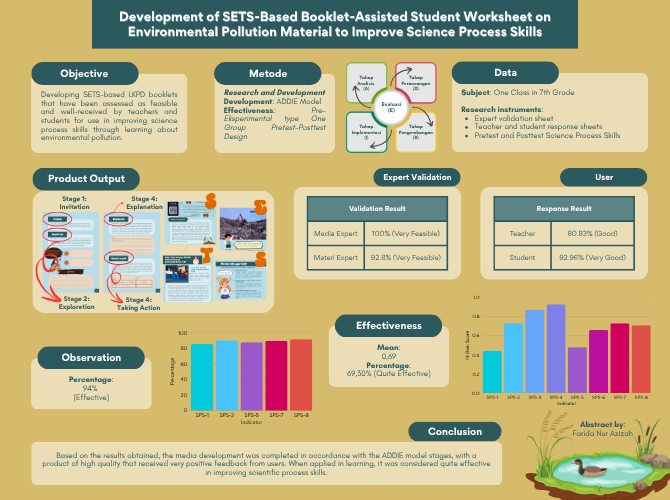
Development of SETS-Based Booklet-Assisted Student Worksheet on Environmental Pollution Material to Improve Science Process Skills
Abstract
Keywords
Full Text:
Download PDFReferences
AAAS. (1971). Science-A Process Approach: Product Development Report. Washington D.C.: Office of Program Planning and Evaluation.
Ango, M. L. (2002). Mastery of Science Process Skills and Their Effective Use in the Teaching of Science: An Educology of Science Education in the Nigerian Context. International Journal of Educology, 16(1), 11–30.
Apriyeni, O., Syamsurizal, S., Alberida, H., & Rahmi, Y. L. (2021). Validitas Booklet pada Materi Bakteri untuk Peserta Didik Kelas X SMA [The Validity of a Booklet on Bacteria Material for Grade X Senior High School Students]. Jurnal Edutech Undiksha, 9(1), 8–13. https://doi.org/10.23887/jeu.v9i1.33805
Azzahra, M. Z., Nawahdani, A. M., & Falani, I. (2024). The Relationship Between Science Process Skills and 21st Century Skills in Science Learning: Systematic Literature Review. EduFisika: Jurnal Pendidikan Fisika, 9(3), 297–305. https://doi.org/10.59052/edufisika.v9i3.38451
Branch, R. M. (2009). Instructional Design: The ADDIE Approach. New York: Springer Science Business Media.
Choirunnisa, N. L., Prabowo, P., & Suryanti, S. (2018). Improving Science Process Skills for Primary School Students through 5E Instructional Model-Based Learning. Journal of Physics: Conference Series, 947(1). https://doi.org/10.1088/1742-6596/947/1/012021
Darma, B. (2021). Statistika Penelitian Menggunakan SPSS [Research Statistics Using SPSS]. Jakarta: Guepedia.
Dass, P. M. (2005). Using a Science/Technology/Society Approach To Prepare Reform-Oriented Science Teachers: The Case of a Secondary Science Methods Course. Issues in Teacher Education, 14(1), 95–108.
Dewanti, B. A., Khikmah, R., Setyaningsih, S., & Septaria, K. (2024). Asesmen Keterampilan Proses Sains melalui LKPD Berbasis SETS : Studi pada Pembelajaran Pencemaran Lingkungan [Assessment of Science Process Skills through SETS-Based Student Worksheets: A Study on Environmental Pollution Learning]. Bioma: Jurnal Biologi Dan Pembelajaran Biologi, 9(2), 83–91. https://doi.org/10.32528/bioma.v9i2.2530
Dewi, P. R., Arnyana, I. B. P., & Maryam, S. (2020). Pengaruh Model Pembelajaran IPA Terpadu Bervisi Sets (Science Environment Technology And Society) Terhadap Hasil Belajar dan Sikap Ilmiah Siswa SMP [The Effect of the SETS (Science Environment Technology And Society) Vision Integrated Science Learning Model on Learning Outcomes and Scientific Attitudes of Junior High School Students]. Wahana Matematika Dan Sains: Jurnal Matematika, Sains, Dan Pembelajarannya, 14(2), 177–187. Retrieved from https://ejournal.undiksha.ac.id/index.php/JPM/article/view/18323
Fahmi, M., & Saleh, D. R. (2017). Kesesuaian Aspek Kebahasaan BSE Bahasa Indonesia SMP Terhadap Standar Isi [The Conformity of Linguistic Aspects of the Indonesian Electronic School Book for Junior High School with the Content Standards]. Linguista: Jurnal Ilmiah Bahasa, Sastra, Dan Pembelajarannya, 1(2), 79. https://doi.org/10.25273/linguista.v1i2.1976
Field, A. (2018). Discovering Statistics Using IBM SPSS Statistics (5th ed.). United Kingdom: SAGE Publication.
Fitra, J., & Maksum, H. (2021). Efektivitas Media Pembelajaran Interaktif dengan Aplikasi Powntoon pada Mata Pelajaran Bimbingan TIK [The Effectiveness of Interactive Learning Media with the Powtoon Application in ICT Guidance Subjects]. Jurnal Pedagogi Dan Pembelajaran, 4(1), 1. https://doi.org/10.23887/jp2.v4i1.31524
Fitriana, F., Kurniawati, Y., & Utami, L. (2019). Analisis Ketrampilan Proses Sains Peserta Didik Pada Materi Laju Reaksi Melalui Model Inquiry Labolatory [Analysis of Students' Science Process Skills on Reaction Rate Material Through the Inquiry Laboratory Model]. Jurnal Tadris Kimiya, 4(2), 226–236. doi: http://doi.org/10.15575/jtk.v4i2.5669
Fredy, Lieung, K. W., Butarbutar, R., & Duli, A. (2019). Science Process Skills in Learning Environmental Pollution using PBL Models. IOP Conference Series: Earth and Environmental Science, 343, 012179. https://doi.org/10.1088/1755-1315/343/1/012179
Gizaw, G. G., & Sota, S. S. (2023). Improving Science Process Skills of Students: A Review of Literature. Science Education International, 34(3), 216–224. https://doi.org/10.33828/sei.v34.i3.5
Hayati, I. A., Rosana, D., & Sukardiyono, S. (2019). Pengembangan Modul Potensi Lokal Berbasis SETS untuk Meningkatkan Keterampilan Proses IPA [Development of a SETS-Based Local Potential Module to Improve Science Process Skills]. Jurnal Inovasi Pendidikan IPA, 5(2), 248–257. Retrieved from https://journal.uny.ac.id/index.php/jipi/article/view/27519
Hunaepi, H., Samsuri, T., Asy’ari, M., & Roniati, S. (2014). Sains Teknologi Masyarakat: Strategi, Pendekatan dan Model Pembelajaran [Science Technology Society: Strategies, Approaches and Learning Models]. Lombok: Duta Pustaka Ilmu.
Ilmiyati, N., Maladona, A., Rahmawati, D., & Rahman, N. A. (2020). Effort To Facilitate Environmental Awareness Through Science, Environment, Technology, And Society (SETS). International Journal of Scientific and Technology Research, 9(3), 511–513.
Ismail, R. N., Arnawa, I. M., & Yerizon, Y. (2020). Student Worksheet Usage Effectiveness Based on Realistic Mathematics Education Toward Mathematical Communication Ability of Junior High School Student. Journal of Physics: Conference Series, 1554(1). https://doi.org/10.1088/1742-6596/1554/1/012044
Lestari, P. M., & Istiyono, E. (2025). Portrait of Observing, Inferring, and Predicting Skills of Junior High School Students. Jurnal Penelitian Pendidikan IPA, 11(2), 910–917. https://doi.org/10.29303/jppipa.v11i2.9681
Mahmudah, L. (2017). Pentingnya Pendekatan Keterampilan Proses Pada Pembelajaran IPA di Madrasah [The Importance of the Process Skills Approach in Science Learning in Madrasah]. Elementary: Islamic Teacher Journal, 4(1), 167–187. https://doi.org/10.21043/elementary.v4i1.2047
Mawardi, M. (2018). Designing the Implementation of Model and Instructional Media. Scholaria: Jurnal Pendidikan Dan Kebudayaan, 8(1), 26–40. https://doi.org/10.24246/j.js.2018.v8.i1.p26-40
Mushani, M. (2021). Science Process Skills in Science Education of Developed and Developing Countries: Literature Review. Unnes Science Education Journal, 10(1), 12–17. https://doi.org/10.15294/usej.v10i1.42153
Noprinda, C. T., & Soleh, S. M. (2019). Pengembangan Lembar Kerja Peserta Didik (LKPD) Berbasis Higher Order Thinking Skill (HOTS) [Development of Student Worksheets (LKPD) Based on Higher Order Thinking Skills (HOTS)]. Indonesian Journal of Science and Mathematics Education, 2(2), 168–176. https://doi.org/10.24042/ijsme.v2i2.4342
Novianti, P., & Syamsurizal, S. (2021). Booklet sebagai Suplemen Bahan Ajar pada Materi Kingdom Animalia untuk Peserta Didik Kelas X SMA/MA [Booklet as a Teaching Material Supplement on Kingdom Animalia for Grade X Senior High School/Madrasah Aliyah Students]. Jurnal Edutech Undiksha, 9(2), 225. https://doi.org/10.23887/jeu.v9i2.40438
Nugraini, A. R., Iswari, R. S., & Anggraito, Y. U. (2022). Development of SETS-Based Booklets to Improve Critical Thinking Skills and the Effectiveness of Biotechnology Learning in SMA/MA. Journal of Innovative Science Education, 11(3), 261–269. https://doi.org/10.15294/jise.v10i1.51437
OECD. (2017). PISA 2015 Assessment and Analytical Framework: Science, Reading, Mathematic, Financial Literacy and Collaborative Problem Solving: Revised Edition. Paris: PISA, OECD Publishing.
OECD. (2023). PISA 2022 Results Factsheets Indonesia. Paris: OECD Publishing.
Özgelen, S. (2012). Students’ Science Process Skills Within a Cognitive Domain Framework. Eurasia Journal of Mathematics, Science and Technology Education, 8(4), 283–292. https://doi.org/10.12973/eurasia.2012.846a
Pakaya, S. Y. C., Dama, L., Hamidun, M. S., Nusantari, E., Baderan, D. W. K., & Katili, A. S. (2023). Development of Problem-Based Learning Modules on Environmental Pollution Materials to Improve Student Learning Outcomes. Jurnal Penelitian Pendidikan IPA, 9(10), 7803–7809. https://doi.org/10.29303/jppipa.v9i10.4323
Pralisaputri, K. R., Heribertus, S., & Chatarina, M. (2016). Pengembangan Media Booklet Berbasis SETS Pada Materi Pokok Mitigasi Dan Adaptasi Bencana Alam Untuk Kelas X SMA [Development of a SETS-Based Booklet on Natural Disaster Mitigation and Adaptation for Grade X Senior High School]. Jurnal GeoEco, 2(2), 147–154.
Retno, R. S., & Marlina, D. (2018). Implementasi SETS (Science Environment Technology and Society) Pada Pembelajaran IPA SD Berbasis Inquiry Terhadap Berpikir Ilmiah Siswa Kelas 4 MI Al-Irsyad Madiun [The Implementation of SETS (Science Environment Technology and Society) in Inquiry-Based Elementary Science Learning on the Scientific Thinking of 4th Grade Students of MI Al-Irsyad Madiun]. Bio-Pedagogi, 7(2), 54. https://doi.org/10.20961/bio-pedagogi.v7i2.27618
Sahnaz, S., Harlita, H., & Ramli, M. (2018). Improving Observing Skills of High School Students through Guided Inquiry Model. International Journal of Pedagogy and Teacher Education, 2(1), 53. https://doi.org/10.20961/ijpte.v2i1.16608
Sarah, S., Khasanah, D. I., Maftukhin, A., Tantri, I. D., & Febriana, M. (2023). SETS-Based Physics Modules Integrated With Local Potentials to Improve Science Process Skills. Edusains, 15(1), 51–63. https://doi.org/10.15408/es.v15i1.29256
Sudibyo, E., Nurita, T., & Fauziah, A. N. M. (2018). Penggunaan Lembar Kerja Berorientasi Pendekatan Keterampilan Proses untuk Melatihkan Keterampilan Proses Sains Siswa SMP [The Use of Worksheets Oriented to the Process Skills Approach to Train Science Process Skills of Junior High School Students]. Jurnal Penelitian Pendidikan IPA, 3(1), 21. https://doi.org/10.26740/jppipa.v3n1.p21-26
Sugiyanto, R., Diplan, Afrom, I., Tinse, M., & Femmy. (2023). Pendampingan Penyusunan LKPD dan Soal HOTS untuk Guru Sekolah Dasar di SDN 2 Palangka Kota Palangkaraya [Assistance in Preparing Student Worksheets and HOTS Questions for Elementary School Teachers at SDN 2 Palangka, Palangkaraya City]. Community Development Journal: Jurnal Pengabdian Masyarakat, 4(2), 1109–1113.
Sugiyono, S. (2019). Metode Penelitian Kuantitatif, Kualitatif dan R&D [Quantitative, Qualitative, and R&D Research Methods]. Bandung: Penerbit Alfabeta.
Sukarelawan, M. I., Indratno, T. K., & Ayu, S. M. (2024). N-Gain vs Stacking: Analisis Perubahan Abilitas Peserta Didik dalam Desain One Group Pretest Posttest [N-Gain vs Stacking: Analysis of Changes in Students' Abilities in a One Group Pretest Posttest Design]. Penerbit Suryacahya.
Supriadi, G. (2021). Statistik Penelitian Pendidikan [Educational Research Statistics]. Yogyakarta: UNY Press.
Wahyuni, M. (2020). Statistik Deskriptif untuk Penelitian Olah Data Manual dan SPSS Versi 25 [Descriptive Statistics for Research with Manual Data Processing and SPSS Version 25]. Yogyakarta: Bintang Surya Madani.
Wild, C. F., Nietsche, E. A., Salbego, C., Teixeira, E., & Favero, N. B. (2019). Validation of Educational Booklet: An Educational Technology in Dengue Prevention. Revista Brasileira de Enfermagem, 72(5), 1318–1325. https://doi.org/10.1590/0034-7167-2018-0771
Yager, R. E. (Ed.). (1992). The Status of Science, Technology, Society: Reform Efforts Around the World: ICASE Yearbook 1992. Hongkong: International Council of Associations for Science Education.
Yörük, N., Morgil, I., & Seçken, N. (2010). The Effects of Science, Technology, Society, Environment (STSE) Interactions on Teaching Chemistry. Natural Science, 2(12), 1417–1424. https://doi.org/10.4236/ns.2010.212173
DOI: https://doi.org/10.17509/jsl.v8i3.86429
Refbacks
- There are currently no refbacks.

Copyright (c) 2025 Farida Nur Azizah Fitrianasari, Dian Nugraheni, Erti Hamimi, Indra Fardhani, Safwatun Nida

This work is licensed under a Creative Commons Attribution-ShareAlike 4.0 International License.


Jl. Dr. Setiabudhi 229 Bandung 40154, West Java, Indonesia