







Development of Biotic (Biology E-Comic) Audiovisual Media to Train Metacognitive Awareness and Cognitive Learning Outcomes
Abstract
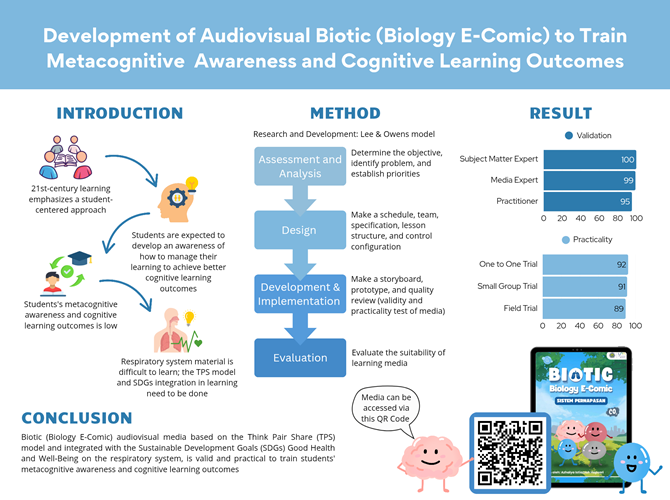
21st-century learning emphasizes a student-centered approach. Learners are expected to develop an awareness of how to manage their own learning and apply appropriate learning strategies, a concept called metacognitive awareness. Students with a high level of metacognitive awareness tend to achieve better cognitive learning outcomes. Therefore, there is a need for instructional media that can support the development of both metacognitive awareness and cognitive achievement. This study aims to develop a Biotic (Biology E-Comic) audiovisual media based on the Think Pair Share (TPS) model and integrated with the Sustainable Development Goals (SDGs) Good Health and Well-Being to train metacognitive awareness and cognitive learning outcomes on the respiratory system material for Grade 11 students (Phase F) at SMAN 1 Singosari. The research and development process adopted the Lee and Owens model, which consists of five stages: assessment and analysis, design, development, implementation, and evaluation. However, the implementation stage was not carried out in this study because the research conditions did not permit it; therefore, it focused solely on the validation and practicality of the media. The final product is a Biotic audiovisual media based on TPS integrated with SDGs, consisting of illustrated comic stories with voice-over dubbing for character dialogues. Validity tests from a subject matter expert, a media expert, and a Biology education practitioner showed an average result of 98.1%. Practicality tests based on the trial results yielded a practicality level of 90.8%. It can be concluded that Biotic audiovisual media are valid and practical to use.
Keywords
Full Text:
Download PDFReferences
Abdullah, R., & Soemantri, D. (2018). Validasi metacognitive awareness inventory pada pendidikan dokter tahap akademik. EJournal Kedokteran Indonesia, 6(1), 15–23. https://doi.org/10.23886/ejki.6.8621
Abrori, F. M., Lavicza, Z., & Cahyono, A. N. (2025). Socioscientific issues comics: A scoping literature review. Journal of Graphic Novels and Comics, 1–20. https://doi.org/10.1080/21504857.2024.2447311
Afriani, G., Soegiarto, I., Suyuti, S., Amarullah, A., & Aristanto, A. (2024). Transformasi guru sebagai fasilitator pembelajaran di era digital. Global Education Journal, 2(1), 91–99. https://doi.org/10.59525/gej.v2i1.332
Agada, A., & Sam-Kayode, C. O. (2022). Effect of audio-visual materials on students’ achievement in biological concepts in College of Education, Oyo. International Journal of Social Science and Education Research Studies, 2(5), 138–142. https://doi.org/10.55677/ijssers/V02I05Y2022-06
Aka, K. A. (2019). Integration Borg & Gall (1983) and Lee & Owen (2004) models as an alternative model of design-based research of interactive multimedia in elementary school. Journal of Physics: Conference Series, 1318(1), 12–22. https://doi.org/10.1088/1742-6596/1318/1/012022
Aka, K. A., Akbar, S., & Sahertian, J. (2018). Development of validation instrument for interactive multimedia learning implementation plan. Proceedings of the 1st International Conference on Early Childhood and Primary Education (ECPE 2018), 118–123. Paris, France: Atlantis Press. https://doi.org/10.2991/ecpe-18.2018.25
Akbar, S. (2013). Instrumen perangkat pembelajaran. Bandung: Remaja Ros.
Alt, D., & Raichel, N. (2020). Reflective journaling and metacognitive awareness: Insights from a longitudinal study in higher education. Reflective Practice, 21(2), 145–158. https://doi.org/10.1080/14623943.2020.1716708
Amalia, D. R. K., Indrowati, M., & Oetomo, D. (2022). Pengembangan media pembelajaran berbasis e-comic pada materi sistem respirasi untuk meningkatkan motivasi belajar siswa SMA [Development of e-comic based learning media on respiratory system material to increase high school students' learning motivation]. Proceeding Biology Education Conference, 19(1), 91–100. https://doi.org/10.31004/cendekia.v5i3.752
Amiyah, W., & Hardiana, M. T. A. N. (2024). Pengembangan e-modul berbasis Heyzine Flipbook pada pembelajaran menulis teks biografi kelas X [Development of Heyzine Flipbook-based e-modules for learning to write biographical texts for class X]. Media Didaktika, 10(2), 10–19. https://doi.org/10.52166/DIDAKTIKA.V10I2.7730
Anderson, L. W., Krathwohl, D. R., Airasian, P. W., Cruikshank, K. A., Mayer, R. E., Pintrich, P. R., … Wittrock, M. C. (2001). A taxonomy for learning, teaching, and assessing: A revision of Bloom’s taxonomy of educational objective. New York: Longman.
Apostolou, D., & Linardatos, G. (2023). Cognitive load approach to digital comics creation: A student-centered learning case. Applied Sciences 2023, Vol. 13, Page 7896, 13(13), 7896. https://doi.org/10.3390/APP13137896
Arends, R. I. (2012). Learning to teach, ninth edition. New York: McGraw-Hill Education.
Arikunto, S. (2013). Prosedur penelitian: suatu pendekatan praktik. Jakarta: Rineka Cipta.
Arsyad, A. (2019). Media pembelajaran edisi revisi. Depok: PT Rajagarafindo Persada.
Asaidah, A. A., Mustofa, R. F., & Chaidir, D. M. (2022). Hubungan kesadaran metakognitif peserta didik dengan hasil belajar biologi [The relationship between students' metacognitive awareness and biology learning outcomes]. BIO-EDU: Jurnal Pendidikan Biologi, 7(1), 35–41. https://doi.org/10.32938/jbe.v7i1.1587
Astuti, F. N., Suranto, S., & Masykuri, M. (2020). The appropriateness of developing the media: Experts’ validation and students’ response of learning media based on augmented reality technology for natural science lesson. Journal of Physics: Conference Series, 1567(4), 1–6. https://doi.org/10.1088/1742-6596/1567/4/042023
Asysyura, F., Adnan, A., & Faisal, F. (2023). The effect of interactive multimedia on students’ cognitive learning outcomes on system materials. Biodidaktika : Jurnal Biologi Dan Pembelajarannya, 18(1), 9–23. https://doi.org/10.30870/biodidaktika.v18i1.17808
Baena-Morales, S., & Fröberg, A. (2023). Towards a more sustainable future: simple recommendations to integrate planetary health into education. The Lancet Planetary Health, 7(10), e868–e873. https://doi.org/10.1016/S2542-5196(23)00194-8
Bappenas. (2014). Kajian indikator Sustainable Development Goals (SDGs). Jakarta: Badan Pusat Statistik.
Berger, M., Michael, G., & Christoph, N. (2023). E-comics: Pictorial learning media to train students’ viewing skills. Journal Emerging Technologies in Education, 1(1), 14–25. https://doi.org/10.55849/JETE.V1I1.188
Boucher, M., Bach, B., Stoiber, C., Wang, Z., & Aigner, W. (2023). Educational data comics: What can comics do for education in visualization? IEEE VIS Workshop on Visualization Education, Literacy, and Activities, 34–40. Institute of Electrical and Electronics Engineers Inc. https://doi.org/10.1109/EDUVIS60792.2023.00012
Branch, R. M. (2009). Instructional design: The ADDIE approach. New York: Springer.
Carvalho, P. F., McLaughlin, E. A., & Koedinger, K. R. (2022). Varied practice testing is sssociated with better learning outcomes in self regulated online learning. Journal of Educational Psychology, 114(8), 1723–1742. https://doi.org/10.1037/edu0000754
Chinpakdee, M. (2022). Using learning journals to promote learner autonomy. ELT Journal, 76(4), 432–440. https://doi.org/10.1093/ELT/CCAB056
Choiriyah, H., & Hidayah, R. (2023). Validity of digital comics to train metacognitive skills on thermochemical materials. Hydrogen: Jurnal Kependidikan Kimia, 11(4), 401–411. https://doi.org/10.33394/hjkk.v11i4.8237
Çini, A., Järvelä, S., Dindar, M., & Malmberg, J. (2023). How multiple levels of metacognitive awareness operate in collaborative problem solving. Metacognition and Learning, 18(3), 891–922. https://doi.org/10.1007/S11409-023-09358-7
Cotiangco, E. N., Huraño, N. J., Sodoso, E. R., Sumagang, M. G., Jumaoas, J. J., Canoy, J., … Sanchez, J. M. (2024). Android-based audio-visual comics in enhancing conceptual understanding and motivation of chemistry concepts. Orbital: The Electronic Journal of Chemistry, 16(2), 125–135. https://doi.org/10.17807/ORBITAL.V16I2.19953
Daryanes, F., Darmadi, D., Fikri, K., Sayuti, I., Rusandi, M. A., & Situmorang, D. D. B. (2023). The development of articulate storyline interactive learning media based on case methods to train student’s problem-solving ability. Heliyon, 9(4), e15082. https://doi.org/10.1016/J.HELIYON.2023.E15082
Dewahrani, Y. R., Apriani, S. P., & Kurniati, T. H. (2023). Development of digital comics as learning media on bacteria. Biosfer: Jurnal Pendidikan Biologi, 16(1), 168–175. https://doi.org/10.21009/BIOSFERJPB.33001
Dewi, L. G. S., Jampel, I. N., & Wibawa, I. M. C. (2023). Reading Literacy Comics: Innovative learning media on the theme of energy and its changes. International Journal of Elementary Education, 7(3), 496–503. https://doi.org/10.23887/IJEE.V7I3.65314
Dhitya, G., & Setiyowati, A. J. (2024). Upaya meningkatkan motivasi belajar melalui bimbingan klasikal dengan media audio visual: Literatur review. Jurnal Pembelajaran, Bimbingan, Dan Pengelolaan Pendidikan, 4(7), 4–10. https://doi.org/10.17977/UM065.V4.I7.2024.4
Ediyani, M., Hayati, U., Salwa, S., Samsul, S., Nursiah, N., & Fauzi, M. B. (2020). Study on development of learning media. Budapest International Research and Critics Institute (BIRCI-Journal): Humanities and Social Sciences, 3(2), 1336–1342. https://doi.org/10.33258/birci.v3i2.989
Firdaus, Z., Zubaidah, S., & Munzil, M. (2024). Pengembangan Edugame pada materi sistem saraf untuk siswa SMA [Development of Edugames on the nervous system material for high school students]. Bioscientist : Jurnal Ilmiah Biologi, 12(1), 1472–1488. https://doi.org/10.33394/bioscientist.v12i1.11924
Forniawan, A., Pratiwi, P. Y., Destiana, D., Azahra, S. D., Fauziah, A., Serosero, R. H., … Novitasari, D. (2024). Biologi dasar. Sukoharjo: Penerbit Tahta Media. https://tahtamedia.co.id/index.php/issj/article/view/682
Golding, S., & Verrier, D. (2021). Teaching people to read comics: the impact of a visual literacy intervention on comprehension of educational comics. Journal of Graphic Novels and Comics, 12(5), 824–836. https://doi.org/10.1080/21504857.2020.1786419
Goren, D., & Kaya, E. (2023). How is students’ understanding of nature of science related with their metacognitive awareness? Science and Education, 32(5), 1471–1496. https://doi.org/10.1007/S11191-022-00381-9/TABLES/3
Haryana, M. R. A., Warsono, S., Achjari, D., & Nahartyo, E. (2022). Virtual reality learning media with innovative learning materials to enhance individual learning outcomes based on cognitive load theory. The International Journal of Management Education, 20(3), 100657. https://doi.org/10.1016/J.IJME.2022.100657
Hayati, N., Panjaitan, R. G. P., Tenriawaru, A. B., & Yixuan, D. (2025). Feasibility of electronic magazine learning media on the subtopic of abnormalities and disorders in the circulatory system for 11th-grade high school students. Journal of Science Learning, 8(1), 50–59. https://doi.org/10.17509/jsl.v7i3.73921
Hetharia, M., Corebima, A. D., & Gofur, A. (2024). Effect of reading strategies, questioning, answering combined with think pair share against metacognitive skills, cognitive learning outcomes and retention. BIOEDUPAT: Pattimura Journal of Biology and Learning, 4(2), 207–213. https://doi.org/10.30598/bioedupat.v4.i2.pp207-213
Hui, H. B., & Mahmud, M. S. (2023). Influence of game-based learning in mathematics education on the students’ cognitive and affective domain: A systematic review. Frontiers in Psychology, 14, 1105806. https://doi.org/10.3389/FPSYG.2023.1105806/BIBTEX
Husna, H., Nerita, S., & Safitri, E. (2023). Analysis of student difficulties in learning biology. Journal Of Biology Education Research (JBER), 4(1), 1–8. https://doi.org/10.55215/JBER.V4I1.5963
Indriyani, L., Ningsih, K., & Yuniarti, A. (2024). The effectiveness of character-based comic media on environmental conservation sub-material learning outcomes. Jurnal Penelitian Pendidikan IPA, 10(2), 506–515. https://doi.org/10.29303/JPPIPA.V10I2.6148
Kesuma, S. W., Sutarsyah, C., & Nurweni, A. (2024). Modifying the think pair share technique based on the metacognitive reading strategy to enhance students’ reading comprehension. International Journal of Current Science Research and Review, 7(8), 6144–6149. https://doi.org/10.47191/ijcsrr/v7-i8-27
Khairinaa, R., Wahyuningsih, D., & Khasanah, A. N. (2023). Relationship between critical thinking skills and metacognition awareness with learning outcomes in science learning. Jurnal Penelitian Pendidikan IPA, 9(5), 2305–2311. https://doi.org/10.29303/jppipa.v9i5.2140
Lang, G. (2018). Using learning journals to increase metacognition, motivation, and learning in computer information systems education. Information Systems Education Journal, 16(6), 39–47. https://isedj.org/2018-16/n6/ISEDJv16n6p39.htm
Lee, W. E., & Owens, D. L. (2004). Multimedia-based instructional design second edition. San Francisco: John Wiley & Sons.
Lestari, B. B., Nugraheni, N., Husain, F., Semarang, U. N., Tinggi, S., & Pati, T. (2024). Penerapan edukasi SDGS di lingkungan sekolah guna mendukung terwujudnya kesejahteraan pendidikan [Implementation of SDGs education in school environments to support the realization of educational welfare]. Jurnal Penelitian Ilmu-Ilmu Sosial, 1(10), 67–72. https://doi.org/10.5281/zenodo.11128176
Li, J., & Xue, E. (2023). Dynamic interaction between student learning behaviour and learning environment: Meta-analysis of student engagement and its influencing factors. Behavioral Sciences, 13(1), 59–74. https://doi.org/10.3390/bs13010059
Liu, F., Wang, X., & Izadpanah, S. (2023). The comparison of the efficiency of the lecture method and flipped classroom instruction method on EFL students’ academic passion and responsibility. SAGE Open, 13(2), 1–15. https://doi.org/10.1177/21582440231174355
Lubis, L. H., Febriani, B., Yana, R. F., Azhar, A., & Darajat, M. (2023). The use of learning media and its effect on improving the quality of student learning outcomes. International Journal Of Education, Social Studies, And Management (IJESSM), 3(2), 7–14. https://doi.org/10.52121/IJESSM.V3I2.148
Maharani, H. R., Ubaidah, N., Basir, M. A., Wijayanti, D., Kusmaryono, I., & Aminudin, M. (2022). Pengembangan profesionalisme guru melalui pelatihan komik digital dengan canva for education [Developing teacher professionalism through digital comic training with Canva for Education]. Dinamisia : Jurnal Pengabdian Kepada Masyarakat, 6(3), 760–768. https://doi.org/10.31849/dinamisia.v6i3.10084
Makiaway, J., Raganas, S. E., Serbo, D. N., & Acuña, A. (2024). A glimpse of my progress: Exploring reflective journaling as an innovation to enhance metacognitive skills, motivation, and acceptability of learners. Journal of Arts, Humanities and Social Science, 1(2), 19–27. https://doi.org/10.69739/jahss.v1i2.104
Mariati, S. L. (2024). The influence of interactive learning media on students’ learning interest in biology subjects in junior high schools. International Journal of Curriculum Development, Teaching and Learning Innovation, 2(3), 127–135. https://doi.org/10.35335/CURRICULUM.V2I3.189
Negi, S. K., Rajkumari, Y., & Rana, M. (2022). A deep dive into metacognition: Insightful tool for moral reasoning and emotional maturity. Neuroscience Informatics, 2(4), 100096. https://doi.org/10.1016/J.NEURI.2022.100096
Nurhalimah, D., & Azzahra, D. T. (2023). The impact of learning media on students’ development in learning. International Journal of Students Education, 1(2), 264–266. https://doi.org/10.62966/IJOSE.V1I2.426
Nurilyasari, D. F., & Sundaygara, C. (2023). Peningkatan motivasi dan hasil belajar kognitif peserta didik dengan model discovery learning berbasis Live Worksheet pada pembelajaran fisika [Improving students' motivation and cognitive learning outcomes with the Live Worksheet-based discovery learning model in physics learning]. Jurnal Terapan Sains & Teknologi, 5(2), 153–162. https://doi.org/10.21067/jtst.v5i2.8808
Nurlaika, F., Sahade, S., & Rijal, A. (2024). The effect of cooperative learning model type Think Pair Share (TPS) on student learning outcomes. Golden Ratio of Data in Summary, 4(2), 641–653. https://doi.org/10.52970/GRDIS.V4I2.648
Nurmala, Nurlambang, T., Sukada, S., & Ayu, R. (2023). Buku saku SDGs. Jakarta Pusat: Filantropi Indonesia.
Nurmi, N., Susilo, H., Ibrohim, I., & Suhadi, S. (2024). Development of metacognitive skills on the implementation of EAQD-PC models-learning journals in biology learning. JPBI (Jurnal Pendidikan Biologi Indonesia), 10(2), 430–440. htt
DOI: https://doi.org/10.17509/jsl.v8i3.83754
Refbacks
- There are currently no refbacks.

Copyright (c) 2025 Azhalya Istiazzah Hapsari, Mimien Henie Irawati Muhdhar, Deny Setiawan, I Wayan Sumberartha, Ajeng Daniarsih, Wachidatul Linda Yuhanna, Zainal Fanani

This work is licensed under a Creative Commons Attribution-ShareAlike 4.0 International License.


Jl. Dr. Setiabudhi 229 Bandung 40154, West Java, Indonesia