







Are Students' Image of Scientists Affected by Parent and Teacher Factors? A Study on the Contextual Relationship between Students, Teachers, and Parents
Abstract
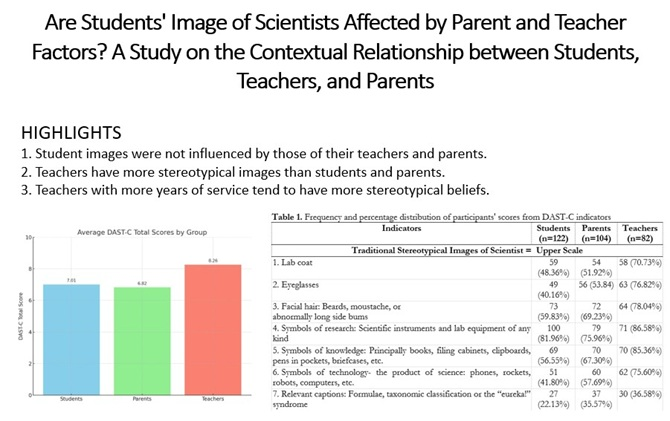
For more than half a century, research has been carried out on the image of scientists. The media, textbooks, teachers, parents, and peer influence were assumed to be the basis of the stereotypical image. Empirical evidence regarding teachers' and parents' perceptions of scientists remains insufficient. This study investigated whether teachers’ and parents’ image of scientists affects the students’ image. Participants consisted of students in the 8-11 age group (n = 122), along with parents (n=104) and teachers (n = 82). Drawings collected via the Draw-a-Scientist Test (DAST) were analysed by the Draw-a-Scientist Test Checklist (DAST-C). The results showed that teachers and parents had no significant effect on students' image of scientists. Therefore, the theoretical underpinnings pointing to the origins of the stereotypical image of scientists were not supported in the study.
Keywords
Full Text:
Download PDFReferences
Alkış Küçükaydın, M. (2018). An action research on the scientist image of 4th-grade students. Asia-Pacific Forum on Science Learning and Teaching, 19(1), 1–22.
Archer, L., Dawson, E., DeWitt, J., Seakins, A., & Wong, B. (2015). “Science capital”: A conceptual, methodological, and empirical argument for extending bourdieusian notions of capital beyond the arts. Journal of Research in Science Teaching, 52(7), 922-948.
Aschbacher, P. R., Li, E., & Roth, E. J. (2010). Is science me? High school students' identities, participation and aspirations in science, engineering, and medicine. Journal of Research in Science Teaching: The Official Journal of the National Association for Research in Science Teaching, 47(5), 564-582.
Ateş, Ö., Ateş, A.M.,& Aladağ, Y.(2021). Perceptions of students and teachers participating in a science festival regarding science and scientists. Research in Science & Technological Education, 39(1), 109-130.
Avraamidou, L. (2013). Superheroes and supervillains: Reconstructing the mad-scientist stereotype in school science. Research in Science & Technology Education, 31(1), 90–115.
Beardslee, D. C., & O'Dowd, D. D. (1961). The college-student image of the scientist. Science, 133(3457), 997-1001.
Bandura, A. (1986). Social foundations of thought and action: A social cognitive theory. Prentice-Hall.Bandura, A. (1997). Self-efficacy: The exercise of control. W.H. Freeman.
Bovina, I. B., & Dragul'skaia, L. I. (2008). College students' representations of science and the scientist. Russian Education & Society, 50(1), 44-64.
Bozzato, P., Fabris, M.A., & Longobardi, C. (2021).Gender, stereotypes and grade level in the draw-a-scientist test in Italian schoolchildren. International Journal of Science Education, 43(16), 2640-2662.
Buldu, M. (2006). Young children’s perceptions of scientists: A preliminary study. Educational Research, 48(1), 121–132.
Cakmakci, G., Tosun, O., Turgut, S., Orenler, S., Sengul, K., & Top, G. (2011). Promoting an inclusive image of scientists among students: Towards research evidence-based practice. International Journal of Science and Mathematics Education, 9(3), 627-655.
Calabrese Barton, A.,Kang, H.,Tan, E.,O'Neill, T. B.,Bautista-Guerra, J., &Brecklin, C. (2013). Crafting a future in science: Tracing middle school girls’ identity work over time and space. American Educational Research Journal, 50(1), 37–75.
Chambers, D. W. (1983). Stereotypic images of the scientist: The draw-a-scientist test. Science Education, 67(2), 255-265.
Chang, H. Y., Lin, T. J., Lee, M. H., Lee, S. W. Y., Lin, T. C., Tan, A. L., & Tsai, C. C. (2020). A systematic review of trends and findings in research employing drawing assessment in science education. Studies in Science Education, 56(1), 77-110.
Christidou, V., Hatzinikita, V., & Samaras, G. (2012). The image of scientific researchers and their activity in Greek adolescents’ drawings. Public Understanding of Science, 21(5), 626–647.
Cohen, L., Manion, L., & Morrison, K. (2018). Research methods in education (8th ed.). Routledge
DeWitt, J., & Archer, L. (2015). Who aspires to a science career? A comparison of survey responses from primary and secondary school students. International Journal of Science Education, 37(13), 2170-2192.
DeWitt, J., Archer, L., Osborne, J., Dillon, J., Willis, B., & Wong, B. (2011). High aspirations but low progression: The science aspirations–careers paradox amongst minority ethnic students. International Journal of Science and Mathematics Education, 9(2), 243-271.
Emvalotis, A., & Koutsianou, A. (2018). Greek primary school students’ images of scientists and their work: has anything changed?. Research in Science & Technological Education, 36(1), 69–85.
Esen, S., Türkyılmaz, S., & Küçükaydın, M. A. (2022). Examining the effect of scientist biographies prepared by digital storytelling on primary school students’ image of the scientist. Pamukkale University Journal of Education, (55), 155-179.
Farland-Smith, D. (2012). Development and field test of the modified draw-a-scientist test and the draw-a-scientist rubric. School Science and Mathematics, 112(2), 109–116.
Ferguson, S. L., & Lezotte, S. M. (2020). Exploring the state of science stereotypes: Systematic review and meta-analysis of the Draw-A-Scientist Checklist. School Science and Mathematics, 120(1), 55–65.
Finson, K. D., Beaver, J. B., & Cramond, B. L. (1995). Development and field test of a checklist for the Draw-A-Scientist Test. School Science and Mathematics, 95(4), 195–205.
Finson, K.D. (2002). Drawing a scientist: What we do and do not know after fifty years of drawings. School Science and Mathematics, 102(7), 335–345.
Finson, K., & Pederson, J. (2011). What are visual data and what utility do they have in science education? Journal of Visual Literacy, 30, 66–85.
Fung, Y. Y. (2002). A comparative study of primary and secondary school students' images of scientists. Research in Science & Technological Education, 20(2), 199-213.
González, D., Mateu, A., Pons, E., & Domínguez, M. (2017). Women scientists as decor: the image of scientists in Spanish press pictures. Science Communication, 39(4), 535-547.
Green, S.B. & Salkind, N.J. (2005). Using SPSS for Windows and Macintosh: Analyzing and undestanding data (4th ed.). Pearson.
Hite, R. L., & White, J. (2022). Hispanic elementary students’ improved perceptions of science and scientists upon participation in an environmental science afterschool club. Applied Environmental Education & Communication, 21(1), 73-86.
Karacam, S., Bilir, V., & Danisman, S. (2021). The effect of the visiting-scientist approach supported by conceptual change activities on the images of the scientist. International Journal of Science Education, 43(2), 197-222.
Koren, P., & Bar, V. (2009). Pupils’ image of ‘the scientist’ among two communities in Israel: A comparative study. International Journal of Science Education, 31(18), 2485-2509.
Lederman, N., & Abd-El-Khalick, F. (1998). Avoiding de-natured science: Activities that promote understandings of the nature of science. In The nature of science in science education (pp. 83-126). Springer.
Losh, S. C., Wilke, R., & Pop, M. (2008). Some methodological issues with “draw a scientist tests” among young children. International Journal of Science Education, 30, 773–792.
Mead, M., & Metraux, R. (1957). Image of the scientist among high school students. Science, 126(3270), 384–390.
Meyer, C., Guenther, L., & Joubert, M. (2019). The Draw-A-Scientist Test in an African context: Comparing students’ (stereotypical) images of scientists across university faculties. Research in Science & Technological Education, 37(1), 1–14.
Miele, E. (2014). Using the Draw-a-Scientist Test for inquiry and evaluation. Journal of College Science Teaching, 43(4), 36–40.
Milford, T. M., & Tippett, C. D. (2013). Preservice teachers’ images of scientists: Do prior science experiences make a difference?. Journal of Science Teacher Education, 24(4), 745-762.
Miller, D. I., Nolla, K. M., Eagly, A. H., & Uttal, D. H. (2018). The development of children's gender-science stereotypes: A meta-analysis of 5 decades of US draw-a-scientist studies. Child Development, 89(6), 1943–1955.
Ministry of National Education (2018). Science teaching program (Primary and secondary schools 3, 4, 5, 6, 7 and 8th grades). State Printing House.
Posnanski, T. J. (2002). Professional development programs for elementary science teachers: An analysis of teacher self-efficacy beliefs and a professional development model. Journal of Science Teacher Education, 13(3), 189-220.
Rampal, A. (1992). Images of science a study of school and scientists: Teachers' views. i. characteristics of scientists. Science Education, 76(4), 415-436.
Rapp, D. N., & Kurby, C. A. (2008). The ‘ins’ and ‘outs’ of learning: Internal representations and external visualizations. In J. Gilbert, M. Reiner, & M. B. Nakhleh (Eds.), Visualization: Theory and practice in science education (pp. 29–52). Springer.
Reinisch, R., Krell, M., Hergert, S., Gogolin, S., & Krüger, D. (2017). Methodical challenges concerning the Draw-A-Scientist Test: A critical view about the assessment and evaluation of learners’ conceptions of scientists. International Journal of Science Education, 39(14), 1952-1975.
Schibeci, R. (2006). Student images of scientists: What are they? Do they matter? Teaching Science, 52(2), 12–16.
Sharma, R. A., & Honan, E. (2020). Fijian pre-service teachers’ ideas about science and scientists. Journal of Science Teacher Education, 31(3), 335-357.
Song, J. W. (1993). Teachers' images of scientists and their respected scientists. Journal of the Korean Association for Science Education, 13(1), 48-55.
Steinke, J., Lapinski, M., Zietsman-Thomas, A., Nwulu, P., Crocker, N., Williams, Y., et al. (2007). Middle school-aged children’s attitudes toward women in science, engineering and technology and the effects of media literacy training. Journal of Women and Minorities in Science and Engineering, 12, 295-323.
Stuart, C., & Thurlow, D. (2000). Making it their own: Preservice teachers’ experiences, beliefs and classroom practice. Journal of Teacher Education, 51(2), 113–121.
Subramaniam, K., Esprívalo Harrell, P., & Wojnowski, D. (2013). Analyzing prospective teachers’ images of scientists using positive, negative and stereotypical images of scientists. Research in Science & Technological Education, 31(1), 66–89.
Symington, D., & Spurling, H. (1990). The ‘Draw a Scientist Test’: Interpreting the data. Research in Science & Technological Education, 8(1), 75-77.
Tabachnick, B. G., & Fidell, L. S. (2007). Using multivariate statistics (6th ed.). Pearson
Tan, A.-L., Jocz, J.A., & Zhai, J. (2015). Spiderman and science: How students’ perceptions of scientists are shaped by popular media. Public Understanding of Science, 26(5), 520–530.
Toma, R. B., Orozco-Gómez, M. L., Molano Niño, A. C., Obando-Correal, N. L., & Suárez Román, R. S. (2022). Testing assumptions of the Draw-a-Scientist-Test (DAST): do stereotyped views affect career aspirations?. International Journal of Science Education, DOI: 10.1080/09500693.2022.2126738
Türkmen, H. (2008). Turkish primary students’ perceptions about scientist and what factors affecting the image of the scientists. Eurasia Journal of Mathematics, Science and Technology Education, 4(1), 55-61.
Villar, P., & Guppy, N. (2015). Gendered science: Representational dynamics in British Columbia science textbooks over the last half century. Canadian Journal of Education/Revue canadienne de l'éducation, 38(3), 1-24.
Yacoubian, H. A., Al-Khatib, L., & Mardirossian, T. (2017). Analysis of the image of scientists portrayed in the Lebanese national science textbooks. Science & Education, 26(5), 513-528.9
DOI: https://doi.org/10.17509/jsl.v8i4.85077
Refbacks
- There are currently no refbacks.

Copyright (c) 2025 Menşure Alkış Küçükaydın

This work is licensed under a Creative Commons Attribution-ShareAlike 4.0 International License.


Jl. Dr. Setiabudhi 229 Bandung 40154, West Java, Indonesia