







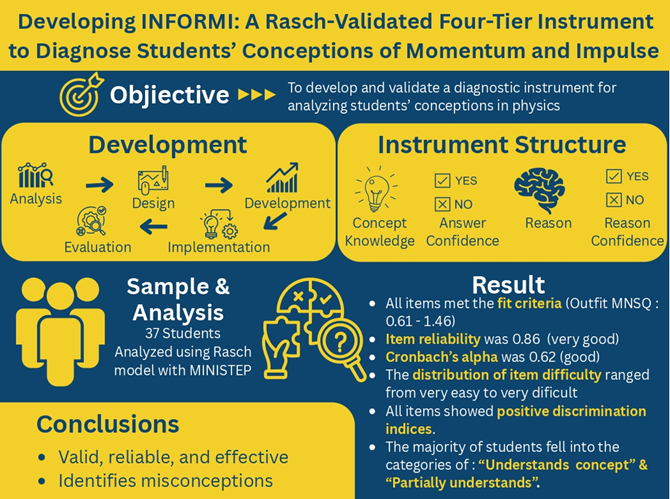
INFORMI: A Rasch-Validated Four-Tier Instrument to Diagnose Students’ Conceptions of Momentum and Impulse
Abstract
Keywords
Full Text:
Download PDFReferences
Adianto, T., & Rusli, M. A. (2021). Analysis of Student’s Difficulties in Solving Physics Problem: Impulse and Momentum Topics. Unnes Science Education Journal, 10(1), 24–33. https://doi.org/10.15294/usej.v10i1.41517
Adimayuda, R., Aminudin, A. H., Kaniawati, I., Suhendi, E., & Samsudin, A. (2020). A multitier open-ended momentum and impulse (MOMI) instrument: Developing and assessing quality of conception of 11th grade sundanese students with rasch analysis. International Journal of Scientific and Technology Research, 9(2), 4799–4804.
Akcanca, N., & Cerrah Özsevgeç, L. (2020). Effect on Academic Achievement and Misconceptions of Pre-service Teachers through Combining Different Teaching Methods in a Preschool Science Course. Journal of Science Learning, 4(1), 41–49. https://doi.org/10.17509/jsl.v4i1.24672
Amalia, S. A., Suhendi, E., Kaniawati, I., Samsudin, A., Fratiwi, N. J., Hidayat, S. R., Zulfikar, A., Sholihat, F. N., Jubaedah, D. S., Setyadin, A. H., Purwanto, M. G., Muhaimin, M. H., Bhakti, S. S., & Afif, N. F. (2019). Diagnosis of Student’s Misconception on Momentum and Impulse Trough Inquiry Learning with Computer Simulation (ILCS). Journal of Physics: Conference Series, 1204(1). https://doi.org/10.1088/1742-6596/1204/1/012073
Anandi, R. P., Sumintono, B., Zailaini, M. A., & Syafitri, R. (2024). Using Rasch Model to Assess the Foreign Language Speaking Anxiety Scale (FLSAS) Among University Students in Salatiga, Indonesia (Issue Proms 2023). Atlantis Press International BV. https://doi.org/10.2991/978-94-6463-494-5_6
Banawi, A., Sopandi, W., Kadarohman, A., & Solehuddin, M. (2022). Five-Tier Multiple-Choice Diagnostic Test Development: Empirical Evidences to Improve Students’ Science Literacy. Proceedings of the International Conference on Madrasah Reform 2021 (ICMR 2021), 633. https://doi.org/10.2991/assehr.k.220104.020
Bayuni, T. C., Sopandi, W., & Sujana, A. (2018). Identification misconception of primary school teacher education students in changes of matters using a five-tier diagnostic test. Journal of Physics: Conference Series, 1013(1). https://doi.org/10.1088/1742-6596/1013/1/012086
Ben-Abu, Y. (2019). The symmetrical energy and momentum principles in introductory university physics courses. Physics Education, 54(4). https://doi.org/10.1088/1361-6552/ab0e3a
Bond, T. G., & Fox, C. M. (2015). Applying the Rasch Model. In Applying the Rasch model: Fundamental Measurement in the Human Sciences. https://doi.org/10.1017/CBO9781107415324.004
Boone, W. J. (2020). Rasch basics for the novice. In Rasch Measurement: Applications in Quantitative Educational Research. https://doi.org/10.1007/978-981-15-1800-3_2
Çelikkanlı, N. Ö., & Kızılcık, H. Ş. (2022). A Review of Studies About Four-Tier Diagnostic Tests in Physics Education. Journal of Turkish Science Education, 19(4), 1291–1311. https://doi.org/10.36681/tused.2022.175
Crogman, H., Peters, R., & Trebeaucrogman, M. (2018). Probing Students Misconceptions results from Concept Inventory and Their Understanding in Science Learning. European J of Physics Education, 9(1), 1309–7202.
Diani, R., Anggraeni, Y. M., Fujiani, D., & Yuliani, E. (2023). The identification of senior high school students’ misconception on physics using the four-tier diagnostic test with certainty of response index. 020016. https://doi.org/10.1063/5.0123837
Diyanahesa, N. E.-H., Kusairi, S., & Latifah, E. (2017). Development of Misconception Diagnostic Test in Momentum and Impulse Using Isomorphic Problem. Journal of Physics: Theories and Applications, 1(2), 145. https://doi.org/10.20961/jphystheor-appl.v1i2.19314
Fang, N., & Guo, Y. (2023). Improving Student Learning of Impulse and Momentum in Particle Dynamics Through Computer Simulation and Animation. Journal of Educational Computing Research, 60(8), 1969–1990. https://doi.org/10.1177/07356331221096979
Fratiwi, N. J., Samsudin, A., Ramalis, T. R., & Costu, B. (2020). Changing students’ conceptions of Newton’s second law through express-refute-investigate-clarify (ERIC) text. Universal Journal of Educational Research, 8(6), 2701–2709. https://doi.org/10.13189/ujer.2020.080655
Grazziotin-Soares, R., Blue, C., Feraro, R., Tochor, K., Ardenghi, T. M., Curtis, D., & Ardenghi, D. M. (2021). The interrelationship between confidence and correctness in a multiple-choice assessment: pointing out misconceptions and assuring valuable questions. BDJ Open, 7(1). https://doi.org/10.1038/s41405-021-00067-4
Gurel, D. K., Eryilmaz, A., & McDermott, L. C. (2015). A review and comparison of diagnostic instruments to identify students’ misconceptions in science. Eurasia Journal of Mathematics, Science and Technology Education, 11(5), 989–1008. https://doi.org/10.12973/eurasia.2015.1369a
Hair, J. F. (2009). Multivariate data analysis.
Hayat, B., Putra, M. D. K., & Suryadi, B. (2020). Comparing item parameter estimates and fit statistics of the Rasch model from three different traditions. Jurnal Penelitian Dan Evaluasi Pendidikan, 24(1). https://doi.org/10.21831/pep.v24i1.29871
Istiyono, E. (2022). Diagnostic Tests as an Important Pillar in Today’s Physics Learning: Four-tier Diagnostic Test a Comprehensive Diagnostic Test Solution. Journal of Physics: Conference Series, 2392(1). https://doi.org/10.1088/1742-6596/2392/1/012001
Jung, H., Kim, Y. R., Lee, H., & Shin, Y. (2019). Advanced instructional design for successive E-learning: Based on the successive approximation model (SAM). International Journal on E-Learning: Corporate, Government, Healthcare, and Higher Education, 18(2), 191–204.
Kaltakci Gurel, D., Eryilmaz, A., & McDermott, L. C. (2015). A Review and Comparison of Diagnostic Instruments to Identify Students’ Misconceptions in Science. EURASIA Journal of Mathematics, Science and Technology Education, 11(5). https://doi.org/10.12973/eurasia.2015.1369a
Kaltakci-Gurel, D., Eryilmaz, A., & McDermott, L. C. (2017). Development and application of a four-tier test to assess pre-service physics teachers’ misconceptions about geometrical optics. Research in Science and Technological Education, 35(2), 238–260. https://doi.org/10.1080/02635143.2017.1310094
Kaniawati, I., Fratiwi, N. J., Danawan, A., Suyana, I., Samsudin, A., & Suhendi, E. (2019). Analyzing students’ misconceptions about Newton’s laws through four-tier Newtonian test ( FTNT ). Journal of Turkish Science Education, 16(1), 110–122. https://doi.org/10.12973/tused.10269a
Kaniawati, I., Rahmadani, S., Fratiwi, N. J., Suyana, I., Danawan, A., Samsudin, A., & Suhendi, E. (2020). An analysis of students’ misconceptions about the implementation of active learning of optics and photonics approach assisted by computer simulation. International Journal of Emerging Technologies in Learning, 15(9), 76–93. https://doi.org/10.3991/ijet.v15i09.12217
Kurniawan, M. A., Rahayu, S., Fajaroh, F., & Almuntasheri, S. (2020). Effectiveness of Dual Situated Learning Model in Improving High School Students’ Conceptions of Chemistry Equilibrium and Preventing Their misconceptions. Journal of Science Learning, 3(2), 99–105. https://doi.org/10.17509/jsl.v3i2.22277
Lassonde, K. A., Kendeou, P., & O’Brien, E. J. (2016). Refutation texts: Overcoming psychology misconceptions that are resistant to change. Scholarship of Teaching and Learning in Psychology, 2(1), 62–74. https://doi.org/10.1037/stl0000054
Liu, G., & Fang, N. (2016). Student misconceptions about force and acceleration in physics and engineering mechanics education. International Journal of Engineering Education, 32(1), 19–29.
Marthaliakirana, A. D., Suwono, H., Saefi, M., & Gofur, A. (2022). Problem-based learning with metacognitive prompts for enhancing argumentation and critical thinking of secondary school students. Eurasia Journal of Mathematics, Science and Technology Education, 18(9). https://doi.org/10.29333/ejmste/12304
Milenković, D. D., Hrin, T. N., Segedinac, M. D., & Horvat, S. (2016). Development of a Three-Tier Test as a Valid Diagnostic Tool for Identification of Misconceptions Related to Carbohydrates. Journal of Chemical Education, 93(9), 1514–1520. https://doi.org/10.1021/acs.jchemed.6b00261
Munfaridah, N., Avraamidou, L., & Goedhart, M. (2021). The Use of Multiple Representations in Undergraduate Physics Education: What Do we Know and Where Do we Go from Here? Eurasia Journal of Mathematics, Science and Technology Education, 17(1), 1–19. https://doi.org/10.29333/ejmste/9577
Nurdini, N., Suhandi, A., Ramalis, T., Samsudin, A., Fratiwi, N. J., & Costu, B. (2020). Developing Multitier Instrument of Fluids Concepts (MIFO) to Measure Student’s Conception: A Rasch Analysis Approach. Journal of Advanced Research in Dynamical and Control Systems, 12(6), 3069–3083. https://doi.org/10.5373/JARDCS/V12I6/S20201273
Ozdemir, E. (2022). Animated Concept Cartoons as a Starter for Cognitive Conflict in Online Science Learning: A Case of Circular Motion. Journal of Science Learning, 5(2), 242–249. https://doi.org/10.17509/jsl.v5i2.41191
Planinic, M., Boone, W. J., Susac, A., & Ivanjek, L. (2019). Rasch analysis in physics education research: Why measurement matters. Physical Review Physics Education Research, 15(2), 20111. https://doi.org/10.1103/PhysRevPhysEducRes.15.020111
Saat, R. M., Fadzil, H. M., Aziz, N. A. A., Haron, K., Rashid, K. A., & Shamsuar, N. R. (2016). Development of an online three-tier diagnostic test to assess pre-university students’ understanding of cellular respiration. Journal of Baltic Science Education, 15(4), 532–546. https://doi.org/10.33225/jbse/16.15.532
Sakinah, N., Amalia, I. F., & Adimayuda, R. (2023). Identifying senior high school students’ misconception on the momentum and impulse concepts uses three-tier diagnostic test. Research in Physics Education, 2(1), 18–25. https://doi.org/10.31980/ripe.v2i1.2377
Salas‐Pilco, S. Z., Yang, Y., & Zhang, Z. (2022). Student engagement in online learning in Latin American higher education during the COVID‐19 pandemic: A systematic review. … Journal of Educational …. https://doi.org/10.1111/bjet.13190
Samsudin, A., Azizah, N., Sasmita, D., Rasmitadila, Fatkhurrohman, M. A., Supriyatman, & Wibowo, F. C. (2020). Analyzing the students’ conceptual change on kinetic theory of gases as a learning effect though computer simulations-assisted conceptual change model. Universal Journal of Educational Research, 8(2), 425–437. https://doi.org/10.13189/ujer.2020.080213
Samsudin, A., Fratiwi, N. J., Ramalis, T. R., Aminudin, A. H., Costu, B., & Nurtanto, M. (2020). Using rasch analysis to develop multi-representation of tier instrument on newton’s law (motion). International Journal of Psychosocial Rehabilitation. https://doi.org/10.37200/IJPR/V24I6/PR260865
Setiani, A., Firmansyah, D., & Ramadhani, C. I. (2023). Analysis of Momentum and Impulse Misconceptions of College Students Using Four-Tier Diagnostic Tests. International Journal of Education and Teaching Zone, 2(3), 349–359. https://doi.org/10.57092/ijetz.v2i3.146
Spatioti, A. G., Kazanidis, I., & Pange, J. (2022). A Comparative Study of the ADDIE Instructional Design Model in Distance Education. In Information (Switzerland) (Vol. 13, Issue 9). https://doi.org/10.3390/info13090402
Sternberg, R. J. (2018). Context-Sensitive Cognitive and Educational Testing. In Educational Psychology Review (Vol. 30, Issue 3, pp. 857–884). https://doi.org/10.1007/s10648-017-9428-0
Sumintono, B. (2018). Rasch Model Measurements as Tools in Assesment for Learning. https://doi.org/10.2991/icei-17.2018.11
Taber, K. S. (2018). The Use of Cronbach’s Alpha When Developing and Reporting Research Instruments in Science Education. Research in Science Education, 48(6), 1273–1296. https://doi.org/10.1007/s11165-016-9602-2
Triyani, G., Danawan, A., Suyana, I., & Kaniawati, I. (2019). An investigation of students’ misconceptions about momentum and impulse through interactive conceptual Instruction (ICI) with computer simulation. Journal of Physics: Conference Series, 1280(5). https://doi.org/10.1088/1742-6596/1280/5/052008
Uccio, U. S. di, Colantonio, A., Galano, S., Marzoli, I., Trani, F., & Testa, I. (2019). Design and validation of a two-tier questionnaire on basic aspects in quantum mechanics. Physical Review Physics Education Research, 15(1). https://doi.org/10.1103/physrevphyseducres.15.010137
Wei, S., Liu, X., Wang, Z., & Wang, X. (2012). Using rasch measurement to develop a computer modeling-based instrument to assess students’ conceptual understanding of matter. Journal of Chemical Education, 89(3), 335–345. https://doi.org/10.1021/ed100852t
Wong, K. S., & Wong, H. (2022). Understanding the Law of Conservation of Momentum in One-Dimensional Collisions Between Two Objects Using the Velocity Space Approach. The Physics Teacher, 60(2), 94–96. https://doi.org/10.1119/5.0024603
Wu, M., Tian, P., Sun, D., Feng, D., & Luo, M. (2025). Evaluating Students’ Conceptual Understanding of Isomers Based on a Four-Tier Diagnostic Tool in Upper Secondary Schools. International Journal of Science and Mathematics Education, 23, 907–947.
Yang, D. C. (2022). Investigating the differences between confidence ratings in the answer and reason tiers in fourth graders via online four-tier test. Studies in Educational Evaluation, 72. https://doi.org/10.1016/j.stueduc.2022.101127
Zarepour, B., Soleimani, H., & Sanjari, M. (2024). Exploring Assessment Strategies Used to Promote Metacognitive Development in Science Education. Assessment and Practice in Educational Sciences, 2(2), 1–9.
DOI: https://doi.org/10.17509/jsl.v8i4.87805
Refbacks
- There are currently no refbacks.

Copyright (c) 2025 Shita Ayu Amalia, Dwi Sulisworo, Nuzulira Janeusse Fratiwi, Nurdini Nurdini, Hera Novia, Achmad Samsudin, Hadi Nasbey, Firmanul Catur Wibowo, Mustafa Sozbilir

This work is licensed under a Creative Commons Attribution-ShareAlike 4.0 International License.


Jl. Dr. Setiabudhi 229 Bandung 40154, West Java, Indonesia