







Enhancing Systems Thinking Through Outdoor Permaculture-Based Science Learning
Abstract
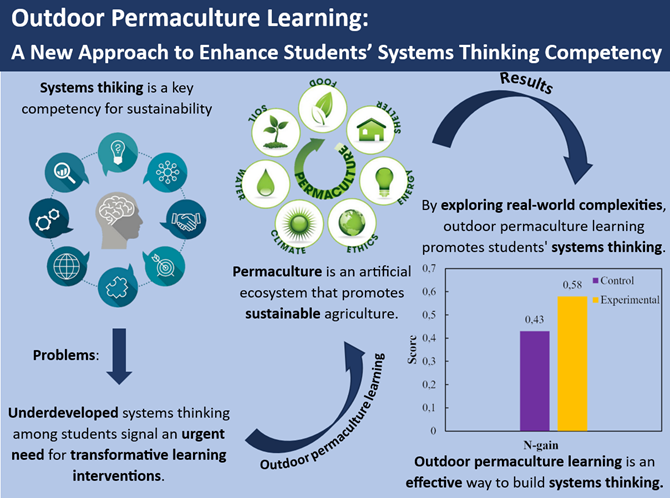
Systems thinking is a key competency for sustainability. It can help students to easily analyze complex matters. This study aims to investigate the students’ systems thinking improvement through outdoor permaculture learning. Permaculture is an artificial ecosystem that promotes sustainable agriculture. There are four learning stations within the permaculture including mini-garden, aquaponic, composting, and black soldier fly farm. This study used a quantitative research method with nonequivalent (pretest and posttest) control-group design. Students in control group followed the regular learning in the classroom. Meanwhile, the students in the experimental group followed the outdoor permaculture learning. The sample included 50 tenth-grade students from a high school in Bandung. Essay questions were used to assess students’ systems thinking, with item analysis confirming that the instrument was both valid and reliable. A statistical t-test showed a significant difference in students’ systems thinking improvement between the two groups (p = 0.01). The experimental group showed a better systems thinking competency improvement. In addition, Cohen’s d value (0.73) indicated a moderate effect size, reflecting a meaningful difference in the gains of systems thinking competency between the two groups. Based on the data, it can be concluded that outdoor permaculture learning is an effective way to enhance students’ systems thinking. This study offers a new perspective on using integrated learning stations in a permaculture setting to strengthen students' systems thinking and support sustainable learning practices in schools.
Keywords
Full Text:
Download PDFReferences
Alakendu, P. R., Afiya, R, S., Senthilkumar, S., & Manivannan, S. (2024). Permaculture : A Sustainable Farming Approach for Modern Era. Haya: The Saudi Journal of Life Sciences, 9(7), 305–312. https://doi.org/10.36348/sjls.2024.v09i07.009
Althouse, K. (2016). An Instructional Module on Permaculture Design Theory for Landscape Architecture Students [Utah State University]. https://digitalcommons.usu.edu/gradreports/793
Amissah, M., Gannon, T., & Monat, J. (2020). What is Systems Thinking? Expert Perspectives from the WPI Systems Thinking Colloquium of 2 October 2019. Systems, 8(1), 6. https://doi.org/10.3390/systems8010006
Aprilia, D., Dianti, Kirana, N. A., Agustina, P. C., Lia, K., Sarnp, Khairul, A. B. A. R., & Ahmad, D. S. (2022). Review: Biogeochemical Process in Mangrove Ecosystem. International Journal of Bonorowo Wetlands, 10(2), 126–141. https://doi.org/10.13057/bonorowo/w100205
Armenia, S., Tsaples, G., Papathanasiou, J., Barnabé, F., & Nazir, S. (2022). Systems Thinking as A Key Competence for Sustainable Development and Digital Transformation. ICERI2022 Proceedings, 1, 2006–2011. https://doi.org/10.21125/iceri.2022.0506
Arnold, R. D., & Wade, J. P. (2015). A Definition of Systems Thinking: A Systems Approach. Conference on Systems Engineering Research, 44, 669–678. https://doi.org/10.1016/j.procs.2015.03.050
Ayotte-Beaudet, J. P., Chastenay, P., Beaudry, M. C., L’Heureux, K., Giamellaro, M., Smith, J., Desjarlais, E., & Paquette, A. (2023). Exploring the Impacts of Contextualised Outdoor Science Education on Learning: The Case of Primary School Students Learning about Ecosystem Relationships. Journal of Biological Education, 57(2), 277–294. https://doi.org/10.1080/00219266.2021.1909634
Baharuddin, R. (2025, April). Analysis of students’systems thinking competency profile on ecosystem issues. In Proceeding International Conference of Sustainable Innovation (Vol. 1, pp. 190-194).
Behl, D. V., & Ferreira, S. (2014). Systems Thinking: An Analysis of Key Factors and Relationships. Procedia Computer Science, 36, 104–109. https://doi.org/10.1016/j.procs.2014.09.045
Creswell, J. W. (2014). Research desing: qualitative, quantitative and mixed methods approaches (Vol. 54). United State of America: Sage Publications.
Davis, A. C., & Stroink, M. L. (2016). The Relationship between Systems Thinking and the New Ecological Paradigm. Systems Research and Behavioral Science, 33(4), 575–586. https://doi.org/https://doi.org/10.1002/sres.2371
Demssie, Y. N., Biemans, H. J. A., & Wesselink, R. (2023). Fostering Students’ Systems Thinking Competence for Sustainability by Using Multiple Real-World Learning Approaches. Environmental Education Research, 29(2), 261–286. https://doi.org/10.1080/13504622.2022.2141692
Didarali, Z., & Gambiza, J. (2019). Permaculture: Challenges and Benefits in Improving Rural Livelihoods in South Africa and Zimbabwe. Sustainability, 11(8), 2219. https://doi.org/10.3390/su11082219
Fraenkel, J. R., Wallen, N., & Helen, H. H. (2023). How to Design and Evaluate Research in Education. In McGraw-Hill Higher Education (Eleventh Ed.). McGraw-Hill Education.
Gilissen, M. G. R., Knippels, M. C. P. J., & van Joolingen, W. R. (2020). Bringing Systems Thinking into the Classroom. International Journal of Science Education, 42(8), 1253–1280. https://doi.org/10.1080/09500693.2020.1755741
Hake, R. R. (1998). Interactive-Engagement Versus Traditional Methods: A Six-Thousand-Student Survey of Mechanics Test Data for Introductory Physics Courses. American Journal of Physics, 66(1), 64–74. https://doi.org/10.1119/1.18809
Johariah, J., Jalmo, T., & Lengkana, D. (2023). Pengembangan Instrumen Penilaian Untuk Mengukur Kemampuan Berpikir Sistem Siswa SMP Pada Materi Pencemaran Lingkungan [Development of an Assessment Instrument to Measure Junior High School Students' Systems Thinking Skills on Environmental Pollution Material]. JUPE : Jurnal Pendidikan Mandala, 8(1), 527. https://doi.org/10.58258/jupe.v8i1.5501
Junge, R., König, B., Villarroel, M., Komives, T., & Jijakli, M. H. (2017). Strategic Points in Aquaponics. Water (Switzerland), 9(3), 1–9. https://doi.org/10.3390/w9030182
Kourayem, F. T., & Ghadim, M. K. (2021). A Review of System Thinking and Wise Organization. New Applied Studies in Management, Economics & Accounting, 4(3), 7–23. https://doi.org/10.22034/nasmea.2021.176216
Krastanova, M., Sirakov, I., Ivanova-Kirilova, S., Yarkov, D., & Orozova, P. (2022). Aquaponic Systems: Biological and Technological Parameters. Biotechnology & Biotechnological Equipment, 36(1), 305–316. https://doi.org/10.1080/13102818.2022.2074892
Krebs, J., & Bach, S. (2018). Permaculture — Scientific Evidence of Principles for the Agroecological Design of Farming Systems. Sustainability, 10(3218), 1–24. https://doi.org/10.3390/su10093218
Kurnia, N., Baharuddin, R., Ngitung, R., & Auliah, A. (2018). Lalat Hijau Lucilia sericata sebagai Agen Biokonversi Sampah Organik: Pengamatan Siklus Hidup [Green Fly Lucilia sericata as an Agent for Bioconversion of Organic Waste: Observation of its Life Cycle].
Lankers, A., Timm, J., & Schmiemann, P. (2023). Students’ Systems Thinking while Modeling a Dynamic Ecological System. Frontiers in Education, 8(7), 1–14. https://doi.org/10.3389/feduc.2023.1187237
Ma, B., Stirling, E., Liu, Y., Zhao, K., Zhou, J., Singh, B. K., Tang, C., Dahlgren, R. A., & Xu, J. (2021). Soil Biogeochemical Cycle Couplings Inferred from a Function-Taxon Network. Research: A Science Paper Journal, 2021, 1–10. https://doi.org/10.34133/2021/7102769
Mambrey, S., Schreiber, N., & Philipp, S. (2022). Young Students’ Reasoning About Ecosystems: The Role of Systems Thinking, Knowledge, Conceptions, and Representation. Research in Science Education, 52, 79–98. https://doi.org/10.1007/s11165-020-09917-x
Mann, J., Gray, T., Truong, S., Brymer, E., Passy, R., Ho, S., Sahlberg, P., Ward, K., Bentsen, P., Curry, C., & Cowper, R. (2022). Getting Out of the Classroom and Into Nature: A Systematic Review of Nature-Specific Outdoor Learning on School Children’s Learning and Development. Frontiers in Public Health, 10(May). https://doi.org/10.3389/fpubh.2022.877058
Martín-Gámez, C., Acebal, M. del C., & Prieto, T. (2018). Developing The Concept of ‘Ecosystem’ Through Inquiry-Based Learning: A Study of Pre-Service Primary Teachers. Journal of Biological Education, 54(2), 147–161. https://doi.org/10.1080/00219266.2018.1554596
Mensah, J. (2019). Sustainable Development: Meaning, History, Principles, Pillars, and Implications for Human Action: Literature Review. Cogent Social Sciences, 5(1), 1–21. https://doi.org/10.1080/23311886.2019.1653531
Mulyadiprana, A., Hamdu, G., & Ade, Y. (2024). STEL (System Thinking and ESD Learning) Model: Developing Elementary School Students’ Systems Thinking Skills. Jurnal Kependidikan: Jurnal Hasil Penelitian Dan Kajian Kepustakaan Di Bidang Pendidikan, Pengajaran Dan Pembelajaran, 10(4), 1665–1674. https://doi.org/10.33394/jk.v10i4.12861
Nuraeni, R., Setiono, & Himatul, A. (2020). Profil Kemampuan Berpikir Sistem Siswa Kelas XI SMA pada Materi Sistem Pernapasan [Profile of Systems Thinking Ability of Grade XI High School Students on Respiratory System Material]. Pedagogi Hayati, 4(1), 1–9. https://doi.org/10.31629/ph.v4i1.2123
Odongo, E. E., Bbosa, W. K., & Kahunde, P. K. (2024). Black Soldier Fly (BSF): A Sustainable Solution for Protein, Waste Management, and a Circular Bio-Economy. European Journal of Theoretical and Applied Sciences, 2(3), 822–834. https://doi.org/10.59324/ejtas.2024.2(3).64
Omran, E. S. E., & Negm, A. (2020). Impacts of pesticides on soil and water resources in Algeria. In Water resources in Algeria-Part I: assessment of surface and groundwater resources (pp. 69-91). Cham: Springer International Publishing.
Pathak, V. M., Verma, V. K., Rawat, B. S., Kaur, B., Babu, N., Sharma, A., Dewali, S., Yadav, M., Kumari, R., Singh, S., Mohapatra, A., Pandey, V., Rana, N., & Cunill, J. M. (2022). Current Status of Pesticide Effects on Environment, Human Health and Its Eco-Friendly Management as Bioremediation: A Comprehensive Review. Frontiers in Microbiology, 13(August), 1–29. https://doi.org/10.3389/fmicb.2022.962619
Phan, T., Bertone, E., Neelamraju, C., Nguyen, N., & Quyet, T. (2024). A Systems Thinking Approach to Understand the Impacts of Pesticides on the Great Barrier Reef Ecosystems Under Climate Change. In Preprint (Vol. 11, Issue Cicc, pp. 76–84). https://doi.org/10.2139/ssrn.4683765
Purvis, B., Mao, Y., & Robinson, D. (2019). Three Pillars of Sustainability: in Search of Conceptual Origins. Sustainability Science, 14(3), 681–695. https://doi.org/10.1007/s11625-018-0627-5
Rains, S., & Whitworth, B. A. (2018). Building an Aquaponics System in the Classroom. In Better Way of Farming (pp. 41–45). Tiger Prints. https://tigerprints.clemson.edu/teach_learn_pub
Saefudin, Kusnadi, Suwandi, T., Najira, Baharuddin, R., & Rachman, H. T. (2025). Integration of Permaculture to Reinvent Students’ Interest in Nature and Environmental Awareness for Quality Education Under SDG-4. Jurnal Pendidikan IPA Indonesia, 14(1), 192–201. https://doi.org/10.15294/jpii.v14i1.22122
Seher, B. U., & Defne, C. G. (2024). Research Trends on Systems Thinking Approach in Science Education. International Journal of Science Education, 46(5), 485–502. https://doi.org/10.1080/09500693.2023.2245106
Semiz, G. K., & Teksöz, G. (2019). Developing the Systems Thinking Skills of Pre-Service Science Teachers through an Outdoor ESD Course. Journal of Adventure Education and Outdoor Learning, 20(4), 337–356. https://doi.org/10.1080/14729679.2019.1686038
Suyanto, S., Suratsih, S., Aprilisa, E., & Limiansi, K. (2022). Learning Biology Using Real Object, ICT, and Blended Learning to Improve Factual and Conceptual Knowledge. Jurnal Pendidikan IPA Indonesia, 11(2), 322–332. https://doi.org/10.15294/jpii.v11i2.33706
Tudi, M., Daniel Ruan, H., Wang, L., Lyu, J., Sadler, R., Connell, D., Chu, C., & Phung, D. T. (2021). Agriculture Development, Pesticide Application and Its Impact on the Environment. International Journal of Environmental Research and Public Health, 18(3), 1112. https://doi.org/10.3390/ijerph18031112
UNESCO. (2017). Education for Sustainable Development Goals. United Nations Educational, Scientific and Cultural Organization.
Vachliotis, T., Salta, K., & Tzougraki, C. (2021). Developing Basic Systems Thinking Skills for Deeper Understanding of Chemistry Concepts in High School Students. Thinking Skills and Creativity, 41(May), 100881. https://doi.org/10.1016/j.tsc.2021.100881
Valentini, M., & Donatiello, P. (2021). Outdoor Education as a Way of Life. Journal of Physical Education and Sport, 21(1), 618–623. https://doi.org/10.7752/jpes.2021.s1072
Voulvoulis, N., Giakoumis, T., Hunt, C., Kioupi, V., Petrou, N., Souliotis, I., Vaghela, C., & binti Wan Rosely, W. (2022). Systems Thinking as a Paradigm Shift for Sustainability Transformation. Global Environmental Change, 75(May), 102544. https://doi.org/10.1016/j.gloenvcha.2022.102544
Wongkiew, S., Hu, Z., Chandran, K., Lee, J. W., & Khanal, S. K. (2017). Nitrogen Transformations in Aquaponic Systems: A Review. Aquacultural Engineering, 76, 9–19. https://doi.org/10.1016/j.aquaeng.2017.01.004
Yin, J., Xie, M., Yu, X., Feng, H., Wang, M., Zhang, Y., & Chen, T. (2024). A Review of The Definition, Influencing Factors, and Mechanisms of Rapid Composting of Organic Waste. Environmental Pollution, 342, 123125. https://doi.org/10.1016/j.envpol.2023.123125
Zidan, Z., Maftuhah, M., Yusti, D., Rahmat, A. A. R., Riandi, R., & Kusnadi, K. (2023). Learning Strategies on Ecosystem Concepts and Environmental Change: A Pedagogical Study Analysis. Assimilation: Indonesian Journal of Biology Education, 6(2), 141–152. https://doi.org/10.17509/aijbe.v6i2.59777
DOI: https://doi.org/10.17509/jsl.v8i3.83486
Refbacks

Copyright (c) 2025 Saefudin Saefudin, Kusnadi Kusnadi, Rahmat Baharuddin, Najira Najira, Zuliande Zidan, Khairil Asnan Khaedar

This work is licensed under a Creative Commons Attribution-ShareAlike 4.0 International License.


Jl. Dr. Setiabudhi 229 Bandung 40154, West Java, Indonesia