







The Effect of TaRL Approach based on Process Differentiation on Problem-Solving Ability
Abstract
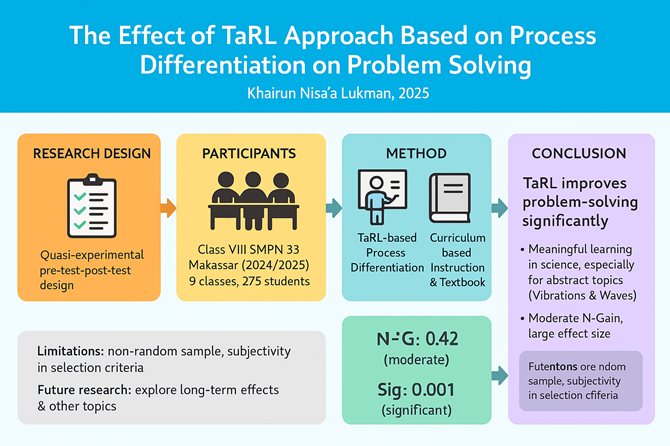
This study aims to evaluate the impact of the Teaching at Right Level (TaRL) approach based on process differentiation on the problem-solving abilities of eighth-grade students at UPT SPF SMPN 33 Makassar, focusing on the core topic of Vibrations and Waves. The research employs a quasi-experimental design with a pretest-posttest framework. Data collection was conducted using a problem-solving ability test instrument. The results indicated that prior to implementing the TaRL approach, the average score for students' problem-solving abilities was 32.33, classified as sufficient. Following the implementation, the average score is 65.77, which falls into the good category. This improvement reflects an N-Gain of 0.49, indicate a moderate increase. Additionally, the hypothesis test revealed a significance level of 0.001, which is less than 0.05, confirming that the hypothesis is accepted. The effect size calculation yielded a value of 0.862, categorizing it as a large effect size.
Keywords
Full Text:
Download PDFReferences
Adhyan, A. R., & Sutirna, S. (2022). Kemampuan Pemecahan Masalah Matematis Siswa Mts Pada Materi Himpunan [Mathematical Problem Solving Ability of Mts Students on Set Material]. JPMI (Jurnal Pembelajaran Matematika Inovatif), 5(2), 451. https://doi.org/10.22460/jpmi.v5i2.10289
Ahyar. (2022). Implementasi Model Pembelajaran TaRL dalam Meningkatkan Dasar Membaca Peserta Didik di Sekolah Dasar Kelas Awal [Implementation of the TaRL Learning Model in Improving the Reading Skills of Students in Early Grade Elementary Schools]. JIIP (Jurnal Ilmiah Ilmu Pendidikan), 5(11), 5241–5246.
Amir, M. F. (2015, October). Pengaruh pembelajaran kontekstual terhadap kemampuan pemecahan masalah matematika siswa sekolah dasar [The influence of contextual learning on elementary school students' mathematical problem-solving abilities]. In Prosiding Seminar Nasional Pendidikan (pp. 34-42).
Amri, M. S., & Abadi, A. (2013). Pengaruh PMR dengan TGT terhadap motivasi, sikap, dan kemampuan pemecahan masalah geometri kelas VII SMP [The influence of PMR with TGT on the motivation, attitude, and problem-solving abilities of grade VII junior high school geometry students]. PYTHAGORAS: Jurnal Pendidikan Matematika, 8(1), 55–68.
Apriliyani, R., Rhomdani, R. W., & Ariyanto, S. T. (2025). Peningkatan Kemampuan Pemahaman Konsep Matematis Siswa Melalui Model PBL Dengan Pendekatan TaRL Pada Materi Bentuk Akar [Improving Students' Mathematical Concept Understanding Ability Through the PBL Model with the TaRL Approach on Root Form Material]. Tirtamath: Jurnal Penelitian dan Pengajaran Matematika, 7(1), 62-72.
Banerjee, A., Banerji, R., Berry, J., Duflo, E., Kannan, H., Mukerji, S., Shotland, M., & Walton, M. (2017). From proof of concept to scalable policies: Challenges and solutions, with an application. Journal of Economics, 31(4), 73–102.
Banerji, R., & Chavan, M. (2016). Improving literacy and math instruction at scale in India’s primary schools: The case of Pratham’s Read India program. Journal of Educational Change, 17(4), 453–473.
Chang, M. C., Shaeffer, S., Al-Samarrai, S., Ragatz, A. B., De Ree, J., & Stevenson, R. (2014). Teacher reform in Indonesia: The role of politics and evidence in policy making. The World Bank.
Chen, X., Yu, G., Cheng, G., & Hao, T. (2019). Research topics, author profiles, and collaboration networks in the top-ranked journal on educational technology over the past 40 years: a bibliometric analysis. Journal of Computers in Education, 6(4).
Damianti, D., & Afriansyah, E. A. (2022). Analisis Kemampuan Pemecahan Masalah Matematis dan Self-Efficacy Siswa SMP [Analysis of Mathematical Problem-Solving Ability and Self-Efficacy of Junior High School Students]. INSPIRAMATIKA, 8(1).
Eccles, J. S., & Roeser, R. W. (2011). Schools as developmental contexts during adolescence. Journal of research on adolescence, 21(1), 225-241.
Elita, G. S., Habibi, M., Putra, A., & Ulandari, N. (2019). Pengaruh pembelajaran problem based learning dengan pendekatan metakognisi terhadap kemampuan pemecahan masalah matematis. Mosharafa: Jurnal Pendidikan Matematika, 8(3), 447-458.
Fraenkel, J. R., Wallen, N. E., & Hyun, H. H. (2012). How to design and evaluate research In educatIon (8th ed.). Mc Graw HIll.
Gay, G. (2018). Culturally responsive teaching: Theory, research, and practice (3rd ed.). Teachers College Press.
Geel, M. V., Trynke, K., Jimmy, F., Diana, D., Jeroen,, V. M., & Andrie, J., V. (2019). Capturing the Complexity of Differentiated Instruction. School Effectiveness and School Improvement, 30(1), 51–67.
Gustine, G. G., & Insawan, R. (2019). Implementation of teaching at the right level program at sekolah menerngah pertama in Indonesia. JRAMath, 2(1), 13–22.
Hamzah, A. (2014). Evaluasi Pembelajaran Matematika. Rajawali Press.
Iraka, J. R., Romiyadi, R., & Irsadi, A. (2024, May). Peningkatan Keterampilan Kolaborasi melalui Metode Pembelajaran Berbasis Games pada Peserta Didik Kelas VIII D SMP Negeri 21 Semarang [Improving Collaborative Skills through Game-Based Learning Methods for Class VIII D Students of SMP Negeri 21 Semarang]. In Prosiding Seminar Nasional Pendidikan dan Penelitian Tindakan Kelas (pp. 876-882).
Istiqomah, N., Aunurrofiq, M., & Winarti, E. R. (2024). Meningkatkan Kemampuan Pemecahan Masalah Matematis Siswa Kelas XI F-6 SMAN 12 Semarang Melalui Model PBL dengan Pendekatan TaRL Berbantuan Teachmint [Improving the Mathematical Problem-Solving Ability of Class XI F-6 Students of SMAN 12 Semarang Through the PBL Model with the TaRL Approach Assisted by Teachmint]. Jurnal Penelitian Tindakan Kelas Universitas Negeri Semarang, 1062–1070.
Kusumaningrum, Farida, & Fitrianawati, M. (2024). Pengaruh Penerapan Pendekatan TaRL Terhadap Kemampuan Berpikir Kritis Siswa Sekolah Dasar Pada Mata Pelajaran Matematika [The Effect of Implementing the TaRL Approach on Elementary School Students' Critical Thinking Skills in Mathematics Subjects]. Jurnal Fundadikdas (Fundamental Pendidikan Dasar), 7(1), 2614–1620.
Ladson-Billings, G. (1995). Toward a theory of culturally relevant pedagogy. American Educational Research Journal, 32(3), 465–491.
Llewellyn, D. (2011). Differentiated Science Inquiry. Corwin A Sage Company.
Manzis, I. (2024). Implementasi pembelajaran berdiferensiasi dengan pemanfaatan Platform Merdeka Mengajar di sekolah dasar [Implementation of differentiated learning by utilizing the Merdeka Mengajar Platform in elementary schools] (Doctoral dissertation, Universitas Jambi).
McMillan, J. H. (2000). Fundamental Assessment Principles for Teachers and School Administrators. Practical Assessment, Research & Evaluation, 7, 78–93.
Naipospos, A. T., & Simanjuntak, S. D. (2025). Implementasi Model Problem Based Learning berbantuan Pendekatan Teaching at the Right Level untuk Meningkatkan Kemampuan Pemecahan Masalah Matematis: Penelitian [Implementation of Problem Based Learning Model Assisted by Teaching at the Right Level Approach to Improve Mathematical Problem Solving Ability: Research]. Jurnal Pengabdian Masyarakat dan Riset Pendidikan, 3(4), 1575-1581.
Organization for Economic Co-Operation and Development (OECD). (2019). PISA 2018 Science Framework in PISA 2018 Assessment and Analytical Framework. Paris: OECD Publishing.
Polya, G. (1978). How to solve it: a new aspect of mathematical method second edition. The Mathematical Gazette.
Ramlawati, Sari, N. I., Kusumawati, R., Yesin, M., Ilmi, N., & Arsyad, A. A. (2025). The Effect of Differentiated Science Inquiry Learning Model Based on Teaching At the Right Level on Students’ Critical Thinking and Science Process Skills. Jurnal Pendidikan IPA Indonesia, 14(1), 1–16. https://doi.org/10.15294/jpii.v14i1.19479
Rosyidah, F. U. N., Jufriadi, A., & Muhibudin, M. I. (2023). Pemecahan Masalah Gelombang Bunyi dan Cahaya melalui Problem Based Learning Terintegrasi Pembelajaran TaRL (Teaching at The Right Level) [Solving Sound and Light Wave Problems through Integrated Problem Based Learning (TaRL) Learning (Teaching at The Right Level)]. Jurnal Pembelajaran, Bimbingan, Dan Pengelolaan Pendidikan, 3(6), 463–472. https://doi.org/10.17977/um065v3i62023p463-472
Salihin., Kartika, R., & Harahap, S. (2024). Peningkatan Kemampuan Pemecahan Masalah Matematika Dengan Pendekatan Teaching At Right Level (TARL) Kelas XI SMA Negeri 5 Medan [Improving Mathematical Problem-Solving Skills with the Teaching At Right Level (TARL) Approach for Class XI of SMA Negeri 5 Medan]. Journal on Education, 7(1).
Simbolon, G. S., & Octariani, D. (2024). Peningkatan Kemampuan Pemecahan Masalah Matematis Melalui Pendekatan Teaching At The Right Level (TaRL) Kelas XII IPA 6 di SMA Negeri 3 Medan [Improving Mathematical Problem Solving Skills Through the Teaching At The Right Level (TaRL) Approach for Class XII IPA 6 at SMA Negeri 3 Medan]. Jurnal Lingkar Pembelajaran Inovatif, 5(12), 175–180.
Smale-Jacobse, A. E., Meijer, A., Helms-Lorenz, M., & Maulana, R. (2019). Differentiated instruction in secondary education: A systematic review of research evidence. Frontiers in Psychology, 10(2366).
Sofyan, R., & Susilawati, S. (2021). Teaching at the right level: A remedial strategy to improve student’s mathematical literacy ability. Journal of Physics: Conference Series, 1823(1), 012097.
Sriwahyuni, K., & Maryati, I. (2022). Kemampuan Pemecahan Masalah Matematis Siswa pada Materi Statistika [Students' Mathematical Problem-Solving Ability in Statistics Material]. Plusminus: Jurnal Pendidikan Matematika, 2(2), 335–344. https://doi.org/10.31980/plusminus.v2i2.1109
Subban, P. (2006). Differentiated instruction: A research basis. International Education Journal, 7(7), 935–947.
Sukarelawan, M. I., Indratno, T. K., & Ayu, S. M. (2024). N-Gain vs Stacking: Analisis perubahan abilitas peserta didik dalam desain one group pretest-posttest [N-Gain vs Stacking: Analysis of changes in learner abilities in a one group pretest-posttest design]. Suryacahya.
Tomlinson, C. (2017). The Rationale for Differenting Instruction in Academically Diverse Classrooms. Journal for the Education of the Gifted, 12–18.
Tomovic, C., McKinney, S., & Berube, C. (2017). Scientific literacy matters: Using literature to meet Next Generation Science Standards and 21st century skills. K-12 Stem Education, 3(2).
Triyanto, S. A., & Prabowo, C. A. (2020). Efektivitas Blended-Problem Based Learning dengan Lesson Study Terhadap Hasil Belajar [The Effectiveness of Blended-Problem Based Learning with Lesson Study on Learning Outcomes]. Bioedukasi UNS, 13(1), 42–48.
Verschaffel, L., Schukajlow, S., Star, J., & Van Dooren, W. (2022). Word problems in mathematics education: A survey. ZDM, 52(1), 1–16.
Widana, I., Wayan, I., Made Y. P., Ni N P., I, G. A. T. J., Komang, S., and i, & W. S. (2018). Higher Order Thinking Skills Assessment towards Critical Thinking on Mathematics Lesson. International Journal of Social Sciences and Humanities (IJSSH), 24–32.
Widyastuti, R., Zuhri, M. S., Rifai, A., & Shodiqin, A. (2024). Pengaruh Model Pembelajaran PBL dengan Pendekatan TaRL terhadapKemampuan Pemecahan Masalah Matematis [The Influence of the PBL Learning Model with the TaRL Approach on Mathematical Problem Solving Ability]. INNOVATIVE: Journal Of Social Science Research, 4(4), 4849–4863.
Yulistiawati, N. A., Mamin, R., & Ramlawati, R. (2019). Pengaruh Model Pembelajaran Berbasis Masalah(Pbm) Terhadap Keterampilan Pemecahan Masalah Ipa Peserta Didik Kelas Viii Smpn 2 Watansoppeng (Studi Pada Materi Pokok Zat Aditif pada Makanan dan Zat Adiktif) [The Influence of Problem-Based Learning Model (PBM) on Science Problem-Solving Skills of Class VIII Students of Smpn 2 Watansoppeng (Study on the Main Material of Food Additives and Addictive Substances)]. Jurnal IPA Terpadu, 2(2), 24-31.
Zdilla, M. (2020). Creating a human gross anatomy laboratory: the experience at a primarily undergraduate institution. Anatomical Science Education, 13(5), 636–647.
DOI: https://doi.org/10.17509/jsl.v8i3.83463
Refbacks
- There are currently no refbacks.

Copyright (c) 2025 Khairun Nisa’a Lukman, Nurhayani H. Muhiddin, Ramlawati Ramlawati

This work is licensed under a Creative Commons Attribution-ShareAlike 4.0 International License.


Jl. Dr. Setiabudhi 229 Bandung 40154, West Java, Indonesia