








Artificial Intelligence-Based Stimulus Website in the Discovery Learning Model: How Does it Affect Students' Motivation, Metacognition, and Engagement?
Abstract
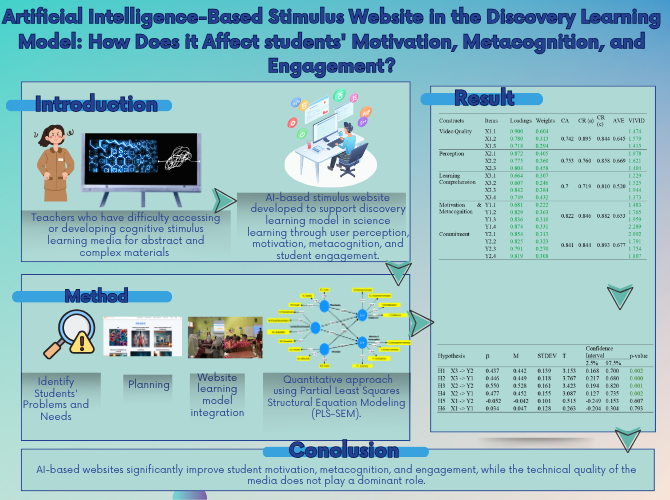
The limitations and conditions of teachers who have difficulty accessing or developing cognitive stimulus learning media for abstract and complex material are a challenge in themselves in implementing the discovery model. This study aims to evaluate an AI-based stimulus website developed to support the discovery learning model. learning in science learning through user perception, motivation, metacognition, and student engagement. This study uses a quantitative approach using Partial Least Squares Structural Equation Modeling (PLS-SEM). The results of the analysis show that the influence of learning Comprehension on Engagement has a coefficient of β = 0.437 (p = 0.002) and on Motivation & Metacognition, β = 0.446 (p = 0.000), indicating that learning comprehension significantly increases student engagement and motivation. Perception of the AI website also has a strong influence on engagement (β = 0.550, p = 0.001) and motivation & metacognition (β = 0.477, p = 0.002). While video quality does not have a significant effect on engagement (β = -0.052, p = 0.607) or motivation & metacognition (β = 0.034, p = 0.793), indicating that psychological and cognitive aspects are more important than technical aspects of video in AI-based learning. Positive perception and conceptual understanding through AI-based websites significantly increase students' motivation, metacognition, and engagement, while the technical quality of the media does not play a dominant role. These results provide recommendations for developers and educators to prioritize interactive designs that support metacognitive reflection and active engagement of students as independent learners in discovery learning that uses AI-based stimuli.
Keywords
Full Text:
Download PDFReferences
Ainsworth, S. (2006). DeFT: A conceptual framework for considering learning with multiple representations. Learning and Instruction, 16(3), 183–198. https://doi.org/10.1016/j.learninstruc.2006.03.001
Amrianto, A., & Lufri, L. (2019). Effect of Example Non Example Method Implementation in Scientific Approach and Discovery Learning Model on VII Grade Students’ Cognitive Competence in Learning Natural Science. Journal of Physics: Conference Series, 1387, 012049. https://doi.org/10.1088/1742-6596/1387/1/012049
Anderson, J. C., & Gerbing, D. W. (1988). Structural equation modeling in practice: A review and recommended two-step approach. Psychological Bulletin, 103(3), 411–423. https://doi.org/10.1037/0033-2909.103.3.411
Ballesta, J., Sosa Medrano, I., Gómez Pérez, I. A., & Ayllón Blanco, M. F. (2024). Neuroeducational proposal for techno-active learning of science teaching: a necessary university change. Interuniversity Electronic Journal of Teacher Training, 27(3), 35–50. https://doi.org/10.6018/reifop.614881
Bruner, J. S. (1961). The act of discovery. Harvard Educational Review, 32, 21–32.
de Jong, T., Sotiriou, S., & Gillet, D. (2014). Innovations in STEM education: the Go-Lab federation of online labs. Smart Learning Environments, 1(1), 3. https://doi.org/10.1186/s40561-014-0003-6
Erwinsyah, E., & Ubaedillah, I. (2025). Tracking Perception of the Discovery Learning Model and Motivation to Learn Biology: Impact on Students' Achievement. Pedagogy, 156(4), 31–51. https://doi.org/10.15823/p.2024.156.2
Firdaus, T. (2025). The Philosophical Construction of Educational Science in Relation to Posthumanism and Transhumanism in Artificial Intelligence. Turkish Academic Research Review - Türk Akademik Araştırmalar Dergisi [TARR], 10(1), 70–83. https://doi.org/10.30622/tarr.1610935
Freeman, S., Eddy, S. L., McDonough, M., Smith, M. K., Okoroafor, N., Jordt, H., & Wenderoth, M. P. (2014). Active learning increases student performance in science, engineering, and mathematics. Proceedings of the National Academy of Sciences, 111(23), 8410–8415. https://doi.org/10.1073/pnas.1319030111
Hair, J., & Alamer, A. (2022). Partial Least Squares Structural Equation Modeling (PLS-SEM) in second language and education research: Guidelines using an applied example. Research Methods in Applied Linguistics, 1(3), 100027. https://doi.org/10.1016/j.rmal.2022.100027
Hair, J. F., Hult, G. T. M., Ringle, C. M., Sarstedt, M., Danks, N. P., & Ray, S. (2021). Partial Least Squares Structural Equation Modeling (PLS-SEM) Using R. Springer.
HMELO-SILVER, C. E., DUNCAN, R. G., & CHINN, C. A. (2007). Scaffolding and Achievement in Problem-Based and Inquiry Learning: A Response to Kirschner, Sweller, and Clark (2006). Educational Psychologist, 42(2), 99–107. https://doi.org/10.1080/00461520701263368
Huang, H.-W., Teng, D. C.-E., & Tiangco, J. A. N. Z. (2024). The Impact of AI Chatbot-Supported Guided Discovery Learning on Pre-service Teachers' Learning Performance and Motivation. Journal of Science, Education and Technology. https://doi.org/10.1007/s10956-024-10179-9
Jhantasana, C. (2023). Should A Rule of Thumb be used to Calculate PLS-SEM Sample Size. Asia Social Issues, 16(5), e254658. https://doi.org/10.48048/asi.2023.254658
Junina, I., Halim, A., & Mahidin. (2020). The effect of discovery learning-based worksheet on students' metacognition skill and learning outcomes. Journal of Physics: Conference Series, 1460(1), 012100. https://doi.org/10.1088/1742-6596/1460/1/012100
Kirschner, P. A., Sweller, J., & Clark, R. E. (2006). Why Minimal Guidance During Instruction Does Not Work: An Analysis of the Failure of Constructivist, Discovery, Problem-Based, Experiential, and Inquiry-Based Teaching. Educational Psychologist, 41(2), 75–86. https://doi.org/10.1207/s15326985ep4102_1
Kock, N., & Hadaya, P. (2018). Minimum sample size estimation in PLS‐SEM: The inverse square root and gamma‐exponential methods. Information Systems Journal, 28(1), 227–261. https://doi.org/10.1111/isj.12131
Kondo, M., Kozaki, R., Kyogoku, S., Oshiro, T., Bannaka, K., Leong, P. K., Takamatsu, K., Mitsunari, K., & Nakata, Y. (2025). New Proposal Active Learning STEAM/Data Science Education in the Age of Industry 5.0 and Society 5.0 Applied Sports and Exercise Instruction Based on Eduinformatics (pp. 525–535). https://doi.org/10.1007/978-981-97-5035-1_41
Kozma, R. B. (2003). Technology and Classroom Practices. Journal of Research on Technology in Education, 36(1), 1–14. https://doi.org/10.1080/15391523.2003.10782399
Mayer, R. (2020). Multimedia Learning. Cambridge University Press. https://doi.org/10.1017/9781316941355
Mayer, R. E. (2004). Should There Be a Three-Strikes Rule Against Pure Discovery Learning? American Psychologist, 59(1), 14–19. https://doi.org/10.1037/0003-066X.59.1.14
Mayer, R. E. (2009). Multimedia Learning. Cambridge University Press. https://doi.org/10.1017/CBO9780511811678
Mayer, R. E. (2017). Using multimedia for e‐learning. Journal of Computer Assisted Learning, 33(5), 403–423. https://doi.org/10.1111/jcal.12197
Mulianingsih, F., Suharini, E., Handoyo, E., & Purnomo, A. (2025). Disaster Mitigation Tactics Through Enhanced Higher Order Thinking Skills via Active Learning in Social Science Education. Journal of Ecohumanism, 4(1). https://doi.org/10.62754/joe.v4i1.6147
Setiaji, B., Alsa, F. N., Lestari, N. P., Supahar, Rahman, N. binti A., & Pebriana, I. N. (2024). STEM based physics guided discovery learning e-module to enhance students' learning motivation and creative thinking skill. 060002. https://doi.org/10.1063/5.0133264
Suardana, I. N., Redhana, I. W., & Yunithasari, N. P. M. (2020). Students' critical thinking skills comparison in discovery learning based on constructing concept mapping and mind mapping. Journal of Physics: Conference Series, 1521(4), 042089. https://doi.org/10.1088/1742-6596/1521/4/042089
Sukarjita, I. W., Yusuf, Y. H. M., Warasabon, D., & Maubuthy, M. S. K. (2024). PKM Creation of Science and Mathematics Learning Media Based on Local Materials. Journal of Community Service Undana, 16–24. https://doi.org/10.35508/jpkmlppm.v18i2.19443
Sulistyo, L., & Kartono. (2021). Guided discovery learning model with the teacher-student active learning approach, assisted by the WhatsApp solution alternative application on the COVID-19 pandemic. Journal of Physics: Conference Series, 1918(4), 042052. https://doi.org/10.1088/1742-6596/1918/4/042052
Suryanda, A., Azrai, E. P., & Setyorini, D. (2021). Improving the Skills of Science Teachers in Developing Innovative Learning Media Based on Local Potential. Dynamics: Journal of Community Service , 5(4).
Sweller, J. (2010a). Cognitive Load Theory: Recent Theoretical Advances. In Cognitive Load Theory (pp. 29–47). Cambridge University Press. https://doi.org/10.1017/CBO9780511844744.004
Sweller, J. (2010b). Element Interactivity and Intrinsic, Extraneous, and Germane Cognitive Load. Educational Psychology Review, 22(2), 123–138. https://doi.org/10.1007/s10648-010-9128-5
DOI: https://doi.org/10.17509/jsl.v8i4.86172
Refbacks
- There are currently no refbacks.

Copyright (c) 2025 Apriana Djara, Thoriqi Firdaus, Agum Yuda Septajati, Riski Dewanto, Ismail Fikri Natadiwijaya, Maryati Maryati, Putra Habib Dhitareka

This work is licensed under a Creative Commons Attribution-ShareAlike 4.0 International License.


Jl. Dr. Setiabudhi 229 Bandung 40154, West Java, Indonesia