







Developing the 'Save the Earth!' E-Module as an ESD-Based Learning Tool to Enhance Sustainability Awareness and Critical Thinking among Indonesian Students
Abstract
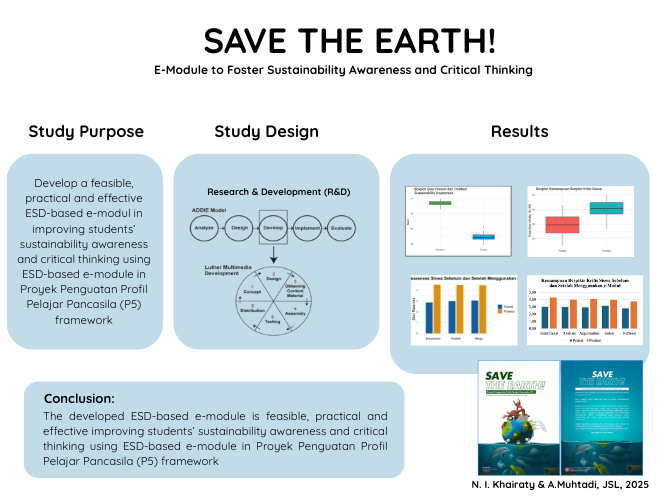
This study aims to develop and evaluate the Save the Earth! e-module based on Education for Sustainable Development (ESD) to enhance students' critical thinking and sustainability awareness within the framework of the Pancasila Student Profile Project (P5). Utilizing the ADDIE development model, the e-module was designed around five interactive learning stages (Orientation, Contextualization, Real Action, Mini Exhibition, and Final Reflection) and integrated multimedia features to support project-based learning. The module's feasibility was assessed by expert validators, yielding average scores of 4.50 (media expert) and 4.60 (content expert), both categorized as "Very Feasible." Practicality testing conducted through small-group and field trials yielded average scores of 4.30 and 4.26, respectively, indicating that the module was "Very Practical" for classroom use. Effectiveness was measured using a one-group pre-test–post-test design. Statistical tests showed significant improvements (p < 0.05) in both critical thinking and sustainability awareness. N-Gain scores revealed moderate improvement in critical thinking (0.67) and high improvement in sustainability awareness (0.74). These results indicate that the Save the Earth! e-module is a valid, practical, and effective educational tool. It holds strong potential for broader dissemination and future development, including integration with digital platforms and expansion to other P5 themes to promote transformative sustainability education.
Keywords
Full Text:
Download PDFReferences
Adnyana, I. M. D. M., Mahendra, K. A., & Raza, S. M. (2023). The importance of green education in primary, secondary and higher education: a review. Journal of Environment and Sustainability Education, 1(2), 42-49. https://doi.org/10.62672/joease.v1i2.14
Afriani, D., Wilujeng, I., & Kuswanto, H. (2019, June). Implementation of problem based learning model assisted edmodo to measure students scientific communication skills. In Journal of Physics: Conference Series (Vol. 1233, No. 1, p. 012041). IOP Publishing.
Agustira, D., Muhdhar, M., Lestari, S., & Pratiwi, R. (2025). Development of a project based learning model with multiliteracy pedagogic content to improve critical thinking skills, problem solving skills, decision making skills, and environmental literacy. Edelweiss Applied Science and Technology, 9(3), 2402-2412. https://doi.org/10.55214/25768484.v9i3.5812
Aisyah, S., Yuliani, Y., & Raharjo, R. (2024). The Students’ Critical Thinking Skills with The Implementation of Sustainability Learning to Energy Conservation and Transformation Material Based on The POE (Predict-Observe-Explain) Model. IJORER : International Journal of Recent Educational Research, 5(1), 193–203. https://doi.org/10.46245/ijorer.v5i1.538
Ajzen, I. (1991). The theory of planned behavior. Organizational Behavior and Human Decision Processes, 50(2), 179–211. https://doi.org/10.1016/0749-5978(91)90020-T
Akbar, F. (2013). What affects students’ acceptance and use of technology. Dietrich College of Humanities and Social Sciences, 15(1), 1-10.
Bommeri, N., Ismail, I. M., & Azeez, K. (2024). Barriers to Communication in Undergraduate Medical Education: Perspectives of Students From Karnataka, India. Cureus. https://doi.org/10.7759/cureus.70364
Branch, R. M. (2009). Instructional Design: The ADDIE Approach. Springer US. https://doi.org/10.1007/978-0-387-09506-6
Cohen, M. P. (1998). Determining sample sizes for surveys with data analyzed by hierarchical linear models. Journal of Official Statistics, 14(3), 267.
Delviyani, D., Tiara, M., Indrawadi, J., & Kurniawati, E. (2025). Implementasi project-based learning pada kegiatan penguatan Profil Pelajar Pancasila di SMA. Journal of Education, Cultural and Politics, 5(1), 125–132. https://doi.org/10.24036/jecco.v5i1.672
Dey, B. & Paria, M. (2025). Role of teachers in sustainable development and the promotion of environmental education in the classroom. The Social Science Review a Multidisciplinary Journal, 3(4), 372-376. https://doi.org/10.70096/tssr.250304058
Ekamilasari, E., & Pursitasari, I. D. (2021). Students’ Critical Thinking Skills and Sustainability Awareness in Science Learning for Implementation Education for Sustainable Development. Indonesian Journal of Multidiciplinary Research, 1(1), 121–124. https://doi.org/10.17509/ijomr.v1i1.33792
Ennis, R. (2011). Critical thinking: Reflection and perspective Part II. Inquiry: Critical thinking across the Disciplines, 26(2), 5-19.
Facione, P. (2015). Critical Thinking: What It Is and Why It Counts. Insight Assessment.
Fathurohman, I., Amri, M. F., Septiyanto, A., & Riandi. (2023). Integrating STEM based Education for Sustainable Development (ESD) to Promote Quality Education: A Systematic Literature Review. Jurnal Penelitian Pendidikan IPA, 9(11), 1052–1059. https://doi.org/10.29303/jppipa.v9i11.4430
Gustinasari, M., Lufri, L., & Ardi, A. (2017). Development of Module Learning Based on Concept with Exampel on Cell Material for Students SMA. Bioeducation Journal, 1(1), 61–74. https://doi.org/10.24036/bioedu.v1i1.29
Hake, R. R. (1999, October). Analyzing change/gain scores.
Hanan, A., Marjani, G., Suherman, U., Firdaus, A., Albustomi, A., Goffary, I., … & Arken, M. (2023). Harnessing technology for environmental method: cultivating high order thinking skills for sustainable maritime development knowledge. Iop Conference Series Earth and Environmental Science, 1265(1), 012004. https://doi.org/10.1088/1755-1315/1265/1/012004
Hassan, A., Noordin, T. A., & Sulaiman, S. (2010). The status on the level of environmental awareness in the concept of sustainable development amongst secondary school students. Procedia - Social and Behavioral Sciences, 2(2), 1276–1280. https://doi.org/10.1016/j.sbspro.2010.03.187
Hayat, M. S., Yunus, M., Nada, N. Q., & Suma, S. (2024). Analysis of the integration of sdgs values in learning science project in vocational schools to build a sustainable lifestyle. KnE Social Sciences. https://doi.org/10.18502/kss.v9i6.15265
Illeris, K. (2014). Transformative Learning and Identity. Journal of Transformative Education, 12(2), 148–163. https://doi.org/10.1177/1541344614548423
Iman, P. F. and Fitriani, N. (2023). Improving problem solving ability through a scientific approach on grade vii mts students. (Jiml) Journal of Innovative Mathematics Learning, 6(4), 240-247. https://doi.org/10.22460/jiml.v6i4.16988
Khalifatun, S., Nuraida, N., Agustin, S. R., Pakpahan, V. E. A., Robbi, M. I. M. N., & Setiyadi, B. (2024). Implementasi inovasi kurikulum proyek penguatan profil pelajar pancasila (p5): tinjauan terhadap efektivitas dan dampaknya dalam pembentukan karakter [Implementation of curriculum innovation in the Pancasila student profile strengthening project (p5): a review of its effectiveness and impact on character formation]. Dharmas Education Journal (DE_Journal), 5(1), 248-259. https://doi.org/10.56667/dejournal.v5i1.1291
Khoiri, N., Hayat, M. S., & Siskawati, D. (2023). Sustainability Awareness Profile of Locational School Students Through ESD-Oriented Project Based Learning. Jurnal Penelitian Pendidikan IPA, 9(SpecialIssue), 932–938. https://doi.org/10.29303/jppipa.v9iSpecialIssue.6239
Landis, J. R., & Koch, G. G. (1977). The measurement of observer agreement for categorical data. biometrics, 159-174.
Mezirow, J. (2018). Transformative learning theory. In Contemporary theories of learning (pp. 114-128). Routledge.
Nabila, W., Encep Andriana, & Rokmanah, S. (2023). Kesulitan Guru dalam Menerapkan Proyek Penguatan Profil Pelajar Pancasila di Sekolah Dasar [Teachers' Difficulties in Implementing the Pancasila Student Profile Strengthening Project in Elementary Schools]. Didaktik : Jurnal Ilmiah PGSD STKIP Subang, 9(5), 2865–2874. https://doi.org/10.36989/didaktik.v9i5.2164
Nurdiyanto, A., & Nurhanurawati, N. (2022). Analysis of The Need for Renewal of Mathematics Teaching Materials in Vocational High School. Prima: Jurnal Pendidikan Matematika, 6(2), 132. https://doi.org/10.31000/prima.v6i2.6180
Nurdyansyah, F., Muflihati, I., Ujianti, R. M. D., Novita, M., Kusumo, H., Mujiono, M., … & Ryan, J. (2022). Indonesian character building strategy: planning the pancasila student profile strengthening project in kurikulum merdeka. KnE Social Sciences. https://doi.org/10.18502/kss.v7i19.12456
Palangda, L., Walukow, M. R., Naharia, O., Wullur, M. N., & Sumual, S. D. M. (2023). Implementation of Merdeka Belajar Policy: Constraints in the Pancasila Students Profile Strengthening Project. International Journal of Multidisciplinary Approach Research and Science, 1(02), 104–116. https://doi.org/10.59653/ijmars.v1i02.62
Pangsuma, N. S., Nurahman, A. A., Riandi, R., & Solihat, R. (2024). Innovation of ESD Learning Module (Education for Sustainable Development) Based on Bugis Local Wisdom for Critical Thinking Skills and Environmental Literacy. Journal of Science Learning, 7(3), 257–266. https://doi.org/10.17509/jsl.v7i3.71247
Pauw, J. B., Gericke, N., Olsson, D., & Berglund, T. (2015). The effectiveness of education for sustainable development. Sustainability, 7(11), 15693-15717. https://doi.org/10.3390/su71115693
Ramadani, M., Pujiastuti, H., Faturrohman, M., & Syamsuri, S. (2023). Integrasi Teknologi Desmos dalam Pembelajaran Matematika: A Systematic Literature Review. JIIP - Jurnal Ilmiah Ilmu Pendidikan, 6(2), 850–855. https://doi.org/10.54371/jiip.v6i2.1340
Redman, A., & Wiek, A. (2021). Competencies for Advancing Transformations Towards Sustainability. Frontiers in Education, 6. https://doi.org/10.3389/feduc.2021.785163
Repanovici, A., Salcă Rotaru, C., & Murzea, C. (2021). Development of Sustainable Thinking by Information Literacy. Sustainability, 13(3), 1287. https://doi.org/10.3390/su13031287
Riduwan, M. B. A. (2022). Skala pengukuran variabel-variabel penelitian.
Rizal, Y., Deovany, M., & Andini, A. S. (2022). Kepercayaan Diri Siswa pada Pelaksanaan Projek Penguatan Profil Pelajar Pancasila [Student Self-Confidence in the Implementation of the Pancasila Student Profile Strengthening Project]. Sosial Horizon: Jurnal Pendidikan Sosial, 9(1), 46–57. https://doi.org/10.31571/sosial.v9i1.3699
Saesaputri, S. M., Fuad, N., & Zulaikha, S. (2024). Evaluasi projek penguatan profil pelajar pancasila (p5) sekolah penggerak di sma negeri 6 bekasi [Evaluation of the project to strengthen the profile of Pancasila students (P5) at the driving school at State Senior High School 6 Bekasi]. Mutiara: Multidiciplinary Scientifict Journal, 2(1), 794-799. https://doi.org/10.57185/mutiara.v2i1.131
Saraswati, S., Linda, R., & Herdini, H. (2019). Development of Interactive E-Module Chemistry Magazine Based on Kvisoft Flipbook Maker for Thermochemistry Materials at Second Grade Senior High School. Journal of Science Learning, 3(1), 1–6. https://doi.org/10.17509/jsl.v3i1.18166
Sass, W., Pauw, J. B., Maeyer, S. De, & Petegem, P. Van. (2021). Development and validation of an instrument for measuring action competence in sustainable development within early adolescents: the action competence in sustainable development questionnaire (ACiSD-Q). Environmental Education Research, 1–20. https://doi.org/10.1080/13504622.2021.1888887
Schröder, S., Wiek, A., Farny, S., & Luthardt, P. (2023). Toward holistic corporate sustainability—Developing employees’ action competence for sustainability in small and medium‐sized enterprises through training. Business Strategy and the Environment, 32(4), 1650–1669. https://doi.org/10.1002/bse.3210
Setyowati*, Y., Kaniawati, I., Sriyati, S., Nurlaelah, E., & Hernani, H. (2022). The Development of Science Teaching Materials Based on the PjBL-STEM Model and ESD Approach on Environmental Pollution Materials. Jurnal IPA & Pembelajaran IPA, 6(1), 45–53. https://doi.org/10.24815/jipi.v6i1.23571
Shayan, N. F., Mohabbati-Kalejahi, N., Alavi, S., & Zahed, M. A. (2022). Sustainable Development Goals (SDGs) as a Framework for Corporate Social Responsibility (CSR). Sustainability, 14(3), 1222. https://doi.org/10.3390/su14031222
Shobah, N., Hariyono, E., Anggaryani, M., Ilhami, F. B., & Citra, N. F. (2025). Belajar Sains Berkelanjutan Website: Enhancing High School Education for Sustainable Development (ESD) Competencies in Global Warming and Renewable Energy. Journal of Science Learning, 8(1), 84–99. https://doi.org/10.17509/jsl.v8i1.80211
Shutaleva, A. (2023). Ecological culture and critical thinking: building of a sustainable future. Sustainability, 15(18), 13492. https://doi.org/10.3390/su151813492
Sihombing, R. A., Muslim, M., & Rahman, T. (2024). From awareness to action: a systematic literature review of teaching materials based on education for sustainable development (esd). Jurnal Pembelajaran Sains, 8(1), 22. https://doi.org/10.17977/um033v8i1p22-30
Sihombing, R. A., Muslim, M., Rahman, T., & Winarno, N. (2024). Enhancing Quality Education in Indonesia: A Literature Review of STEM-ESD Landscape Contributions. Journal of Science Learning, 7(3), 213–226. https://doi.org/10.17509/jsl.v7i3.69046
Sterling, S. (2001). Sustainable education: Re-visioning learning and change. Schumacher Society/Green Books. https://www.greenbooks.co.uk/sustainable-education
Sugiyono, D. (2013). Metode penelitian pendidikan pendekatan kuantitatif, kualitatif dan R&D [Educational research methods using quantitative, qualitative and R&D approaches].
Sulastri, S. and Irafahmi, D. (2023). Critical thinking and sustainability awareness of accounting students in higher education. Arkus, 9(2), 396-399. https://doi.org/10.37275/arkus.v9i2.413
Sulistianti, A., Aliyyah, R. R., & Gani, R. A. (2024). Projek Penguatan Profil Pelajar Pancasila: Persepsi Guru Sekolah Dasar [Pancasila Student Profile Strengthening Project: Elementary School Teachers' Perceptions]. Karimah Tauhid, 3(3), 3121–3131. https://doi.org/10.30997/karimahtauhid.v3i3.12200
Suryawati, E., Yennita, Y., Afwa, S. R., Dianti, P. R., & Syafrinal, S. (2023). Real action based on search solve create and share (SSCS) model to improve sustainability awareness of junior high school students. JPBI (Jurnal Pendidikan Biologi Indonesia), 9(3), 271–281. https://doi.org/10.22219/jpbi.v9i3.28940
Sutopo, H., Samosir, R. S., & Gatc, J. (2019). Mobile Multimedia Evaluation: Development of Stop Drugs Tutorial. International Journal of Interactive Mobile Technologies (IJIM), 13(05), 124. https://doi.org/10.3991/ijim.v13i05.9436
Taylor, E. W. (2017). Transformative Learning Theory. In Transformative Learning Meets Bildung (pp. 17–29). SensePublishers. https://doi.org/10.1007/978-94-6300-797-9_2
Thorn, S., Seibold, S., Leverkus, A. B., Michler, T., Müller, J., Noss, R. F., … & Lindenmayer, D. B. (2020). The living dead: acknowledging life after tree death to stop forest degradation. Frontiers in Ecology and the Environment, 18(9), 505-512. https://doi.org/10.1002/fee.2252
Ummah, F., Munaa, N., Vica, N., Saputra, M. G., Kusdiana, A., Nurdiana, F., & Nuriyati. (2023). Learning Beyond the Classroom: An Effective Way Understanding the Hospital Health Promotion Among Hospital Administration Students (pp. 132–137). https://doi.org/10.2991/978-94-6463-202-6_16
UNESCO. (2020). Education for sustainable development: a roadmap. UNESCO. https://doi.org/10.54675/YFRE1448
Wiggins, G., & McTighe, J. (2005). Understanding by Design. 1–14.
Yasa, I. W. P., Lasmawan, I. W., & Suharta, I. G. P. (2023). Projek penguatan profil pelajar pancasila (p5) berbasis kearifan lokal untuk mewujudkan pelajar indonesia pancasilais: peluang dan tantangan [The Pancasila student profile strengthening project (P5) based on local wisdom to create Pancasilaist Indonesian students: opportunities and challenges]. Jurnal Pendidikan Sejarah Indonesia, 6(2), 239. https://doi.org/10.17977/um0330v6i2p239-253
DOI: https://doi.org/10.17509/jsl.v8i4.87171
Refbacks
- There are currently no refbacks.

Copyright (c) 2025 Nurul Inayah Khairaty, Ali Muhtadi, Nuraini Yusuf

This work is licensed under a Creative Commons Attribution-ShareAlike 4.0 International License.


Jl. Dr. Setiabudhi 229 Bandung 40154, West Java, Indonesia