







The Effect of Engineering Design-Based STEM Activities on Students' Entrepreneurial Skills
Abstract
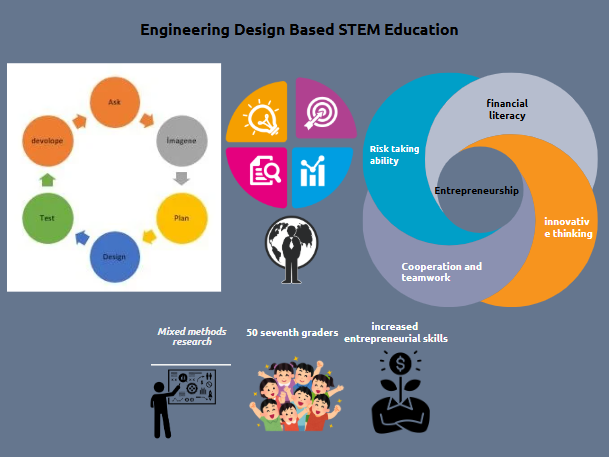
The aim of this study is to reveal the effect of engineering design-based STEM activities on the entrepreneurial skills of seventh-grade students. In this context, students were asked to design engineering design-based STEM activities for problems identified using real-life situations, and at the end of this process, an attempt was made to determine whether their entrepreneurial skills had changed based on the solutions they brought to the problem. The research was conducted using a mixed method and a sequential design, first obtaining quantitative data and then collecting and analysing qualitative data to examine the reasons behind the results obtained from the quantitative data in depth. The participants of the research consisted of 50 seventh-grade students, 26 in the experimental group and 24 in the control group, attending a state secondary school. The data collection tools used in the study were the science-based entrepreneurship scale and a semi-structured interview form. The results of the study revealed that engineering design-based STEM activities had a positive effect on the development and improvement of entrepreneurial skills in students. The participants stated that they enjoyed the application process, were active during the process, and that a student-centred process was effective in achieving these results. The participants emphasised that it was a process that developed their entrepreneurial skills and changed their perceptions of entrepreneurship.
Keywords
Full Text:
Download PDFReferences
Achor, E. E., & Wilfred-Bonse, K. (2013). The need to integrate entrepreneurship education into science education teachers' curriculum in Nigeria. Journal of Science and Vocational Education (JSVE), 7.
Ağca, V., & Yumuşakipek, H. D. (2015). Forces driving the entrepreneurship trend today. Entrepreneurship: Basic Concepts, Types of Entrepreneurship, Current Issues in
Entrepreneurship, Editor: Erdoğan Kaygın and Bülent Güven, Siyah İnci Yayınları, 11-33.
Akgündüz, D., Aydeniz, M., Çakmakçı, G., Çavaş, B., Çorlu, M. S., Öner, T., & Özdemir, S. (2015). STEM education Turkey report. Istanbul: Scala Basım.
Aydeniz, M., & Bilican, K. (2018). The impact of engagement in STEM activities on primary preservice teachers' conceptualisation of STEM and knowledge of STEM pedagogy. Journal of Research in STEM Education, 4(2), 213-234.
Aydın, E., & Baydere, F. K. (2023). The Effects of the Activities Developed According to the Engineering Design Process on the Subject of "Simple Machines" on 8th Grade Students' Conceptual Understanding and Scientific Process Skills. IBAD Journal of Social Sciences, (14), 121-154.
Aygün, S. S., Atalay, N., Kılıç, Z., & Yaşar, S. (2016). Development of 21st century skills competence perceptions scale for pre-service teachers: Validity and reliability study. Journal of Pamukkale University Faculty of Education, 40(40), 160-175.
Bybee, R. W. (2010). The teaching of science: 21st century perspectives. NSTA press.
Bybee, R. W. (2013). The case for STEM education: Challenges and opportunities.
Capobianco, B. & Rupp, M. (2014). STEM teachers' planned and enacted attempts at implementing engineering designbased instruction. School Science and Mathematics, 114(6), 258-270.
Creswell, J. W., & Clark, V. P. (2007). Mixed methods research. Thousand Oaks, CA.
Creswell, J. W., & Creswell, J. D. (2017). Research design: Qualitative, quantitative, and mixed methods approaches. Sage publications.
Creswell, J. W., & Plano Clark, V. L. (2023). Revisiting mixed methods research designs twenty years later. Handbook of mixed methods research designs, 1(1), 21-36.
Çelik, A. (2018). Entrepreneurship with informatics: A case study of 5th grade students' production with informatics in design-oriented improvisation activity.
Çepni, S. (2010). Introduction to research and project studies.Trabzon.
Çevik, M., Şentürk, C., & Abdioğlu, C. (2019). From STEM to STEM+. Educated Book.
Deveci, İ. (2016). Development, implementation and evaluation of entrepreneurship education modules integrated with science curriculum (5-8) (Doctoral dissertation, Bursa Uludag University (Turkey)).
Deveci, İ., & Konuş, F. Z. (2022). The predictive power of Turkish middle school students' entrepreneurial competencies on STEM attitudes. The Journal of Entrepreneurship, 31(2), 425-457.
Deveci, İ., & Seikkula-Lein, J. (2016). Finnish Science Teacher Educators' Opinions about the Implementation Process Related to Entrepreneurship Education. Electronic Journal of Science Education, 20(4), 1-20.
Dym, C. L., Little, P., Orwin, E. J., & Spjut, R. E. (2009). The design process. Engineering Design: A project-Based Introduction, 22.
English, L. D., King, D., & Smeed, J. (2017). Advancing integrated STEM learning through engineering design: Sixth-grade students' design and construction of earthquake resistant buildings. The Journal of Educational Research, 110(3), 255-271.
European Commission. (2013). Commission implementing regulation (EU) no. 485/2013 of 24 May. Official Journal of the European Union, 56, 12-26. https://doi.org/10.2903/j.efsa.2013.3067
European Commission. (2004). Action plan: The European agenda for entrepreneurship. (https://eur-lex.europa.eu/legal-content/EN/TXT/PDF/?uri=CELEX:52004DC0070&from=EN) Retrieved 18.03.2025
European Commission (2008). "Think Small First" A "Small Business Act" for Europe. https://eur-lex.europa.eu/legal-content/EN/TXT/PDF/?uri=CELEX:52008DC0394&from=en (Date of access: 18.03.2025)
European Commission. (2012). At the crossroads. Annual report on small and medium-sized enterprises in the EU, 2011/12 on http://ec.europa.eu/enterprise/policies/sme/facts-figures-analysis/performancereview/files/supporting-documents/2012/annual-report_en.pdf (Accessed 20.03.2025).
Evcim, İ. (2021). Investigation of the effect of developing the force and energy unit with STEM integration in science course on students' critical thinking skills and entrepreneurship competencies. Yıldız Technical University.
Fakharzadeh, A. (2012). Development of entrepreneurial attitude in Iranian elementary literature textbooks. Journal of Entrepreneurship Education, 15, 49.
Fan, S. C., & Yu, K. C. (2017). How an integrative STEM curriculum can benefit students in engineering design practices. International Journal of Technology and Design Education, 27, 107-129.
Fayolle, A., & Gailly, B. (2008). From craft to science: Teaching models and learning processes in entrepreneurship education. Journal of European industrial training, 32(7), 569-593.
Ferrante, F. (2005). Revealing entrepreneurial talent. Small Business Economics, 25, 159-174.
Florin, J., Karri, R., & Rossiter, N. (2007). Fostering entrepreneurial drive in business education: An attitudinal approach. Journal of management education, 31(1), 17-42.
Graduates, D. E. (2008). Putting entrepreneurship at the centre of higher education. September 2008. Published by NESTA.
Hacıoğlu, Y., Yamak, H. & Kavak, N. (2017) The opinions of prospective science teachers regarding STEM education: the engineering design based science education. GED/ GAGGED, 37(2), 649-684.
Hisrich, R. D., & Peters, M. P. (1989). Views of Trade Activity with the Soviet Union and China by US Manufacturers. Journal of Global Marketing, 2(2), 53-73.
İşcan, Ö. F., & Kaygın, E. (2011). A research to determine the entrepreneurial tendencies of university students as potential entrepreneurs. Journal of organisation and management sciences, 3(2), 275-286.
Konuş, F. Z. (2019). Predicting the entrepreneurial tendencies of seventh and eighth grade secondary school students' STEM attitudes (Master's thesis, Graduate School of Natural and Applied Sciences).
Kurnaz, S. (2017). A research in Orhangazi district of Bursa province for determining the entrepreneurship levels of students in Anatolian high schools that give and do not give accounting education (Master's thesis, Institute of Social Sciences).
MEB (2013). Primary Education Institutions (Primary and Secondary Schools) Science Course (Grades 3,4,5,6,7 and 7) Curriculum. Ministry of National Education, Board of Education and Discipline Presidency, Ankara.
MEB (2018). Primary Education Institutions (Primary and Secondary Schools) Science Course (3,4,5,6,7 and 7th Grades) Curriculum. Ministry of National Education, Board of Education and Discipline Presidency, Ankara.
MEB (2018). MEB 2023 vision. http://2023vizyonu.meb.gov.tr/doc/2023_EGITIM_VIZYONU.pdf. (Date of access: 12.03.2025)
MEB (2024). Primary Education Institutions (Primary and Secondary Schools) Science Course (Grades 3,4,5,6,7 and 7) Curriculum. Ministry of National Education, Board of Education and Discipline Presidency, Ankara.
Mercan Höbek, K. (2014). Analysis of the subjects in which engineering-design method can be applied in secondary school 6th, 7th, 8th grade science and technology curriculum: Preparing alternative energy sources teaching materials. Erciyes University Institute of Educational Sciences (Master's Thesis). 1, 75.
Miles, M. B., & Huberman, A. M. (1984). Drawing valid meaning from qualitative data: Toward a shared craft. Educational researcher, 13(5), 20-30.
Moore, T. J., & Smith, K. A. (2014). Advancing the state of the art of STEM integration. Journal of STEM Education: Innovations and Research, 15(1), 5.
Moore, T. J., Stohlmann, M. S., Wang, H. H., Tank, K. M., & Roehrig, G. H. (2014). Implementation and integration of engineering in K-12 STEM education. In J. Strobel, S¸ . Purzer, & M. Cardella (Eds.), Engineering in precollege settings: Research into practice. West Lafayette, IN: Purdue Press.
Morrison, A. (2000). Entrepreneurship: what triggers it?. International Journal of Entrepreneurial Behaviour & Research, 6(2), 59-71.
National Aeronautics and Space Administration. (2011). Beginning engineering, science and technology educator guides: An educator's guide to the engineering design process grades 6-8. Retrieved from https://www.nasa.gov/pdf/630754main_NASAsBESTActivityGuide6-8.pdf (Access date: 14.03.2025).
National Research Council [NRC]. (2012). A Framework for k-12 science education: practices, crosscutting concepts, and core ideas. Washington DC: The National Academic Press.
NGSS Lead States. (2013). Next generation science standards: For states by states. Washington, DC: The National Academies Press.
Özcan, E. (2019). The effect of socio-scientific argumentation method on students' level of associating knowledge with daily life, entrepreneurship and attitudes towards sustainable science (Doctoral dissertation, Dokuz Eylul Universitesi (Turkey)).
P21. (2009). P21 Framework Definitions. Partnership For 21st Century Skills (P21), December 2009. Accessed online at : http://www.21stcenturyskills.org on 15 july 2025.
Patton, M. Q. (2005). Qualitative Research. New York: John Wiley & Sons, Ltd.
Pekbay, C., Saka, Y., & Kaptan, F. (2020). Secondary school students' views on activities prepared based on STEM education approach: Green engineering activities. Journal of Inonu University Faculty of Education, 21(2), 840-857.
Prajapati, R. K., Sharma, B., & Sharma, D. (2017). Significance of life skills education. Contemporary Issues in Education Research, 10(1), 1-6.
Rae, D., Martin, L., Antcliff, V., & Hannon, P. (2010, November). The 2010 survey of enterprise and entrepreneurship in higher education. In 33rd ISBE Conference (pp. 3-4).
Sanders, M. (2015). Integrative STEM education: A more robust explanation.
Sarı, U. Yazıcı, YY (2020). Pre-service teachers' views on STEM education and Arduino practices. SDU International Journal of Educational Studies, 7(2), 246-261.
Sarı., U., & Yazıcı, Y. Y. (2019). Science teachers' views on science and engineering applications. International Journal of Social Sciences and Education Research, 5(2), 157-167.
Selcen Guzey, S., Harwell, M., Moreno, M., Peralta, Y., & Moore, T. J. (2017). The impact of design-based STEM integration curricula on student achievement in engineering, science, and mathematics. Journal of Science Education and Technology, 26, 207-222.
Shahin, M., Ilic, O., Gonsalvez, C., & Whittle, J. (2021). The impact of a STEM-based entrepreneurship programme on the entrepreneurial intention of secondary school female students. International Entrepreneurship and Management Journal, 17(4), 1867-1898.
Shane, S., & Venkataraman, S. (2000). The promise of entrepreneurship as a field of research. Academy of management review, 25(1), 217-226.
Soutaris, V., Zerbinati, S. & Al-Lahan, A., (2007). Do entrepreneurship programmes raise entrepreneurial intention of science and engineering students? The effect of learning, inspiration and resources. Journal of Business Venturing, 22:566-591, 2007.
Stevenson, H. H., & Jarillo, J. C. (2007). A paradigm of entrepreneurship: Entrepreneurial management. In Entrepreneurship: Concepts, theory and perspective (pp. 155-170). Berlin, Heidelberg: Springer Berlin Heidelberg.
Şirin, E. (2020). The effect of entrepreneurship-focused STEM activities on 7th grade students' entrepreneurship skills and STEM attitudes (Master's thesis, Institute of Educational Sciences).
Turiman, P., Omar, J., Daud, A. M., & Osman, K. (2012). Fostering the 21st century skills through scientific literacy and science process skills. Procedia-Social and Behavioural Sciences, 59, 110-116.
TÜBİTAK. National Science and Technology Policies 2003-2023 Strategy Paper, 19th ed.; TÜBİTAK: Ankara, Turkey, 2016; pp. 1-137.
TÜSİAD (2011). Vizyon 2050 Turkey Report, Date of access: 15 March 2025; http://www.tusiad.org.tr/__rsc/shared/file/vızyon-2050-rapor.pdf.
Ursavaş, N., & Karal, E. (2019). Science Teachers' Thoughts on Life Skills and Their Relevance to Science Outcomes. Journal of Mediterranean Egitim Arastirmalari, 13(30), 246-269.
Wilson, F., Kickul, J., & Marlino, D. (2007). Gender, entrepreneurial self-efficacy, and entrepreneurial career intentions: Implications for entrepreneurship education. Entrepreneurship theory and practice, 31(3), 387-406.
Wilson, K. E. (2008). Entrepreneurship education in Europe. Entrepreneurship and higher education.
World Economic Forum. (2009). Educating the next wave of entrepreneurs: Unlocking entrepreneurial capabilities to meet the global challenges of the 21st century. Geneva, Switzerland: World Economic Forum. (Retrieved 14 March 2025). https://www.weforum.org/publications/world-economic-forum-annual-meeting-2009/
Yıldırım, A. and Şimşek, H. (2016). Qualitative Research Methods in Social Sciences (Expanded 10th Edition). Ankara: Seçkin Publishing.
Yıldırım, H., & Gelmez-Burakgazi, S. (2020). A research on studies on STEM education in Turkey: Meta-synthesis study. Pamukkale University Journal of Faculty of Education, 50, 291-314. doi: 10.9779/pauefd.590319
Yolagiden, C., & Bektas, O. (2021). Development of Entrepreneurship Scale for Science Course: Validity and Reliability Study. Afyon Kocatepe University Journal of Social Sciences, 23(4), 1349-1365.
Zhbanova, K. S. (2017). How the arts standards support STEM concepts: A journey from STEM to STEAM. Journal of STEM Arts, Crafts, and Constructions, 2(2), 1.
DOI: https://doi.org/10.17509/jsl.v8i4.86917
Refbacks
- There are currently no refbacks.

Copyright (c) 2025 Hasan Hüseyin KUL, Fulya ÖNER ARMAĞAN

This work is licensed under a Creative Commons Attribution-ShareAlike 4.0 International License.


Jl. Dr. Setiabudhi 229 Bandung 40154, West Java, Indonesia