







Exploring the Factors Influencing Teachers’ Perceptions and Students’ Attitudes in STEM Education Development
Abstract
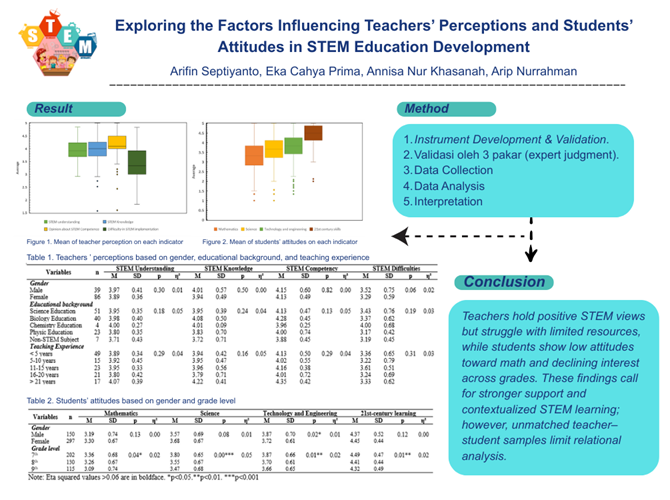
The rapid evolution of information and communication technologies, combined with the growing demand for a skilled workforce in science, technology, engineering, and mathematics (STEM) fields, has underscored the importance of STEM education in shaping the future workforce. Despite its critical role, a persistent gap remains between students' academic performance in STEM subjects and their interest in pursuing STEM careers. This study investigates the dynamics of teachers' perceptions and students' attitudes towards STEM education in secondary schools in Indonesia. Using a quantitative approach with a cross-sectional design, this study examines the impact of demographic factors, including gender, educational background, and teaching experience, on teachers' perceptions, as well as how gender and grade level influence students' attitudes towards STEM. The study employed a questionnaire to measure students’ attitudes toward STEM across four dimensions (science, mathematics, technology, and engineering) and teachers’ perceptions across four indicators (STEM understanding, STEM competencies, STEM knowledge, and implementation challenges). The study involved 125 teachers and 447 students, with data analyzed through descriptive statistics, correlation analysis, and ANOVA. Results show that while teachers hold positive perceptions of STEM education, challenges related to resource limitations and the complexity of interdisciplinary teaching remain significant. Students’ attitudes towards STEM varied, with a notable decline in positive attitudes as grade levels increased, especially in mathematics. The findings contribute to the development of more adaptive STEM education policies and practices in Indonesia, providing insights for future educational reforms.
Keywords
Full Text:
Download PDFReferences
Ardianto, D., Rubini, B., & Pursitasari, I. D. (2023). Assessing STEM career interest among secondary students: A Rasch model measurement analysis. Eurasia Journal of Mathematics, Science and Technology Education, 19(1), em2213. https://doi.org/10.29333/ejmste/12796
Arlinwibowo, J., Retnawati, H., Pradani, R. G., & Fatima, G. N. (2023). STEM Implementation Issues in Indonesia: Identifying the Problems Source and Its Implications. Qualitative Report, 28(8), 2213–2229. https://doi.org/10.46743/2160-3715/2023.5667
Asmara, A. S., Hardi, H., & Ardiyanti, Y. (2019). Contextual Learning on Mathematical Subjects to Enhance Student Motivation for Learning in Vocational High School. JPI (Jurnal Pendidikan Indonesia), 8(2), 228. https://doi.org/10.23887/jpi-undiksha.v8i2.13499
Atabey, N., & Topcu, M. S. (2021). The Relationship between Turkish Middle School Students’ 21st Century Skills and STEM Career Interest: Gender Effect. Journal of Education in Science, Environment and Health, 7(2), 86–103. https://doi.org/10.21891/jeseh.739586
Balta, N., Japashov, N., Mansurova, A., Tzafilkou, K., Oliveira, A. W., & Lathrop, R. (2023). Middle- and secondary-school students’ STEM career interest and its relationship to gender, grades, and family size in Kazakhstan. Science Education, 107(2), 401–426. https://doi.org/https://doi.org/10.1002/sce.21776
Beers, S. Z. (2011). What are the skills students will need in the 21 st century? 1–6. https://cosee.umaine.edu/files/coseeos/21st_century_skills.pdf
Brage-del-Río, M., Martin-Núñez, J. L., & Pablo-Lerchundi, I. (2025). Educational Strategies to Reduce the Gender Gap in the Self-Efficacy of High School Students in STEM Teaching. Frontiers in Education, 10(May). https://doi.org/10.3389/feduc.2025.1553001
Bustamante-Mora, A., Diéguez-Rebolledo, M., Díaz-Arancibia, J., Sánchez-Vázquez, E., & Medina-Gómez, J. (2025). Inclusive Pedagogical Models in STEM: The Importance of Emotional Intelligence, Resilience, and Motivation with a Gender Perspective. Sustainability (Switzerland), 17(10), 1–39. https://doi.org/10.3390/su17104437
Bybee, R. W. (2013). The case for education: STEM challenges and opportunities. NSTA (National Science Teachers Assocation), 33–40. www.nsta.org/permissions.
Canuto, P. P., & Espique, F. (2023). Gender Equality in Science Classrooms: Examining the Implementation of Gender-responsive Approach and its Impact on Science Education. International Journal of Learning, Teaching and Educational Research, 22(6), 659–678. https://doi.org/10.26803/ijlter.22.6.33
Chen, K., & Chen, C. (2021). Effects of STEM inquiry method on learning attitude and creativity. Eurasia Journal of Mathematics, Science and Technology Education, 17(11), 1–6. https://doi.org/10.29333/EJMSTE/11254
Cotterill-Walker, S. M. (2012). Where is the evidence that master’s level nursing education makes a difference to patient care? A literature review. Nurse Education Today, 32(1), 57–64. https://doi.org/https://doi.org/10.1016/j.nedt.2011.02.001
Cresswell, J. W., & Clark, V. L. P. (2018). Designing and conducting mixed methods research. In HERD: Health Environments Research & Design Journal (third edit, Vol. 12, Issue 1, pp. 164–166). SAGE Publications Ltd. https://doi.org/10.1177/1937586719832223
David Adeline, W. (2024). Empowering Girls in Stem Education: Strategies to Address Gender Disparities. Research Output Journal of Arts and Management, 3(3), 63–68. https://rojournals.org/roj-art-and-management/
Delaney, J. M., & Devereux, P. J. (2019). Understanding gender differences in STEM: Evidence from college applications✰. Economics of Education Review, 72, 219–238. https://doi.org/https://doi.org/10.1016/j.econedurev.2019.06.002
Deniş-Çeliker, H., & Dere, S. (2022). The Effects of The Problem-Based Learnıng Supported by Experiments in Science Course: Students’ Inquiry Learning and Reflective Thinking Skills. Journal of Science Learning, 5(1), 14–27. https://doi.org/10.17509/jsl.v5i1.32076
Diana, N., Turmudi, & Yohannes. (2021). Analysis of teachers’ difficulties in implementing STEM approach in learning: A study literature. Journal of Physics: Conference Series, 1806(1). https://doi.org/10.1088/1742-6596/1806/1/012219
Ekelemu, E. (2014). Teacher attitude, experience and background knowledge effect on the use of inquiry method of Teaching IRJTE Teacher attitude, experience and background knowledge effect on the use of inquiry method of Teaching. Global Research Journal of Education, 2(4), 198–206.
English, L. D. (2016). STEM education K-12: perspectives on integration. International Journal of STEM Education, 3(1), 1–8. https://doi.org/10.1186/s40594-016-0036-1
Ergün, A. (2019). Identification of the interest of Turkish middle-school students in stem careers: Gender and grade level differences. Journal of Baltic Science Education, 18(1), 90–104. https://doi.org/10.33225/jbse/19.18.90
Faber, M., Unfried, A., Wiebe, E. N., Corn, J., Townsend, L. T. W., & Collins, T. L. (2013). Student attitudes toward stem: The development of upper elementary school and middle/high school student surveys. ASEE Annual Conference and Exposition, Conference Proceedings, June.
Farwati, R., Metafisika, K., Sari, I., Sitinjak, D. S., Solikha, D. F., & Solfarina, S. (2021). STEM Education Implementation in Indonesia: A Scoping Review. International Journal of STEM Education for Sustainability, 1(1), 11–32. https://doi.org/10.53889/ijses.v1i1.2
Firda, R.-, Kaniwati, I., & Sriyati, S. (2021). STEM Learning in Sustainability Issues to Improve Sustainability Consciousness of Junior High School Students. Paedagogia, 24(1), 53. https://doi.org/10.20961/paedagogia.v24i1.54212
Fritz, A., Haase, Victor, G., & Räsänen, P. (2019). International Handbook of Mathematical Learning Difficulties: Foreword by Springer.
García-González, E., Jiménez-Fontana, R., & Azcárate, P. (2020). Education for sustainability and the sustainable development goals: Pre-service teachers’ perceptions and knowledge. Sustainability, 12(7741). https://doi.org/10.3390/su12187741
Hall, B. J. M., Ponton, M. K., & Hall, J. M. (2005). Mathematics self-efficacy of college freshman. Journal of Developmental Education, 28, 26–32.
Honey, M., Pearson, G., & Schweingruber, H. (2014). STEM integration in K-12 education status, prospects, and an agenda for research. In T. N. A. Press (Ed.), 70th Annual International Technology Education Association Conference. https://www.nap.edu/catalog/18612/stem-integration-in-k-12-education-status-prospects-and-an
Juliangkary, E. (2025). Realistic Mathematics Education as a Contextual Approach in Overcoming Learning Difficulties Circle. 10(2), 569–576.
Kijima, R., & Sun, K. L. (2020). 'Females Don’t Need to be Reluctant’: Employing Design Thinking to Harness Creative Confidence and Interest in STEAM. International Journal of Art and Design Education, 40(1), 66–81. https://doi.org/10.1111/jade.12307
Lane, C., Kaya-Capocci, S., Kelly, R., O’Connell, T., & Goos, M. (2022). Fascinating or dull? Female students’ attitudes towards STEM subjects and careers. Frontiers in Psychology, 13(September), 1–16. https://doi.org/10.3389/fpsyg.2022.959972
Le, L. T. B., Tran, T. T., & Tran, N. H. (2021). Challenges to STEM education in Vietnamese high school contexts. Heliyon, 7(12), e08649. https://doi.org/10.1016/j.heliyon.2021.e08649
Margot, K. C., & Kettler, T. (2019). Teachers’ perception of STEM integration and education: a systematic literature review. International Journal of STEM Education, 6(1). https://doi.org/10.1186/s40594-018-0151-2
Mau, W. C., Chen, S. J., & Lin, C. C. (2019). Assessing high school student’s stem career interests using a social cognitive framework. Education Sciences, 9(2). https://doi.org/10.3390/educsci9020151
Muneer, S., Santhosh, M., Parangusan, H., & Bhadra, J. (2025). A meta-analysis to explore the role of design thinking in enhancing creativity as learning outcomes in STEM education. In International Journal of Technology and Design Education (Issue 0123456789). Springer Netherlands. https://doi.org/10.1007/s10798-025-10005-2
Nadelson, L. S., & Seifert, A. L. (2017). Integrated STEM defined: Contexts, challenges, and the future. Journal of Educational Research, 110(3), 221–223. https://doi.org/10.1080/00220671.2017.1289775
National Center for Science and Engineering Statistics. (2023). Women, Minorities, and Persons with Disabilities in Science and Engineering: 2021. Special Report NSF 21-321, 1–62. https://ncses.nsf.gov/pubs/nsf21321/report/introduction
Nugraha, M. G., Kidman, G., & Tan, H. (2023). Pre-service teacher in STEM education: An integrative review and mapping of the Indonesian research literature. Eurasia Journal of Mathematics, Science and Technology Education, 19(5). https://doi.org/10.29333/ejmste/13155
OECD. (2016). Innovating Education and Educating for Innovation. OECD Publishing. https://doi.org/10.1787/9789264265097-en
OECD. (2025). Gender Differences in Education, Skills and STEM Careers in Latin America and the Caribbean: Insights from PISA and PIAAC. In Gender Differences in Education, Skills and STEM Careers in Latin America and the Caribbean. OECD Publishing. https://doi.org/10.1787/4ea07281-en
Özcan, B., & Kültür, Y. Z. (2021). The Relationship Between Sources of Mathematics Self-Efficacy and Mathematics Test and Course Achievement in High School Seniors. SAGE Open, 11(3). https://doi.org/10.1177/21582440211040124
Perdana, R., Apriani, A. N., Richardo, R., Rochaendi, E., & Kusuma, C. (2021). Elementary students’ attitudes towards STEM and 21st-century skills. International Journal of Evaluation and Research in Education, 10(3), 1080–1088. https://doi.org/10.11591/IJERE.V10I3.21389
Permanasari, A., Rubini, B., & Nugroho, O. F. (2021). STEM education in Indonesia: Science teachers’ and students’ perspectives. Journal of Innovation in Educational and Cultural Research, 2(1), 7–16. https://doi.org/10.46843/jiecr.v2i1.24
Pilotti, M. A. E., El Alaoui, K., & Al-Zohbi, G. (2022). What Are Male and Female Students’ Views of Science in a Society in Transition? A Self-Study of an Institution of Higher Education. Education Sciences, 12(12). https://doi.org/10.3390/educsci12120920
Potvin, P., & Hasni, A. (2014). Interest, motivation and attitude towards science and technology at K-12 levels: a systematic review of 12 years of educational research. Studies in Science Education, 50(1), 85–129. https://doi.org/10.1080/03057267.2014.881626
Quigley, C. F., Herro, D., & Jamil, F. M. (2017). Developing a conceptual model of STEAM teaching practices. School Science and Mathematics, 117(1–2), 1–12. https://doi.org/10.1111/ssm.12201
Rahman, A. A., Kaniawati, I., Riandi, R., & Hendayana, S. (2023). Secondary Science Teachers Perception on STEM Learning for Sustainable Development. Jurnal Penelitian Pendidikan IPA, 9(3), 1297–1303. https://doi.org/10.29303/jppipa.v9i3.2776
Septiyanto, A., Widodo, A., & Prima, E. C. (2024). Elementary Teachers ’ Science Background and Its Impact on Their Science Teaching. Acta Scientiae, 26(1), 205–232. https://doi.org/10.17648/acta.scientiae.7889
Shin, S., Rachmatullah, A., Roshayanti, F., Ha, M., & Lee, J. K. (2018). Career motivation of secondary students in STEM: a cross-cultural study between Korea and Indonesia. International Journal for Educational and Vocational Guidance, 18(2), 203–231. https://doi.org/10.1007/s10775-017-9355-0
Stohlmann, M., Moore, T., & Roehrig, G. (2012). Considerations for Teaching Integrated STEM Education. Journal of Pre-College Engineering Education Research, 2(1), 28–34. https://doi.org/10.5703/1288284314653
Tamba, R. M., & Chiang, C. L. (2021). Gender Disparity in North Sumatera Higher Education and Challenges of Young Indonesian Women in Science and STEM Education. Advances in Engineering Research, 209(Ijcse), 635–641.
Tan, A. L., Ong, Y. S., Ng, Y. S., & Tan, J. H. J. (2023). STEM Problem Solving: Inquiry, Concepts, and Reasoning. Science and Education, 32(2), 381–397. https://doi.org/10.1007/s11191-021-00310-2
To Khuyen, N. T., Van Bien, N., Lin, P. L., Lin, J., & Chang, C. Y. (2020). Measuring teachers’ perceptions to sustain STEM education development. Sustainability, 12(4), 1–15. https://doi.org/10.3390/su12041531
Toma, R. B., & Greca, I. M. (2018). The effect of integrative STEM instruction on elementary students’ attitudes toward science. Eurasia Journal of Mathematics, Science and Technology Education, 14(4), 1383–1395. https://doi.org/10.29333/ejmste/83676
Tunc, C., & Bagceci, B. (2020). Teachers’ Views of the Implementation of STEM Approach in Secondary Schools and The Effects on Students. Pedagogical Research, 6(1), em0085. https://doi.org/10.29333/pr/9295
UNESCO. (2019). Sub-Education policy review report: Education for sustainable development. UNESCO, Paris France, 290.
Ünlü, Z. K., Dököe, İ., & Ünlü, V. (2016). Adaptation of the Science, Technology, Engineering, and Mathematics Career Interest Survey (STEM-CIS) into Turkish. Eurasian Journal of Educational Research, 16(63), 21–36. https://doi.org/10.14689/ejer.2016.63.2
Wahono, B., & Chang, C. Y. (2019). Assessing Teacher’s Attitude, Knowledge, and Application (AKA) on STEM: An Effort to Foster the Sustainable Development of STEM Education. Sustainability (Switzerland), 11(4). https://doi.org/10.3390/su11040950
Wang, H., Moore, T. J., Roehrig, G. H., & Park, M. S. (2011). STEM Integration : Teacher Perceptions and Practice STEM Integration : Teacher Perceptions and Practice. Journal of Pre-College Engineering Education Research (J-PEER), 1(2), 1–13. https://doi.org/10.5703/1288284314636
Wang, N., Tan, A. L., Zhou, X., Liu, K., Zeng, F., & Xiang, J. (2023). Gender differences in high school students’ interest in STEM careers: a multi-group comparison based on structural equation model. International Journal of STEM Education, 10(1). https://doi.org/10.1186/s40594-023-00443-6
WEF. (2022). The Global Risks Report 2022. In World Economic Forum. wef.ch/risks22
Weinstein, C. S. (1988). Preservice teachers’ expectations about the first year of teaching. Teaching and Teacher Education, 4(1), 31–40. https://doi.org/https://doi.org/10.1016/0742-051X(88)90022-4
Yamtinah, S., Utami, B., Masykuri, M., Mulyani, B., Ulfa, M., & Shidiq, A. S. (2022). Secondary School Science Teacher Response to Minimum Competency Assessment: Challenges and Opportunities. Jurnal Penelitian Pendidikan IPA, 8(1), 124–131. https://doi.org/10.29303/jppipa.v8i1.1075
Zhou, S. N., Zeng, H., Xu, S. R., Chen, L. C., & Xiao, H. (2019). Exploring changes in primary students’ attitudes towards science, technology, engineering and mathematics (STEM) across genders and grade levels. Journal of Baltic Science Education, 18(3), 466–480. https://doi.org/10.33225/jbse/19.18.46
DOI: https://doi.org/10.17509/jsl.v8i4.89498
Refbacks
- There are currently no refbacks.

Copyright (c) 2025 Arifin Septiyanto, Eka Cahya Prima, Annisa Nur Khasanah, Arip Nurahman

This work is licensed under a Creative Commons Attribution-ShareAlike 4.0 International License.


Jl. Dr. Setiabudhi 229 Bandung 40154, West Java, Indonesia