







The Effective Ways to Affect Students’ Motivation in Science Education: A Systematic Literature Review
Abstract
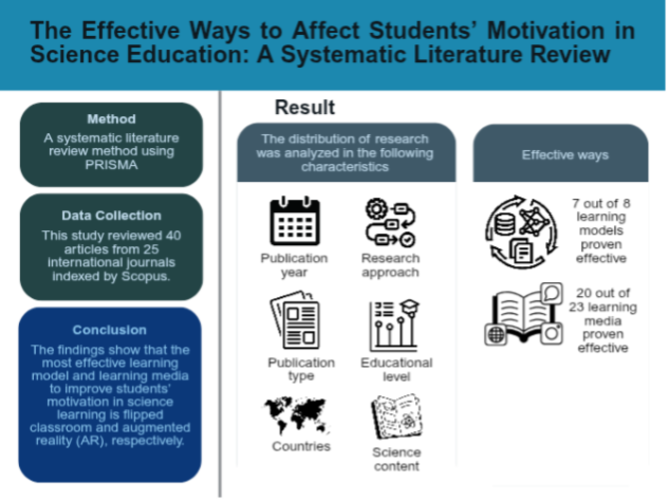
This study addresses a critical gap in science education research, where existing studies on student motivation largely analyze singular learning methods in isolation, lacking comprehensive, comparative assessments of diverse approaches. This research reviewed Scopus-indexed articles with 5 inclusion and exclusion criterias published from 2015 to 2025 to characterize research trends and identify effective learning models and media affecting student motivation in science education. The research method used was a systematic literature review using PRISMA method. This study analyzes the characteristics of content, including publication year, publication type, countries where the research was conducted, research approach, educational level, and science content. The articles included in this study were chosen from international journals. The research approaches applied in the articles are quantitative, qualitative, mixed method, and research and development. Furthermore, this study found that students’ motivation have been evaluated in various educational level (stage) for instance in elementary school, middle school, high school, and undergraduate. Moreover, the results of science content analysis showed that the evaluation of students’ motivation was found in Science, Physics, Biology, Chemistry, and the integration of science with other subjects. Our findings reveal that while research spans various educational levels and science topics, flipped classroom and augmented reality (AR) are highly effective in fostering student motivation. This study offers valuable insights for educators and researchers on implementing impactful strategies.
Keywords
Full Text:
Download PDFReferences
Afriani, L., Mutmainnah, & Sunarni. (2025). Understanding the Design of Research and Development Methods in the Field of Education. International Journal of Education and Social Science, 6.
Ahmad, K. R., Yuliartini, N. P. R., Ibrahim, M., & Hapipi, M. (2024). The Utilization of Virtual Reality Technology to Enhance Student Motivation in Mathematics Lessons: A Systematic Literature Review. International Seminar on Student Research in Education, Science, and Technology, 1, 235–243. http://journal.ummat.ac.id/index.php/issrestec
Ahmad, N. J., Yakob, N., Bunyamin, M. A. H., Winarno, N., & Akmal, W. H. (2021). The effect of interactive computer animation and simulation on students’ achievement and motivation in learning electrochemistry. Jurnal Pendidikan IPA Indonesia, 10(3), 311–324. https://doi.org/10.15294/JPII.V10I3.26013
Ahmed, I., Ghafoor, A., Liliuara, D., & Qurrota’ Akyuningrum, V. (2025). The impact of ai learning tools on ESL learners’ motivation and success: A systematic literature review. English Learning Innovation, 6, 134–142. https://doi.org/10.22219/englie
Alizkan, U., Wibowo, F. C., Sanjaya, L., Kurniawan, B. R., & Prahani, B. K. (2021). Trends of augmented reality in science learning: A review of the literature. Journal of Physics: Conference Series, 2019(1). https://doi.org/10.1088/1742-6596/2019/1/012060
Alonso, R. K., Velez, A., Diego Mantecón, M. Á., & Heredia Oliva, E. (2025). Blended learning in higher education for the development of intrinsic motivation: a systematic review. In Cogent Education (Vol. 12, Issue 1). Taylor and Francis Ltd. https://doi.org/10.1080/2331186X.2025.2487572
Argaw, A. S., Haile, B. B., Ayalew, B. T., & Kuma, S. G. (2017). The effect of problem based learning (PBL) instruction on students’ motivation and problem solving skills of physics. Eurasia Journal of Mathematics, Science and Technology Education, 13(3), 857–871. https://doi.org/10.12973/eurasia.2017.00647a
Artyukhov, A., Lapidus, A., Yeremenko, O., Artyukhova, N., & Churikanova, O. (2024). An R Studio Bibliometrix Analysis of Global Research Trends of Educational Crises in 2020s. SocioEconomic Challenges (SEC), 8(2).
Ashraf, M. A., Yang, M., Zhang, Y., Denden, M., Tlili, A., Liu, J., Huang, R., & Burgos, D. (2021). A systematic review of systematic reviews on blended learning: Trends, gaps and future directions. In Psychology Research and Behavior Management (Vol. 14, pp. 1525–1541). Dove Medical Press Ltd. https://doi.org/10.2147/PRBM.S331741
Aşıksoy, G. (2017). The effects of the gamified flipped classroom environment (GFCE) on students’ motivation, learning achievements and perception in a physics course. Quality and Quantity, 52, 129–145. https://doi.org/10.1007/s11135-017-0597-1
Azahra, A., Aisyah, D. R., Fitriah, M. F., & Anasta, N. D. C. (2025). Analisis Peran Guru dalam Meningkatkan Motivasi Belajar pada Siswa Sekolah Dasar. Journal on Education, 7(02), 10093–10106.
Azzahra, F., Rahmadita, J., & Hazmi, Z. (2024). The Effectiveness of Using Wordwall Website in Improving Science Learning Motivation in Elementary School: A Literature Review. In International Journal of Education and Learning Assessment (Vol. 01, Issue 01). Hal. https://scholar.google.com/.
Banda, H. J., & Nzabahimana, J. (2023). The impact of physics education technology (PhET) interactive simulation-based learning on motivation and academic achievement among malawian physics students. Journal of Science Education and Technology, 32(1), 127–141.
Başar, T. (2022). The Effect of Digital Stories on 3rd Graders’ Achievement, Attitudes and Motivation in Science Lesson. Participatory Educational Research, 9(5), 127–142. https://doi.org/10.17275/per.22.107.9.5
Bawaneh, A. K., & Alnamshan, M. M. (2023). Design Thinking in Science Education: Enhancing Undergraduate Students’ Motivation and Achievement in Learning Biology. International Journal of Information and Education Technology, 13(4), 621–633. https://doi.org/10.18178/ijiet.2023.13.4.1846
Byusa, E., Kampire, E., & Mwesigye, A. R. (2022). Game-based learning approach on students’ motivation and understanding of chemistry concepts: A systematic review of literature. In Heliyon (Vol. 8, Issue 5). Elsevier Ltd. https://doi.org/10.1016/j.heliyon.2022.e09541
Chan, Y. L., & Norlizah, C. H. (2017). Studentsâ Motivation towards Science Learning and Studentsâ Science Achievement. International Journal of Academic Research in Progressive Education and Development, 6(4). https://doi.org/10.6007/ijarped/v6-i4/3716
Chang, S. C., & Hwang, G. J. (2018). Impacts of an augmented reality-based flipped learning guiding approach on students’ scientific project performance and perceptions. Computers and Education, 125, 226–239. https://doi.org/10.1016/j.compedu.2018.06.007
Chans, G. M., & Portuguez Castro, M. (2021). Gamification as a strategy to increase motivation and engagement in higher education chemistry students. Computers, 10(10). https://doi.org/10.3390/computers10100132
Chen, C., Abdul Rabu, S. N., & Jamiat, N. (2025). ENHANCING PHYSICS LEARNING ACHIEVEMENT, MOTIVATION AND INQUIRY SKILLS IN A FLIPPED CLASSROOM: A STRUCTURED INQUIRY-BASED VIRTUAL LAB APPROACH. Journal of Baltic Science Education, 24(1), 37–52. https://doi.org/10.33225/jbse/25.24.37
Chen, C. H., & Chou, M. H. (2015). Enhancing middle school students’ scientific learning and motivation through agent-based learning. Journal of Computer Assisted Learning, 31(5), 481–492. https://doi.org/10.1111/jcal.12094
Cicuto, C. A. T., & Torres, B. B. (2016). Implementing an Active Learning Environment to Influence Students’ Motivation in Biochemistry. Journal of Chemical Education, 93(6), 1020–1026. https://doi.org/10.1021/acs.jchemed.5b00965
Ciloglu, T., & Ustun, A. B. (2023). The effects of mobile AR-based biology learning experience on students’ motivation, self‐efficacy, and attitudes in online learning. Journal of Science Education and Technology, 32(3), 309–337.
Corkin, D. M., Horn, C., & Pattison, D. (2017). The effects of an active learning intervention in biology on college students’ classroom motivational climate perceptions, motivation, and achievement. Educational Psychology, 37(9), 1106–1124. https://doi.org/10.1080/01443410.2017.1324128
Dixon, K., & Wendt, J. L. (2021). Science Motivation and Achievement Among Minority Urban High School Students: an Examination of the Flipped Classroom Model. Journal of Science Education and Technology, 30(5), 642–657. https://doi.org/10.1007/s10956-021-09909-0
Ellwood, R., & Abrams, E. (2018). Student’s social interaction in inquiry-based science education: how experiences of flow can increase motivation and achievement. Cultural Studies of Science Education, 13(2), 395–427. https://doi.org/10.1007/s11422-016-9769-x
Erbas, C., & Demirer, V. (2019). The effects of augmented reality on students’ academic achievement and motivation in a biology course. Journal of Computer Assisted Learning, 35(3), 450–458. https://doi.org/10.1111/jcal.12350
Faiqoh, E. (2023). SYSTEMATIC LITERATURE REVIEW: THE USE OF DIGITAL LEARNING MEDIA TO ENHANCE STUDENTS’ LEARNING MOTIVATION Elok Faiqoh. PROCEEDING THE SECOND ENGLISH NATIONAL SEMINAR" EXPLORING EMERGING TECHNOLOGIES IN ENGLISH EDUCATION, 16–22.
Filgona, J., Sakiyo, J., Gwany, D. M., & Okoronka, A. U. (2020). Motivation in Learning. Asian Journal of Education and Social Studies, 16–37. https://doi.org/10.9734/ajess/2020/v10i430273
Firdaus, Z., & Murtiyasa, B. (2021). Learning Metabolic System Using Phet Simulation to Improve Student Motivation. Proceeding of The Progressive and Fun Education International Conference, 161–169.
Fitria, T. N. (2023). The impact of gamification on students’ motivation: A Systematic Literature Review. LingTera, 9(2), 47–61. https://doi.org/10.21831/lt.v9i2.56616
Fukuzawa, S., Boyd, C., & Cahn, J. (2017). Student Motivation in Response to Problem-based Learning. Collected Essays on Learning and Teaching, 10, 175–188. https://doi.org/10.22329/celt.v10i0.4748
Gani, A., Syukri, M., Khairunnisak, K., Nazar, M., & Sari, R. P. (2020). Improving concept understanding and motivation of learners through Phet simulation word. Journal of Physics: Conference Series, 1567(4). https://doi.org/10.1088/1742-6596/1567/4/042013
Hariyono, E., Rizki, I. A., Lestari, D. A., Citra, N. F., Islamiyah, A. N., & Agusty, A. I. (2023). ENGKLEK GAME ETHNOSCIENCE-BASED LEARNING MATERIAL (EGEBLM) TO IMPROVE STUDENTS’ CONCEPTUAL UNDERSTANDING AND LEARNING MOTIVATION. Jurnal Pendidikan IPA Indonesia, 12(4), 635–647. https://doi.org/10.15294/jpii.v12i4.43941
Hursen, C., & Bas, C. (2019). Use of gamification applications in science education. International Journal of Emerging Technologies in Learning, 14(1), 4–23. https://doi.org/10.3991/ijet.v14i01.8894
Ilma, A. Z., Wilujeng, I., Widowati, A., Nurtanto, M., & Kholifah, N. (2023). A Systematic Literature Review of STEM Education in Indonesia (2016-2021): Contribution to Improving Skills in 21st Century Learning. Pegem Egitim ve Ogretim Dergisi, 13(2), 134–146. https://doi.org/10.47750/pegegog.13.02.17
Insyasiska, D., Zubaidah, S., & Susilo, H. (2015). PENGARUH PROJECT BASED LEARNING TERHADAP MOTIVASI. https://www.researchgate.net/publication/322468052
Ishida, A., & Sekiyama, T. (2024). Variables influencing students’ learning motivation: critical literature review. In Frontiers in Education (Vol. 9). Frontiers Media SA. https://doi.org/10.3389/feduc.2024.1445011
Jannah, A., Mahfud, M. Z., & Komarayanti, S. (2023). The IMPLEMENTATION OF PjBL TO INCREASE STUDENTS’LEARNING ACTIVITY AND MOTIVATION AT SMA MUHAMMADIYAH 3 JEMBER. ScienceEdu, 23–31.
Jayaweera, D., Flume, P. A., Singer, N. G., Cohen, M. S., Lachiewicz, A. M., Cameron, A., Kumar, N., Thompson, J., Cabrera, A., Daudelin, D., Shaker, R., & Bauer, P. R. (2021). Prioritizing studies of COVID-19 and lessons learned. Journal of Clinical and Translational Science, 5(1). https://doi.org/10.1017/cts.2021.784
Jdaitawi, M. (2020). Does flipped learning promote positive emotions in science education? A comparison between traditional and flipped classroom approaches. Electronic Journal of E-Learning, 18(6), 516–524. https://doi.org/10.34190/JEL.18.6.004
Jordan, S. (2012). Student engagement with assessment and feedback: Some lessons from short-answer free-text e-assessment questions. Computers & Education, 58(2), 818–834.
Khan, T., Johnston, K., & Ophoff, J. (2019). The impact of an augmented reality application on learning motivation of students. Advances in Human‐Computer Interaction, 2019(1), 7208494.
Kholifah, E. R., & Sofwan, M. (2024). Comparison of Data Collection Methods: Advantages and Disadvantages. Jurnal Kepemimpinan Dan Pengurusan Sekolah, 9(4), 519–525.
Kumar, P., & Mithun, D. (2024). A Novel Approach to Educational Augmented Reality: Real-Time Enhancement and Interactivity. 2024 Third International Conference on Intelligent Techniques in Control, Optimization and Signal Processing (INCOS), 1–6.
Lai, E. R. (2011). Motivation: A Literature Review Research Report. http://www.pearsonassessments.com/research.
Lam, C. P., & Siew, N. M. (2024). Flipped classroom in science education: Correlating student experience with attitudes. Problems of Education in the 21st Century, 82(5), 672.
Lee, G. G., Jeon, Y. E., & Hong, H. G. (2021). The effects of cooperative flipped learning on science achievement and motivation in high school students. International Journal of Science Education, 43(9), 1381–1407. https://doi.org/10.1080/09500693.2021.1917788
Liu, Q., Ma, J., Yu, S., Wang, Q., & Xu, S. (2023). Effects of an augmented reality-based chemistry experiential application on student knowledge gains, learning motivation, and technology perception. Journal of Science Education and Technology, 32(2), 153–167.
Liu, R., Wang, L., Koszalka, T. A., & Wan, K. (2022). Effects of immersive virtual reality classrooms on students’ academic achievement, motivation and cognitive load in science lessons. Journal of Computer Assisted Learning, 38(5), 1422–1433.
Meulenbroeks, R., van Rijn, R., & Reijerkerk, M. (2024). Fostering Secondary School Science Students’ Intrinsic Motivation by Inquiry-based Learning. Research in Science Education, 54(3), 339–358. https://doi.org/10.1007/s11165-023-10139-0
Mustapha, M. Z., & Abdullah, N. (2024). The Effects of Flipped Classroom Teaching Method on Science Studentsâ€TM Higher Order Thinking Skills, Engagement and Satisfaction. International Journal of Research and Innovation in Social Science, 8(3s), 3389–3403.
Nazeer, S., Somu, K. B., & Roobini, M. S. (2023). Interactive learning using mobile based augmented reality application. 2023 International Conference on Advances in Computing, Communication and Applied Informatics (ACCAI), 1–7.
Nikou, S. A., & Economides, A. A. (2015). The impact of paper-based, computer-based and mobile-based self-assessment on students’ science motivation and achievement. Computers in Human Behavior, 55, 1241–1248. https://doi.org/10.1016/j.chb.2015.09.025
Nikou, S. A., & Economides, A. A. (2018). Mobile-Based micro-Learning and Assessment: Impact on learning performance and motivation of high school students. Journal of Computer Assisted Learning, 34(3), 269–278. https://doi.org/10.1111/jcal.12240
Nkereuwem, I. V., Obi, N. C., & Oyovwikoghene, S. (2023). Relationship Between Chatbots and AI-Powered Gamification on Chemistry Students’ Motivation. The African Journal of Science, Technology and Mathematics Education, 9(5), 317–322. https://www.researchgate.net/publication/376133480
Okariz, A., Huebra, M., Sarasola, A., Ibarretxe, J., Bidegain, G., & Zubimendi, J. L. (2023). Gamifying Physics Laboratory Work Increases Motivation and Enhances Acquisition of the Skills Required for Application of the Scientific Method. Education Sciences, 13(3). https://doi.org/10.3390/educsci13030302
Özarslan, M., & Çetin, G. (2018). Effects of biology project studies on gifted and talented students’ motivation toward learning biology. Gifted Education International, 34(3), 205–221. https://doi.org/10.1177/0261429417754203
Pati, D., & Lorusso, L. N. (2018). How to Write a Systematic Review of the Literature. Health Environments Research and Design Journal, 11(1), 15–30. https://doi.org/10.1177/1937586717747384
Radulović, B., Dorocki, M., Ninković, S. O., Stojanović, M., & Adamov, J. (2023). THE EFFECTS OF BLENDED LEARNING APPROACH ON STUDENT MOTIVATION FOR LEARNING PHYSICS. Journal of Baltic Science Education, 22(1), 73–82. https://doi.org/10.33225/jbse/23.22.73
Ramadhani, D., Suriani, A., Nisa, S., Hamka, J., & Tawar Barat, A. (2024). Hubungan Antara Motivasi Belajar dan Prestasi Akademik Dalam Mata Pelajaran IPA di Sekolah Dasar. Jurnal Bintang Pendidikan Indonesia, 2, 249–254. https://doi.org/10.62383/jembatan.v2i3.3108
Ryan, R. M., & Deci, E. L. (2000). Intrinsic and Extrinsic Motivations: Classic Definitions and New Directions. Contemporary Educational Psychology, 25(1), 54–67. https://doi.org/10.1006/ceps.1999.1020
Saadon, N. F. S. M., Ahmad, I., & Pee, A. N. C. (2020). The Implementation of Augmented Reality in Increasing Student Motivation: Systematic Literature Review. IOP Conference Series: Materials Science and Engineering, 854(1). https://doi.org/10.1088/1757-899X/854/1/012043
Schmidthaler, E., Anđic, B., Schmollmüller, M., Sabitzer, B., & Lavicza, Z. (2023). MOBILE AUGMENTED REALITY IN BIOLOGICAL EDUCATION: PERCEPTIONS OF AUSTRIAN SECONDARY SCHOOL TEACHERS. Journal on Efficiency and Responsibility in Education and Science, 16(2), 113–127. https://doi.org/10.7160/eriesj.2023.160203
Shi, Y., Tong, M., & Long, T. (2021). Investigating relationships among blended synchronous learning environments, students’ motivation, and cognitive engagement: A mixed methods study. Computers and Education, 168. https://doi.org/10.1016/j.compedu.2021.104193
Srisawasdi, N., & Panjaburee, P. (2019). Implementation of Game-transformed Inquiry-based Learning to Promote the Understanding of and Motivation to Learn Chemistry. Journal of Science Education and Technology, 28(2), 152–164. https://doi.org/10.1007/s10956-018-9754-0
Su, C. H., & Cheng, C. H. (2015). A mobile gamification learning system for improving the learning motivation and achievements. Journal of Computer Assisted Learning, 31(3), 268–286. https://doi.org/10.1111/jcal.12088
Susilawati, A., Yusrizal, Y., Halim, A., Syukri, M., Khaldun, I., & Susanna, S. (2022). Effect of Using Physics Education Technology (PhET) Simulation Media to Enhance Students’ Motivation and Problem-Solving Skills in Learning Physics. Jurnal Penelitian Pendidikan IPA, 8(3), 1157–1167. https://doi.org/10.29303/jppipa.v8i3.1571
Teplá, M., & Distler, P. (2025). The impact of long-term inquiry-based science education on students’ motivation and knowledge acquisition: the role of gender, subject, and level of inquiry. Humanities and Social Sciences Communications, 12(1). https://doi.org/10.1057/s41599-025-04437-3
Tuan, H. L., Chin, C. C., & Shieh, S. H. (2005). The development of a questionnaire to measure students’ motivation towards science learning. International Journal of Science Education, 27(6), 639–654. https://doi.org/10.1080/0950069042000323737
Vero, E., & Puka, E. (2017). The Importance of Motivation in an Educational Environment. Pensa MultiMedia, 15, 57–66.
VÎȘCU, I. (2024). Optimizing the educational environment for implementing active learning methodologies. Acta et Commentationes: Științe Ale Educației, 37(3), 97–105. https://doi.org/10.36120/2587-3636.v37i3.97-105
Williams, K. C., & Williams, C. C. (2011). Five key ingredients for improving student motivation. Research in Higher Education Journal, 12, 1.
Willoughby, B. R., Flack, N. A. M. S., Bird, R. J., & Woodley, S. J. (2024). Motivation to learn in university science students studying anatomy: A mixed-methods analysis of what drives learning. Anatomical Sciences Education, 17(4), 818–830. https://doi.org/10.1002/ase.2416
Xiao, Y., & Watson, M. (2019). Guidance on Conducting a Systematic Literature Review. In Journal of Planning Education and Research (Vol. 39, Issue 1, pp. 93–112). SAGE Publications Inc. https://doi.org/10.1177/0739456X17723971
Yuliastini, I. B., Rahayu, S., Fajaroh, F., & Mansour, N. (2018). Effectiveness of pogil with ssi context on vocational high school students’ chemistry learning motivation. Jurnal Pendidikan IPA Indonesia, 7(1), 85–95. https://doi.org/10.15294/jpii.v7i1.9928
Zhang, Y., Mang, H. A., Hajama, S., & Chu, H. E. (2025). Systematic Review: Influences of Fully Immersive Virtual Reality on Students’ Motivation in Learning Science. Asia-Pacific Science Education. https://doi.org/10.1163/23641177-bja10090
Ziden, A. A., Ziden, A. A. A., & Ifedayo, A. E. (2022). Effectiveness of Augmented Reality (AR) on Students’ Achievement and Motivation in Learning Science. Eurasia Journal of Mathematics, Science and Technology Education, 18(4). https://doi.org/10.29333/ejmste/11923
DOI: https://doi.org/10.17509/jsl.v9i1.90189
Refbacks
- There are currently no refbacks.

Copyright (c) 2026 Anugrah Puspa Inda Pratiwi, Nanang Winarno, Amaira Utami, Andi Suhandi, Rohim Aminullah Firdaus

This work is licensed under a Creative Commons Attribution-ShareAlike 4.0 International License.


Jl. Dr. Setiabudhi 229 Bandung 40154, West Java, Indonesia