







Trends on Computational Thinking (CT) in Science Education Research (SER) (2015-2024): Bibliometrics and Content Analysis
Abstract
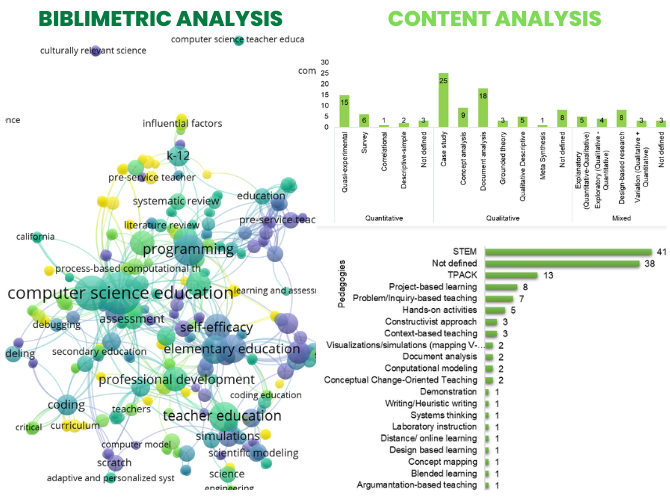
This study examines research methods, target groups, technologies and pedagogies, institutions and countries involved in CT research in the SER literature. Bibliometric analysis of 137 articles identified in the SCIE and SSCI Web of Science (WoS) databases. A total of 120 articles were also subjected to content analysis. 17 articles were excluded from the content analysis because the full texts were not accessible. The results indicate that the studies focused on CT itself from 2015 to 2018, whereas from 2019 to 2020, CT was linked to computer science education, science education, teaching and learning strategies, and teacher education. However, CT has become the dominant topic, accompanied by the concept of assessment. From 2021--2022, the SARS-CoV-2 pandemic led studies focusing on programming, assessment, computer science education, robots, science education and teacher education.
Keywords
Full Text:
Download PDFReferences
Aria, M., & Cuccurullo, C. (2017). Bibliometrix: An R-tool for comprehensive science mapping analysis. Journal of Informetrics, 11(4), 959-975. https://doi.org/10.1016/j.joi.2017.08.007
Barr, D., Harrison, J. & Conery, L. (2011). Computational thinking: A digital age skill for everyone. Learning & Leading with Technology, 38(6), 20-23. Access Date: https://files.eric.ed.gov/fulltext/EJ918910.pdf
Barr, V. & Stephenson, C. (2011). Bringing computational thinking to k-12: what is ınvolved and what is the role of the computer science education community? ACM Inroads, 2(1), 48-54. DOI:10.1145/1929887.1929905
Bundy, A. (2007). Computational thinking is pervasive. Access: http://www.inf.ed.ac.uk/publications/online/1245.pdf , Access Date: 17.08.2024
Calder, N. (2010). Using Scratch: an integrated problem-solving app-roach to mathematical thinking, Australian Primary Mathematics Classroom, 15(4), 9- 14.
Choi, J. Lee, Y., & Lee, E. (2016). Puzzle based algorithm learning for cultivating computational thinking. Wireless Personal Communications, 93(1), 131-145. DOI:10.1007/s11277-016-3679-9
CSTA & ISTE (2011). Computational Thinking Teacher Resources, Second Edition. http://www.iste.org/docs/ct-documents/ct-teacher- resources_2ed-pdf.pdf?sfvrsn=2
Denning, P. J. (2017) Computational thinking in science. American Scientist, 150, 13- 17. http://denninginstitute.com/pjd/PUBS/AmSci-2017-ct-science.pdf
Denning, P. J., & Martell, C. H. (2015). Great principles of computing. MIT (Massachusetts Institute of Technology).
Donthu, N., Kumar, Mukherjee, Pandey, & Lim (2021). How to conduct a bibliometric analysis: An overview and guidelines? Journal of Business Research, 133, 285-296. https://doi.org/10.1016/j.jbusres.2021.04.070Doi: 10.1016/j.jbusres.2021.04.070
Gretter, S., & Yadav, A. (2016). Computational thinking and media & information literacy: An integrated approach to teaching twenty-first century skills. TechTrends, 60, 510-516. http://dx.doi.org/10.1007/s11528-016-0098-4
Gülbahar, Y., Kalelioğlu, F., Doğan, D. & Karataş, E. (2020). Bebras: A social approach for concept based learning of ınformatics and computational thinking. Ankara University Journal of Faculty of Educational Sciences (JFES), 53 (1), 241-272. https://doi.org/10.30964/auebfd.560771
ISTE (2016) ISTE Standards For Students(Permitted Educational Use). https://www.computacional.com.br/files/ISTE-CSTA/ISTE%20-%20Standards%20for%20Students%202016.pdf
ISTE & CSTA, (2011). Operational definition of computational thinking for K–12 education. https://cdn.iste.org/www-root/Computational_Thinking_Operational_Definition_ISTE.pdf
Jaipal-Jamani, K., & Angeli, C. (2017). Effect of robotics on elementary preservice teachers’ self-efficacy, science learning, and computational thinking. Journal of science education and technology, 26, 175-192. DOI 10.1007/s10956-016-9663-z
Ketelhut, D. J., Mills, K., Hestness, E., Cabrera, L., Plane, J., & McGinnis, J. R. (2020). Teacher change following a professional development experience in integrating computational thinking into elementary science. Journal of Science Education and Technology, 29, 174-188. https://doi.org/10.1007/s10956-019-09798-4
Kite, V., & Park, S. (2022). Preparing inservice science teachers to bring unplugged computational thinking to their students. Teaching and Teacher Education, 120, 1-11. https://doi.org/10.1016/j.tate.2022.103904
Lai, C. S., & Lai, M. H. (2012, June). Using computer programming to enhance science learning for 5th graders in Taipei. In 2012 International Symposium on Computer, Consumer and Control (pp. 146-148). IEEE. DOI:10.1109/IS3C.2012.45
Resnick, M., & Robinson, K. (2017). Lifelong kindergarten: Cultivating creativity through projects, passion, peers, and play. MIT.
Román-González, M., Pérez-González, J. C., & Jiménez-Fernández, C. (2017). Whi- ch cognitive abilities underlie computational thinking? Criterion validity of the Computational Thinking Test. Computers in Human Behavior, 72, 678-691. https://doi.org/10.1016/j.chb.2016.08.047
Sands, P., Yadav, A., & Good, J. (2018). Computational thinking in K-12: In-service teacher perceptions of computational thinking. Computational thinking in the STEM disciplines: Foundations and research highlights, 151-164.
UNESCO. (2023). Technology in education: A tool on whose terms? Scientific and Cultural Organization. https://doi.org/10.54676/UZQV8501
Weinberg, A. E. (2013). Computational thinking: An investigation of the existing scholarship and research. [Doctoral dissertation, Colorado State University], Colorado.
Wing, J.M., 2006. Computational thinking. Communications of the ACM, 49(3), 33-35. https://doi.org/10.1145/1118178.111821
DOI: https://doi.org/10.17509/jsl.v9i1.91698
Refbacks
- There are currently no refbacks.

Copyright (c) 2026 Betül Okcu, Dilek Teke, Mustafa Sözbilir

This work is licensed under a Creative Commons Attribution-ShareAlike 4.0 International License.


Jl. Dr. Setiabudhi 229 Bandung 40154, West Java, Indonesia