







Future Research Directions Of Problem-Based Learning and E-Modules In 21st-Century Physics Education: A Bibliometric Analysis
Abstract
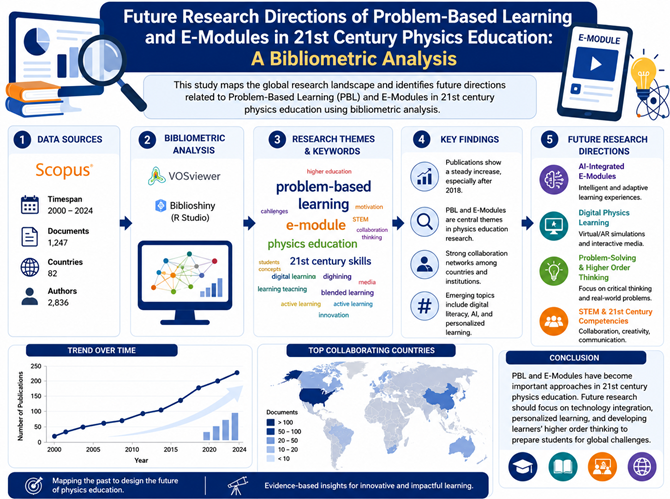
This study aims to analyze research trends and future directions related to Problem-Based Learning (PBL) and e-modules in 21st-century physics education through a bibliometric approach. An analysis was conducted of 281 scientific articles published between 2015 and 2025 and indexed in international databases, using keywords related to PBL, e-modules, and physics education. Bibliometric and VOSviewer were used to map publication trends, productive sources, and keyword networks. The results show a significant increase in publications after 2019, with PBL remaining the primary approach related to problem-solving, while e-modules serve as digital learning resources that support structured and self-directed learning. Physics education largely serves as an implementation context, indicating that the integration of PBL and e-modules specific to the physics discipline is still limited. These findings provide a strategic foundation for the development of PBL-based e-modules and serve as a guide for empirical research and curriculum innovation in 21st-century physics education.
Keywords
Full Text:
Download PDFReferences
Ali, S. S. (2019). Problem Based Learning: A Student-Centered Approach. English Language Teaching, 12(5), 73. https://doi.org/10.5539/ELT.V12N5P73
Alviz-Meza, A., Vásquez-Coronado, M. H., Delgado-Caramutti, J. G., & Blanco-Victorio, D. J. (2022). Bibliometric analysis of fourth industrial revolution applied to heritage studies based on web of science and scopus databases from 2016 to 2021. Heritage Science 2022 10:1, 10(1), 189-. https://doi.org/10.1186/s40494-022-00821-3
Anazifa, R. D., & Djukri. (2017). Project- based learning and problem- based learning: Are they effective to improve student’s thinking skills? Jurnal Pendidikan IPA Indonesia, 6(2), 346–355. https://doi.org/10.15294/JPII.V6I2.11100
Aria, M., & Cuccurullo, C. (2017). bibliometrix: An R-tool for comprehensive science mapping analysis. Journal of Informetrics, 11(4), 959–975. https://doi.org/10.1016/J.JOI.2017.08.007
Ariantini, K. P., Suwastini, N. K. A., Adnyani, N. L. P. S., Dantes, G. R., & Jayantini, I. G. A. S. R. (2021). Integrating Social Media into English Language Learning: How and to What Benefits According to Recent Studies. NOBEL: Journal of Literature and Language Teaching, 12(1), 91–111. https://doi.org/10.15642/NOBEL.2021.12.1.91-111
Azer, S. A. (2017). Top-Cited Articles in Problem-Based Learning: A Bibliometric Analysis and Quality of Evidence Assessment. Journal of Dental Education, 81(4), 458–478. https://doi.org/10.21815/JDE.016.011
Bashir, F., & Warraich, N. F. (2023). Systematic literature review of Semantic Web for distance learning. Interactive Learning Environments, 31(1), 527–543. https://doi.org/10.1080/10494820.2020.1799023
Belay, F., Berhane, D., Teshale, H., Mulubrhan, G., Hagos, T., Gebremariam, H., Brhane, T., & Islam, Z. (2023). The effect of war on educational institutions of Eastern Tigray zone, Tigray state, Ethiopia. International Journal of Educational Development, 102, 102864. https://doi.org/10.1016/J.IJEDUDEV.2023.102864
Branch, W. A. (2004). The Theory of Rationally Heterogeneous Expectations: Evidence from Survey Data on Inflation Expectations. Economic Journal, 114(497), 592–621. https://ideas.repec.org/a/ecj/econjl/v114y2004i497p592-621.html
Donthu, N., Kumar, S., Mukherjee, D., Pandey, N., & Lim, W. M. (2021). How to conduct a bibliometric analysis: An overview and guidelines. Journal of Business Research, 133, 285–296. https://doi.org/10.1016/J.JBUSRES.2021.04.070
Dwi Astutik, R., Niswati, M., & Jauhariyah, R. (2021). Studi Meta Analisis Problem Based Learning dalam Pembelajaran Fisika. Orbita, 7(1), 159–168. https://doi.org/10.31764/ORBITA.V7I1.4525
Ernawati, E., & Rahmawati, R. (2021). Application of Problem Based Learning Model to Mathematical Thinking Ability. EduMa: Mathematics Education Learning and Teaching, 10(2), 187–197. https://doi.org/10.24235/EDUMA.V10I2.9060
Fullan, M., Mackay, T., Redman, K., Cropley, M., & Miller, A. (2021). The right drivers for whole system success CSE LEADING EDUCATION SERIES. The Cntre for Strategic Education. https://michaelfullan.ca/wp-content/uploads/2021/03/Fullan-CSE-Leading-Education-Series-01-2021R2-compressed.pdf
Garzón, J., Kinshuk, Baldiris, S., Gutiérrez, J., & Pavón, J. (2020). How do pedagogical approaches affect the impact of augmented reality on education? A meta-analysis and research synthesis. Educational Research Review, 31, 100334. https://doi.org/10.1016/J.EDUREV.2020.100334
Goos, M., Pipa, J., & Peixoto, F. (2021). Effectiveness of grade retention: A systematic review and meta-analysis. Educational Research Review, 34, 100401. https://doi.org/10.1016/J.EDUREV.2021.100401
Handoyo, W. S., & Safran, S. (2025). Enhancing Problem-Solving Skills on Ethnic Diversity Through Problem-Based Learning in Fifth-Grade Students. Journal of Social Work and Science Education, 6(3), 1088–1097. https://doi.org/10.52690/JSWSE.V6I3.1251
Hidayati, I. N., Berliana, C. I., & Zaman, B. (2024). Penerapan Metode Problem Based Learning dalam Meningkatkan Berfikir Kritis Pada Pembelajaran PAI. Journal of Instructional and Development Researches, 4(6), 540–550. https://doi.org/10.53621/JIDER.V4I6.418
Hinojo-Lucena, F. J., Aznar-Díaz, I., Cáceres-Reche, M. P., & Romero-Rodríguez, J. M. (2019). Artificial Intelligence in Higher Education: A Bibliometric Study on its Impact in the Scientific Literature. Education Sciences 2019, Vol. 9, Page 51, 9(1), 51. https://doi.org/10.3390/EDUCSCI9010051
Hmelo-Silver, C. E. (2004). Problem-based learning: What and how do students learn? Educational Psychology Review, 16(3), 235–266. https://doi.org/10.1023/B:EDPR.0000034022.16470.F3/METRICS
Howard, S. K., Tondeur, J., Ma, J., & Yang, J. (2021). What to teach? Strategies for developing digital competency in preservice teacher training. Computers & Education, 165, 104149. https://doi.org/10.1016/J.COMPEDU.2021.104149
Huang, C. J., Thirumalraj, B., Tao, H. C., Shitaw, K. N., Sutiono, H., Hagos, T. T., Beyene, T. T., Kuo, L. M., Wang, C. C., Wu, S. H., Su, W. N., & Hwang, B. J. (2021). Decoupling the origins of irreversible coulombic efficiency in anode-free lithium metal batteries. Nature Communications 2021 12:1, 12(1), 1452-. https://doi.org/10.1038/s41467-021-21683-6
Kalonde, G., Boateng, S., Duedu, C., Kalonde, G., Boateng, S., & Duedu, C. (2025). Artificial Intelligence in Classroom Assessment: Opportunities, Equity Challenges, and Best Practices for Formative and Summative Integration. Open Access Library Journal, 12(9), 1–16. https://doi.org/10.4236/OALIB.1114121
Luciani, M., Barisone, M., Bentivegna, M., Fioremisto, A., Galeazzi, G., La Monica, M. A., Musci, A., Ausili, D., & Dal Molin, A. (2024). Italian Nursing Research: A Bibliometric Analysis from 1980 to 2020. Nursing Reports, 14(4), 3933–3942. https://doi.org/10.3390/NURSREP14040287/S1
Luckin, R., & Cukurova, M. (2019). Designing educational technologies in the age of AI: A learning sciences-driven approach. British Journal of Educational Technology, 50(6), 2824–2838. https://doi.org/10.1111/BJET.12861
Musa’ad, F., Ahmad, R. E., Sundari, S., & Hidayani, H. (2024). Pembelajaran Berbasis Proyek untuk Meningkatkan Kemampuan Berpikir Kritis Siswa. Jurnal Cendekia : Jurnal Pendidikan Matematika, 8(2), 1481–1487. https://doi.org/10.31004/CENDEKIA.V8I2.3361
Musridannur. (2025). Implementation of Problem Based Learning Model to Improve Student Learning Outcomes in Islamic Education Learning at SD Negeri 341 Batahan. Jurnal Cendekia Islam Indonesia, 1(1), 404–418. https://doi.org/10.62945/JCII.V1I1.130
OECD. (2022). OECD Economic Outlook, Volume 2022 Issue 2: Confronting the Crisis. OECD Economic Outlook, OECD Economic Outlook, 2022(2). https://doi.org/10.1787/F6DA2159-EN
Page, M. J., McKenzie, J. E., Bossuyt, P. M., Boutron, I., Hoffmann, T. C., Mulrow, C. D., Shamseer, L., Tetzlaff, J. M., Akl, E. A., Brennan, S. E., Chou, R., Glanville, J., Grimshaw, J. M., Hróbjartsson, A., Lalu, M. M., Li, T., Loder, E. W., Mayo-Wilson, E., McDonald, S., … Moher, D. (2021). The PRISMA 2020 statement: an updated guideline for reporting systematic reviews. BMJ, 372. https://doi.org/10.1136/BMJ.N71
Puspa, V. R., Hidayat, T., & Supriatno, B. (2021). Development of android-based digital determination key application (e-KeyPlant) as learning media for plant identification. Journal of Physics: Conference Series, 1806(1), 012145. https://doi.org/10.1088/1742-6596/1806/1/012145
Riyadi, S., Fauziah, N., 2b, A., Ningtyas, D. A., Widiyanah, I., & Bachri, S. (2025). Implementasi Pendekatan Deep Learning dalam Peningkatan Kualitas Pembelajaran di Sekolah Dasar Darul Ilmi Surabaya. Paradigma: Jurnal Filsafat, Sains, Teknologi, Dan Sosial Budaya, 31(2), 648–653. https://doi.org/10.33503/PARADIGMA.V31I2.2598
Sari, M., & Rosidah, A. (2023). Implementasi Model Pembelajaran Problem Based Learning (PBL) Terhadap Hasil Belajar IPS SD. Jurnal Ilmiah Pendidik Indonesia, 2(1), 8–17. https://doi.org/10.56916/JIPI.V2I1.307
Sarıkaya, Ö., & Çeliker, H. D. (2024). A Bibliometric Analysis of Publications on Problem- Based Learning. Bartın University Journal of Faculty of Education, 13(3), 453–466. https://doi.org/10.14686/BUEFAD.1088208
Schmidt, H. G., Rotgans, J. I., & Yew, E. H. J. (2011). The process of problem-based learning: What works and why. Medical Education, 45(8), 792–806. https://doi.org/10.1111/J.1365-2923.2011.04035.X;PAGE:STRING:ARTICLE/CHAPTER
Smarandache, I. G., Maricutoiu, L. P., Ilie, M. D., Iancu, D. E., & Mladenovici, V. (2022). Students’ approach to learning: evidence regarding the importance of the interest-to-effort ratio. Higher Education Research & Development, 41(2), 546–561. https://doi.org/10.1080/07294360.2020.1865283
Sulhiyah, S. (2025). Research Trends of Problem Based Learning (PBL) Based E-Modules to Improve Students’ Science Process Skills in Science Learning: Bibliometric Analysis (2015-2024). International Journal of Science Education and Science, 2(2), 144–152. https://doi.org/10.56566/IJSES.V2I2.265
Suliyanah, Adelia, B. D., Jauhariyah, M. N. R., Misbah, Mahtari, S., Saregar, A., & Deta, U. A. (2021). A bibliometric analysis of minimum competency assessment research with VOS viewer related to the impact in physics education on 2019-2020. Journal of Physics: Conference Series, 2110(1). https://doi.org/10.1088/1742-6596/2110/1/012022
Suprapto, N., Prahani, B. K., & Cheng, T. H. (2021). Indonesian curriculum reform in policy and local wisdom: Perspectives from science education. Jurnal Pendidikan IPA Indonesia, 10(1), 69–80. https://doi.org/10.15294/JPII.V10I1.28438
Sutarmi, K., & Suarjana, I. M. (2017). Peningkatan Hasil Belajar Siswa Menggunakan Metode Problem Solving dalam Pembelajaran. Jurnal Ilmiah Sekolah Dasar, 1(2), 75–82. https://doi.org/10.23887/JISD.V1I2.10141
Suwastini, N. K. A., Puspawati, N. W. N., Adnyani, N. L. P. S., Dantes, G. R., & Rusnalasari, Z. D. (2021). Problem-based learning and 21st-century skills: Are they compatible? EduLite: Journal of English Education, Literature and Culture, 6(2), 326–340. https://doi.org/10.30659/E.6.2.326-340
van Eck, N. J., & Waltman, L. (2010). Software survey: VOSviewer, a computer program for bibliometric mapping. Scientometrics, 84(2), 523–538. https://doi.org/10.1007/S11192-009-0146-3
Yew, E. H. J., & Goh, K. (2016). Problem-Based Learning: An Overview of its Process and Impact on Learning. Health Professions Education, 2(2), 75–79. https://doi.org/10.1016/J.HPE.2016.01.004
Zawacki-Richter, O., Marín, V. I., Bond, M., & Gouverneur, F. (2019). Systematic review of research on artificial intelligence applications in higher education – where are the educators? International Journal of Educational Technology in Higher Education 2019 16:1, 16(1), 39-. https://doi.org/10.1186/S41239-019-0171-0
Zhang, L., Lin, X., Wang, Y., & Liu, Y. (2022). Sleep quality in patients with gastroesophageal reflux disease: A polysomnographic study. Journal of Neurogastroenterology and Motility, 28, 289–297.
DOI: https://doi.org/10.17509/jsl.v9i2.97292
Refbacks
- There are currently no refbacks.

Copyright (c) 2026 Rizka Eka Firnanda, Dwikoranto Dwikoranto, Rahmatta Thoriq Lintangesukmanjaya, Lindsay Natalia Bergsma

This work is licensed under a Creative Commons Attribution-ShareAlike 4.0 International License.


Jl. Dr. Setiabudhi 229 Bandung 40154, West Java, Indonesia