







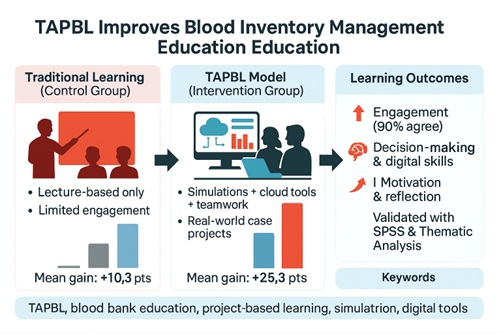
Effectiveness of Technology-Assisted Project-Based Learning Model in Teaching Blood Inventory Management Principles to Blood Bank Technology Students
Abstract
Keywords
Full Text:
Download PDFReferences
Abidi, S. M. A., Qureshi, F., & Fatima, S. K. (2025). Integrating Community Perspectives to Improve Healthcare Interventions: A Qualitative Analysis of Focus Group Discussions for Students-Led Clinics in Karachi. Global Advances in Integrative Medicine and Health, 14. https://doi.org/10.1177/27536130251353172
Alharbi, N. S. (2024). Evaluating competency-based medical education: a systematized review of current practices. BMC Medical Education, 24(1). https://doi.org/10.1186/s12909-024-05609-6
Astuti, N. W., Purnamaningsih, N., & Sunarsih, T. (2021). Overview of Blood Stocks and Demand During the COVID-19 Pandemic in Blood Donation Unit PMI Sleman Yogyakarta. Jurnal Profesi Medika : Jurnal Kedokteran Dan Kesehatan, 15(1). https://doi.org/10.33533/jpm.v15i1.2910
Baidoo, B., Ankomah, E., Alhassan, M., Benya, G., Obike, E., Benfo, A., Boachie, J., & Adu, P. (2024). Mixed-methods exploration of the knowledge of young adults about blood donation processes; a one-center cross-sectional study in a tertiary institution. PLoS ONE, 19(1 January). https://doi.org/10.1371/journal.pone.0295600
Bates, I., & Owusu-Ofori, S. (2020). Blood Transfusion. Manson’s Tropical Diseases, 229. https://doi.org/10.1016/B978-1-4160-4470-3.50018-5
Cabero-Almenara, J., De-La-Portilla-De-Juan, F., Barroso-Osuna, J., & Palacios-Rodríguez, A. (2023). Technology-Enhanced Learning in Health Sciences: Improving the Motivation and Performance of Medical Students with Immersive Reality. Applied Sciences (Switzerland), 13(14). https://doi.org/10.3390/app13148420
Chien, J. H., Yao, C. Y., Chen, H. F., & Ho, T. F. (2025). Trends in blood transfusion and causes of blood wastage: a retrospective analysis in a teaching hospital. BMC Health Services Research, 25(1). https://doi.org/10.1186/s12913-024-12170-x
Doherty, I. (2024). Technology Enhanced Learning in Medical Education. In Oxford Handbook of Medical Education. Oxford. https://www.researchgate.net/publication/386251176
Elkhamisy, F. A. A., Zidan, A. H., & Fathelbab, M. F. (2022). Using project-based learning to enhance curricular integration and relevance of basic medical sciences in pre-clerkship years. Alexandria Journal of Medicine, 58(1), 1–7. https://doi.org/10.1080/20905068.2021.2009652
Filetti, S., & Saso, L. (2020). Innovative Medical Education in the Digital Era. Mc Graw Hill.
Freddie, T., Phoebe, D., Elsie, I., Oscar, G., Willow, R., Arlo, J., Grace, S., Emily, A., Olivia, I., Oliver, N., Florence, M., Abeyk, M., & Freya, I. (2024). The Future of Blood Transfusions: Improving Safety and Efficiency. https://doi.org/10.13140/RG.2.2.33308.91522
Hujjatusnaini, N., Corebima, A. D., Prawiro, S. R., & Gofur, A. (2022). The Effect Of Blended Project-Based Learning Integrated With 21st-Century Skills On Pre-Service Biology Teachers’ Higher-Order Thinking Skills. Jurnal Pendidikan IPA Indonesia, 11(1), 104–118. https://doi.org/10.15294/jpii.v11i1.27148
Kldiashvili, E., Abiatari, I., & Zarnadze, M. (2025a). Project-Based Approach as Methodology to Improve Academic Performance of Medical School Students Within the Research Line Teaching Course: A Quasi-Experimental Study. Health Science Reports, 8(3). https://doi.org/10.1002/hsr2.70562
Kldiashvili, E., Abiatari, I., & Zarnadze, M. (2025b). Project-Based Approach as Methodology to Improve Academic Performance of Medical School Students Within the Research Line Teaching Course: A Quasi-Experimental Study. Health Science Reports, 8(3). https://doi.org/10.1002/hsr2.70562
Koo, M., & Yang, S.-W. (2025). Likert-Type Scale. Encyclopedia, 5(1), 18. https://doi.org/10.3390/encyclopedia5010018
Lee, S., Yoon, J. Y., & Hwang, Y. (2024). Collaborative project-based learning in global health: Enhancing competencies and skills for undergraduate nursing students. BMC Nursing, 23(1). https://doi.org/10.1186/s12912-024-02111-8
Muthivhi, T. N., Olmsted, M. G., Park, H., Sha, M., Raju, V., Mokoena, T., Bloch, E. M., Murphy, E. L., & Reddy, R. (2015). Motivators and deterrents to blood donation among Black South Africans: A qualitative analysis of focus group data. Transfusion Medicine, 25(4), 249–258. https://doi.org/10.1111/tme.12218
Najafi, M., Ahmadi, A., & Zolfagharinia, H. (2017). Blood inventory management in hospitals: Considering supply and demand uncertainty and blood transshipment possibility. Operations Research for Health Care, 15, 43–56. https://doi.org/10.1016/j.orhc.2017.08.006
Pranjol, M. Z. I., Oprandi, P., & Watson, S. (2024). Project-based learning in biomedical sciences: using the collaborative creation of revision resources to consolidate knowledge, promote cohort identity and develop transferable skills. Journal of Biological Education, 58(5), 1048–1064. https://doi.org/10.1080/00219266.2022.2147576
Priyatni, E. T., Suryani, A. W., Fachrunnisa, R., Supriyanto, A., & Zakaria, I. (2020). Pemanfaatan NVivo Dalam Penelitian Kualitatif. Universitas Negeri Malang.
Rahmah, W. N., & Chairunnissa, A. (2021). Pengaruh Lama Penyimpanan Kantong Darah Terhadap Kadar Hemoglobin Pada Komponen Whole Blood Di Unit Donor Darah Pmi Kota Palangka Raya. Borneo Journal of Medical Laboratory Technology.
Rosdiana, Y. (2019). Pengaruh Model Pembelajaran Problem Based Learning (Pbl) Terhadap Sikap Ilmiah Dan Hasil Belajar Peserta Didik Pada Sub Materi Psikotropika. In J.Bio. & Pend.Bio (Vol. 4, Issue 1).
Sahid Ramadhan, M. N., Amyus, A., Fajar, A. N., Sfenrianto, S., Kanz, A. F., & Mufaqih, M. S. (2019). Blood Bank Information System Based on Cloud Computing in Indonesia. Journal of Physics: Conference Series, 1179(1). https://doi.org/10.1088/1742-6596/1179/1/012028
Sedayu, A., Herpratiwi, Yulianti, D., & Distrik, I. W. (2024). Impact of OER-assisted Problem-based Learning on Creative Thinking and Self-Efficacy in Physics Education. Qubahan Academic Journal, 4(3), 748–762. https://doi.org/10.48161/qaj.v4n3a817
Setwaba, M. S. (2022). An evaluation of inventory management practices in support of healthcare services in Limpopo Department of Health-Matome Sidney Setwaba [MANCOSA]. https://doi.org/10.13140/RG.2.2.19807.64164
Thakur, S. K. (2024). Forecasting demand for blood products: Towards inventory management of a perishable product. Bioinformation, 20(1), 20–28. https://doi.org/10.6026/973206300200020
WHO. (2023a). Blood safety and availability. https://www.who.int/news-room/fact-sheets/detail/blood-safety-and-availability
WHO. (2023b). Guidance On Ensuring A Sufficient Supply Of Safe Blood And Blood Components During Emergencies. World Health Organization.
Wright, S. L., & Wright, S. L. (2023). Creation of E-Learning about ABO Grouping for Transfusion Scientists.
Yulisma, L., Aprilia Hendrawati, M., & Ernasari, E. (2023). Student Collaboration Skills through the Implementation of the Project Based Learning (PjBL) Model on Blood Circulatory System Material. Journal Of Biology Education Research, 4, 89–95. https://journal.unpak.ac.id/index.php/jber
Zhang, L., & Ma, Y. (2023). A study of the impact of project-based learning on student learning effects: a meta-analysis study. In Frontiers in Psychology (Vol. 14). Frontiers Media SA. https://doi.org/10.3389/fpsyg.2023.1202728
Zhang, Y., Liu, H., & Hu, Q. (2021). TransFuse: Fusing Transformers and CNNs for Medical Image Segmentation. http://arxiv.org/abs/2102.08005
DOI: https://doi.org/10.17509/jsl.v9i1.88334
Refbacks
- There are currently no refbacks.

Copyright (c) 2026 Cityta Putri Kwarta

This work is licensed under a Creative Commons Attribution-ShareAlike 4.0 International License.


Jl. Dr. Setiabudhi 229 Bandung 40154, West Java, Indonesia