







Middle School Students’ Sustainable Living Awareness and Conscious Consumerism Perceptions: A Prediction Study
Abstract
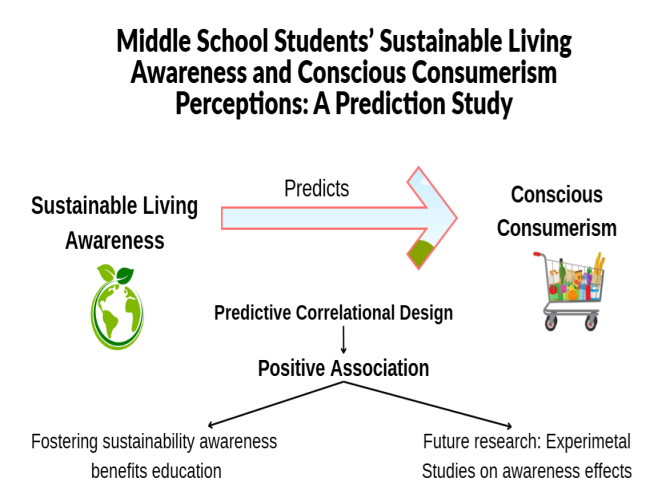
The purpose of this study is to examine whether middle school students' awareness of sustainable living predicts their perceptions of conscious consumerism. A predictive correlational design was employed. The sample was selected using convenience and criterion sampling methods. One hundred fifty-two middle school students (seventh and eighth grade) participated in the study. The participants included 97 females and 55 males from an urban public middle school in Kahramanmaraş, representing a predominantly middle-income socioeconomic background. Data were collected using two instruments: the Sustainable Living Awareness Scale (environmental, economic, and social dimensions) and the Conscious Consumerism Perception Scale (consumer responsibility, quality awareness, and budget–price consciousness). Data were analyzed using simple linear regression. The results indicate that middle school students' awareness of sustainable living significantly predicts their perceptions of conscious consumerism. This findings that enhancing students' awareness of sustainability is associated with an increased perception of conscious consumerism. Future research could explore the impact of activities designed to raise students' awareness of sustainable living on their perceptions of conscious consumerism through experimental methods.
Keywords
Full Text:
Download PDFReferences
Abu-Bader, S.H. (2021). Using statistical methods in social science research: With a complete SPSS guide (Third Edition). New York: Oxford University Press.
Akgül, F. A., & Aydoğdu, M. (2020). Ortaokul öğrencileri için sürdürülebilir yaşama yönelik farkındalık ölçeğinin geliştirilmesi [Development of sustainable living awareness scale for middle school students]. Trakya Eğitim Dergisi, 10(2), 378-393. https://doi.org/10.24315/tred.633081
Alan, Ü., & Atalay Kabasakal, K. (2020). Effect of number of response options on the psychometric properties of Likert-type scales used with children. Studies in Educational Evaluation, 66, 100895. https://doi.org/10.1016/j.stueduc.2020.100895
Ary, D., Jacobs, L. C., Sorensen, C., & Walker, D. A. (2014). Introduction to research in education (9th Edition). Belmont: Cengage Learning.
Ayaydın, Y., Usta-Gezer, S., & Acar-Şeşen, B. (2023). A study on sustainable living awareness of gifted secondary school students. Research on Education and Psychology (REP), 7(Special Issue 2), 602-624. https://doi.org/10.54535/rep.1363669
Azrak, Y. (2023). Ortaokul 8. sınıf öğrencilerinin sürdürülebilir yaşama yönelik farkındalıklarının incelenmesi [Examination of the sustainable living awareness of secondary school 8th grade students']. PESA Uluslararası Sosyal Araştırmalar Dergisi, 9(1), 33-42.
Balbağ, N. L. (2023). Evaluation of primary school teachers and students opinions about conscious consumerism. International Journal of Educational Research Review, 8(2), 180-194. https://doi.org/10.24331/ijere.1219830
Bennett, K., Heritage, B., & Allen, P. (2023). SPSS statistics: A practical guide (5th Edition). Victoria: Cengage Learning.
Bursa Chamber of Commerce and Industry. (2022). Safe production of children’s clothing for export: Training set for children’s clothing manufacturers, suppliers, industry employees, and consumers. European Union Erasmus+ Programme – Made in EU Project. https://ec.europa.eu/programmes/erasmus-plus/project-result-content/74e7a61c-a7a3-4e1e-b8fd-c30e77e840ff/Output_5.pdf
Canlas, I. P., Karpudewan, M., & Mohamed-Ali-Khan, N. S. (2022). More than twenty years of Value-Belief-Norm Theory of environmentalism: What has been and yet to be done?. Interdisciplinary Journal of Environmental and Science Education, 18(2), e2269. https://doi.org/10.21601/ijese/11801
Celik, Y. (2022). The awareness of the students about the concepts in the production distribution and consumption learning field in the social studies course curriculum. Educational Research and Reviews, 17(1), 1–13. https://doi.org/10.5897/err2021.4214
Chen, C., An, Q., Zheng, L., & Guan, C. (2022). Sustainability literacy: Assessment of knowingness, attitude and behavior regarding sustainable development among students in China. Sustainability, 14(9), 4886. https://doi.org/10.3390/su14094886
Cohen, J. (1988). Statistical power analysis for the behavioral sciences (2nd edition). Hillsdale: Lawrence Erlbaum Associates.
Creswell, J. W., & Guetterman, T. C. (2019). Educational research: planning, conducting, and evaluating quantitative and qualitative research (Six edition). New Jersey: Pearson Education.
Cubukcu, E. (2013). Walking for sustainable living. Procedia-Social and Behavioral Sciences, 85, 33-42. https://doi.org/10.1016/j.sbspro.2013.08.335
Deksne, J., Lonska, J., Kodors, S., Litavniece, L., Zvaigzne, A., Silicka, I., & Kotane, I. (2025). Insights into Awareness and Perceptions of Food Waste and School Catering Practices: A Student-Centered Study in Rezekne City, Latvia. Resources, 14(4), 59. https://doi.org/10.3390/resources14040059
Dere, İ., & Aktaşlı, İ. (2020). Conscious consumerism education in social studies courses: Reflections of an action research. International Journal of Contemporary Educational Research, 7(1), 215–227. https://doi.org/10.33200/ijcer.666525
Dündar, Ş. (2017). The effects of conscious consumerism-related parental role modeling, parental communication, and social studies on children’s socialization as conscious consumers. Mersin University Journal of the Faculty of Education, 13(2), 726-743.
Enderez, C. J., Javier, C. L. M., Alfanoso, J. L. C., Amoguis, J. A., Macalalad, M. B., Salera III, J. P., ... & Sausa, L. P. (2024, November). Perceived knowledge, attitude, and practices on environmentally responsible consumerism of students. In 11th International Scholars Conference, 11(3), 941-952.
Ersoy, A., & Papatğa, E. (2015). İlkokul öğrencilerinin hikâyeler aracılığıyla bilinçli tüketici farkındalığının geliştirilmesi [The improvement of the conscious consumerism awareness of elementary stundents via stories]. Journal of Policy Analysis in Education, 4(1), 61-78.
European Commission (2021). Education for environmental sustainability: Policies and approaches in European Union member states. Tasiopoulou, E., Billon, N., Finlayson, A., Siarova, H., Pribuišis, K., Gras-Velazquez, A., Mulvik, I., Bajorinaitė, M., Sabaliauskas, E., Fronza, V., Vežikauskaitė, J. and Disterheft, A. (eds), Luxembourg: Publications Office of the European Union. https://data.europa.eu/doi/10.2766/391
European Commission (2024). Learning for sustainability in Europe: Building competences and supporting teachers and schools. Eurydice report. Luxembourg: Publications Office of the European Union.
European Commission. (2023). Study of consumer education initiatives in EU Member States: Final report. VVA Brussels with support from Ipsos on the consumer survey, on behalf of DG JUST Unit B1, European Innovation Council and SMEs Executive Agency (EISMEA). https://ec.europa.eu
Fiates, G. M. R., De Mello Castanho Amboni, R. D., & Teixeira, E. (2008). Consumer behaviour of Brazilian primary school students: findings from focus group interviews. International Journal of Consumer Studies, 32(2), 157–162. Portico. https://doi.org/10.1111/j.1470-6431.2007.00661.x
Field, A., (2024). Discovering statistics using IBM SPSS statistics (6th Edition). California: SAGE Publications.
Garai-Fodor, M. (2023). Analysis of financially aware consumer segments from the perspective of conscious consumer behaviour. Acta Polytechnica Hungarica, 20(3), 83-100. https://doi.org/10.12700/aph.20.3.2023.3.6
Gülmez, M. (2006). Pazarlama yönü itibariyle bilinçli tüketim ve bilinçli tüketiciye ilişkin bir saha araştırması. Selçuk Üniversitesi Sosyal Bilimler MYO Dergisi, 9(1-2) 153-178.
Haan, M., Konijn, E. A., Burgers, C., Eden, A., Brugman, B. C., & Verheggen, P. P. (2018). Identifying sustainablepopulation segments using a multi-domain questionnaire: A five factor sustainability scale. Social Marketing Quarterly, 24(4), 264–280. https://doi.org/10.1177/1524500418794019
Jackson, T. (2005). Motivating sustainable consumption: A review of evidence on consumer behaviour and behavioural change. A report to the Sustainable Development Research Network. https://timjackson.org.uk/wp-content/uploads/2018/04/Jackson.-2005.-Motiv ating-Sustainable-Consumption.pdf (30.01.2025)
Jeronen, E., Keinonen, T., & Kärkkäinen, S. (2024). Visioning transformative science education for sustainability. Discourse and Communication for Sustainable Education, 15(1), 19-38. https://doi.org/10.2478/dcse-2024-0003
Jhanji, H., & Sarin, V. (2018). Relationship between environmental consciousness and green purchase behaviour among youth. International Journal of Green Economics, 12(3-4), 171-181. https://doi.org/10.1504/ijge.2018.097871
Kahyaoglu, M., & Kiriktaş, H. (2013). The research of the relationship between primary school students’ environmentally responsible behaviors and conscious consumer behaviors. International Journal of Educational Research and Technology, 4(3), 1-8.
Kazmierczak-Piwko, L., Kułyk, P., Dybikowska, A., Dubicki, P., & Binek, Z. (2022). Sustainable consumption among children and adolescents. Production Engineering Archives, 28(3), 257-267. https://doi.org/10.30657/pea.2022.28.32
Koçulu, A. (2025). Developing secondary school students’ sustainable living awareness to help achieve the sustainable development goals. Sustainability, 17(11), 4757. https://doi.org/10.3390/su17114757
Lorek, S., & Fuchs, D. (2013). Strong sustainable consumption governance – precondition for a degrowth path? Journal of Cleaner Production, 38, 36-43. https://doi.org/10.1016/j.jclepro.2011.08.008
Mellor, D., & Moore, K. A. (2013). The Use of Likert Scales With Children. Journal of Pediatric Psychology, 39(3), 369–379. https://doi.org/10.1093/jpepsy/jst079
Ministry of National Education (MoNE). (2024). Fen bilimleri dersi öğretim programi (3, 4, 5, 6, 7 ve 8. siniflar) Türkiye yüzyılı maarif modeli [Science course curriculum (3, 4, 5, 6, 7 and 8. grades) Turkish century education model]. Ankara: Ministry of Education.
Olsson, D., Gericke, N., & Chang-Rundgren, S. N. (2016). The effect of implementation of education for sustainable development in Swedish compulsory schools – assessing pupils’ sustainability consciousness. Environmental Education Research, 22(2), 176–202. https://doi.org/10.1080/13504622.2015.1005057
Pallant, J. (2016). SPSS survival manual: A step by step guide to data analysis using IBM SPSS (sixth edition). New York: McGraw-Hill Education.
Pereira, E. F. S., Moreira, S. I., & Ribeiro, A. M. (2024). Reflection on the 5R’s in an educommunicative proposal with sixth grade students at the Prof. Deócles Vieira de Camargo State School in the city of Tatuí-SP. Contribuciones a Las Ciencias Sociales, 17(2), e5268. https://doi.org/10.55905/revconv.17n.2-200
Preston, C. C., & Colman, A. M. (2000). Optimal number of response categories in rating scales: reliability, validity, discriminating power, and respondent preferences. Acta Psychologica, 104(1), 1–15. https://doi.org/10.1016/s0001-6918(99)00050-5
Qureshi, S. M. Q. (2020). Learning by sustainable living to improve sustainability literacy. International Journal of Sustainability in Higher Education, 21(1), 161-178. https://doi.org/10.1108/ijshe-01-2019-0001
Rijnhout, L., & Lorek, S. (2012). EU sustainable lifestyles roadmap and action plan 2050: Pathways for enabling social innovation and behaviour change. Collaborating Centre on Sustainable Consumption and Production (CSCP). Funded by the European Commission’s Seventh Framework Programme (FP7), Socio-economic Sciences and Humanities. https://www.sustainable-lifestyles.eu
Sağlam, H. İ. (2010). Bilinçli tüketicilik düzeyi ölçeği çalışması [A study of a scale for the level of conscious consumerism]. International Journal of Human Sciences, 7(1), 1190-1200.
Scharenberg, K., Waltner, E.-M., Mischo, C., & Rieß, W. (2021). Development of students’ sustainability competencies: Do teachers make a difference? Sustainability, 13(22), 12594. https://doi.org/10.3390/su132212594
Siva, E., & Chandrachud, S. (2022). A study on organic farm product purchasing, in view of organic product consumers. International Journal of Health Sciences, 6(S1), 3372–3384. https://doi.org/10.53730/ijhs.v6ns1.5506
Stern, P. C. (2000). New environmental theories: Toward a coherent Theory of Environmentally significant behavior. Journal of Social Issues, 56(3), 407–424. Portico. https://doi.org/10.1111/0022-4537.00175
Stern, P. C., Dietz, T., Abel, T., Guagnano, G. A., & Kalof, L. (1999). A Value-Belief-Norm Theory of Support for Social Movements: The Case of Environmentalism. Human Ecology Review, 6(2), 81–97. http://www.jstor.org/stable/24707060
Süle, M. (2012). Can conscious consumption be learned? The role of Hungarian consumer protection education in becoming conscious consumers. International journal of consumer studies, 36(2), 211-220. https://doi.org/10.1111/j.1470-6431.2011.01085.x
Suna, M., & Çengelci-Köse, T. (2023). The effect of activities for sustainability awareness on students' sustainable living awareness in the social studies course. Türk Akademik Yayınlar Dergisi (TAY Journal), 7(special issue), 275-297. https://doi.org/10.29329/tayjournal.2023.609.11
Swedhaa-Shanmathi V., & Vinothkumar M. (2025). Exploring the influence of mindful observation, biospheric value and personal norms in shaping pro-environmental behaviour among adolescents: A mediation analysis. Journal of Human Values. https://doi.org/10.1177/09716858251332015
Thøgersen, J. (2005). How may consumer policy empower consumers for sustainable lifestyles? Journal of Consumer Policy, 28(2), 143-177. https://doi.org/10.1007/s10603005-2982-8
Tural, A., Saraç, İ., Atay, T., & Üstünel, S. (2024). Evaluating conscious consumer behaviors among fourth grade students: A sustainability perspective. International Journal of Eurasian Education and Culture, 9(25), 1-28. http://dx.doi.org/10.35826/ijoecc.1818
Uddin, S. F., & Khan, M. N. (2018). Young consumer's green purchasing behavior: Opportunities for green marketing. Journal of Global Marketing, 31(4), 270-281. https://doi.org/10.1080/08911762.2017.1407982
Wagner, W.E. (2020). Using IBM SPSS statistics for research methods and social science statistics (7th ed.). California: SAGE Publications.
White, P., & Tytler, R. (2025). Science Education: Fit for the Future - Editorial. Research in Science Education, 55(4), 733–742. https://doi.org/10.1007/s11165-025-10277-7
Wynveen, B. J. (2017). Improving sustainable living education through the use of formative experiments. Journal of Education for Sustainable Development, 11(1), 14-32. https://doi.org/10.1177/0973408217696532
Yüzbaşıoğlu, M. K. (2023). Examining the ımpact of ınterdisciplinary practices on secondary school students' awareness of sustainable living. Kastamonu Education Journal, 31(4), 590-599. https://doi.org/10.24106/kefdergi-2023-006
Zsóka, Á., Szerényi, Z. M., Széchy, A., & Kocsis, T. (2013). Greening due to environmental education? environmental knowledge, attitudes, consumer behavior and everyday pro-environmental activities of hungarian high school and university students. Journal of Cleaner Production, 48, 126–138. https://doi.org/10.1016/j.jclepro.2012.11.030
DOI: https://doi.org/10.17509/jsl.v9i1.92265
Refbacks
- There are currently no refbacks.

Copyright (c) 2026 İsa Deveci

This work is licensed under a Creative Commons Attribution-ShareAlike 4.0 International License.


Jl. Dr. Setiabudhi 229 Bandung 40154, West Java, Indonesia